LG Uplus Secures Technology to Cut AI Token Costs by 90%... B2B Business to Ramp Up Next Year
- Input
- 2026-11-15 09:00:00
- Updated
- 2026-11-15 09:00:07
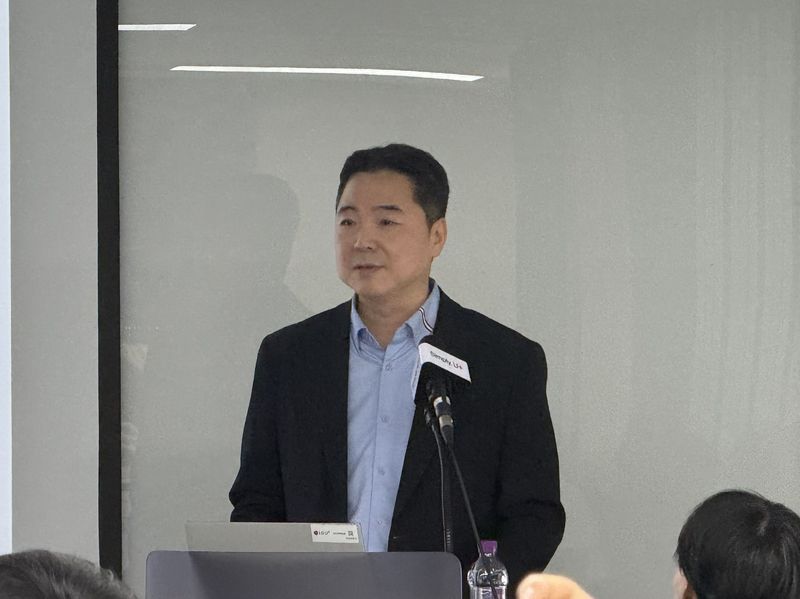
[Financial News] LG Uplus is targeting the business-to-business (B2B) market with token optimization technology that lowers operating costs while maintaining the performance of artificial intelligence (AI) services. After internal testing showed that operating costs for some AI tasks could be reduced by roughly 90%, the company plans to pursue related business with corporate customers starting next year.
LG Uplus announced the plan at the AI Token Optimization Study it held on the 12th at With Space in Seodaemun District, Seoul.
AI tokens are the basic units AI uses to process information and generate responses. As AI agents that carry out tasks through multiple steps have become more widespread, companies are facing higher token usage and operating costs.
LG Uplus is therefore focusing on developing technologies to lower AI operating costs, including improving AI agents’ task efficiency and making models more lightweight.
One of its key technologies is harness engineering, which reduces unnecessary repetition of tasks by AI agents. It minimizes token waste by designing task pathways according to the type of query and ensuring that agents use only the tools they need. In proofs of concept (PoCs) involving internal coding agents and other systems, the company has recorded cases in which token use fell by at least 90%.
The company is also developing dynamic query routing, a technology that automatically selects an AI model based on the difficulty of a query. It uses smaller models for simple summaries and high-performance models for complex reasoning. Internal tests showed that it reduced the cost of handling general queries by at least 25% and the cost of coding agents by at least 30%.
“Our goal is not simply to reduce the unit price of tokens, but to determine how cost-effectively we can handle the tasks customers actually want to perform,” emphasized Lee Sang-yeop, LG Uplus’s chief technology officer (CTO).
LG Uplus has also made progress in making AI models more lightweight and improving response-generation speed. Using technologies such as quantization, which reduces data precision, the company cut the size of the on-device model for its call-based AI service ixi-O from 2.4–3 GB to about 800 MB, while achieving at least 95% of the performance of the cloud models used for comparison. It also more than doubled token generation speed through technologies such as speculative decoding, in which a larger model verifies responses generated by a smaller model. Two papers reporting related research findings were accepted at NeurIPS, a leading global AI conference.
When it first launched its call-based AI service ixi-O, LG Uplus used LG AI Research’s on-device model alongside Google’s Gemini. It later lowered operating costs by adjusting the share of usage among models, including its own AI models and EXAONE. The company is also responsible for running and operating AI models for Kakao’s AI for Everyone, which is scheduled for commercialization at the end of the year, and is advancing its optimization technology. Drawing on the technology and operational experience it has accumulated through ixi-O, its AI contact center (AICC), and its in-house AI transformation (AX), LG Uplus plans to launch a token optimization business for corporate customers next year.
“By combining world-class model compression and inference technologies with operational expertise informed by how AI tasks are carried out, we will provide cost-efficient AI services to corporate customers starting next year,” the CTO said.
[email protected] Choi Hye-rim Reporter