“The Future of the Military Academies: We Ask Cadets Directly” Survey Launched for 2,350 Army, Navy and Air Force Cadets
- Input
- 2026-11-13 13:49:02
- Updated
- 2026-11-13 13:53:23
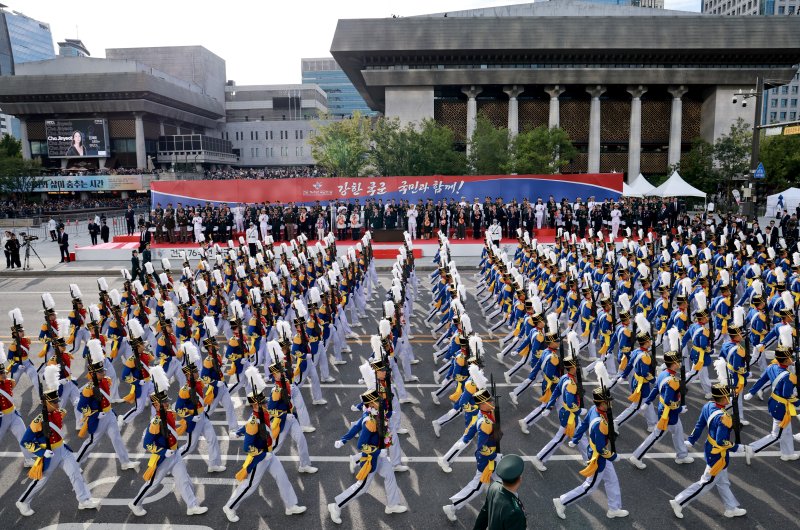
According to a ministry official on the 13th, the Ministry of National Defense will conduct an online survey over five days, from that day through the 17th, targeting approximately 2,350 first- through fourth-year cadets at the Army, Navy and Air Force academies, and will make the comprehensive analysis public. The survey is seen as both a follow-up measure promised by Defense Minister Kang Shin-cheol, who emphasized at a meeting with Korea Military Academy cadets on the 10th that the views of the entire cadet body mattered most, and a key validation step toward finalizing revisions to the detailed plan this month, alongside the recently launched civilian special advisory committee.
A ministry official added that while the survey is being conducted among all cadets enrolled at the academies, the participation of around 100 fourth-year Naval Academy cadets currently on a long-range cruise training mission has necessarily been restricted by operational conditions in the area.
The survey was designed as four in-depth open-ended questions to elicit candid, firsthand views from cadets on curriculum revisions and plans for a graduate school, both of which are currently under serious consideration within the ministry. Specifically, it asks about improvements needed to strengthen the academies’ educational capabilities; what is essential to preserving their traditions and each service’s unique expertise after integration; respondents’ willingness to apply to a graduate school and their preferred fields of study; and factors to consider in establishing the Korean Armed Forces Academy.
To prevent outside interference and ensure fairness, respondents were instructed to access individual internet links and enter their academy, year, track and cadet number. To strictly protect respondents’ anonymity, the Korea Institute for Defense Analyses (KIDA) will compile and analyze the raw data, while the ministry will receive only the aggregate results, with all personally identifying information removed.
The ministry also firmly rejected claims raised by some that the revised plan had already decided to relocate the Korea Military Academy while excluding the views of the individual services—a criticism described as “sidelining the services.” A ministry official said the claim was untrue and explained that the ministry was still seeking the best approach to establishing the academy. The official added that the ministry would gather input from a range of sources, including the views of each service’s chief of staff, meetings with cadets, expert advice and ruling party-government discussions, then revise and finalize the basic plan before coordinating the details with each service.
The survey’s focus on “preserving each service’s expertise” and “willingness to pursue graduate studies” aligns with the push to revise the curriculum reform plan, which gained momentum after Minister Kang took office in September. In July, the ministry unveiled a basic plan to combine the three service academies at Jaundae in Daejeon and operate them as a single four-year undergraduate school. But after facing opposition from the services and alumni associations, it recently broadened engagement by launching a civilian special advisory committee that included six opponents of integration as a “red team.”
Instead of a blanket four-year integration, the ministry is reportedly considering a broad range of network-based alternatives, including a “2+2” plan with joint instruction in the first and second years followed by service-specific instruction in the third and fourth, and a rotating “1+2+1” curriculum with joint instruction in the first and fourth years and service-specific instruction in the second and third. It is also reportedly giving serious consideration to establishing the “Korean Armed Forces Academy Graduate School” ahead of schedule, though it had been a medium- to long-term project, to attract outstanding faculty and deepen jointness across the armed forces. One option under consideration would fully open admissions to all officers who did not graduate from one of the service academies, including those commissioned through ROTC, the bachelor’s-degree program and the Korea Army Academy at Yeongcheon.
Attention is focused on whether the comprehensive survey of 2,350 cadets will prove to be a pivotal turning point in determining the final version of the detailed plan for establishing the Korean Armed Forces Academy, set to be finalized this month and built around a combination of a rotating curriculum and an open-admission graduate school.
[email protected] Lee Jong-yoon Reporter