"Without a Stock Market Surge, Even Gangbuk Home Prices Will Start to Level Off," Expert Says: Real Estate Outlook for Next Year
- Input
- 2026-11-15 07:00:00
- Updated
- 2026-11-15 07:00:03

[Financial News] With Seoul apartment prices having risen for 91 consecutive weeks, one forecast says the pace of gains is unlikely to slow any faster. While the three Gangnam districts are seeing a correction as properties come onto the market in response to tax changes, some areas, including the Gangbuk region and the semiconductor belt, are still on an upward trend, analysts say.
On the 12th, Kim Inman, head of the Real Estate Economic Research Institute, appeared on “Real Estate Research Institute” on SBS Love FM’s “Park Yeon-mi’s Nest Egg Research Institute” and assessed the Seoul apartment market, predicting, “I don’t think the pace of gains will slow any faster from here.”
“Signs of a rebound in Gangnam ... no sharp drop or surge expected”
According to the weekly apartment price trends released by the Korea Real Estate Board (KREB) on the 12th for the second week of November (as of November 9), Seoul apartment sale prices rose by an average of 0.07% from the previous week. Seoul’s weekly rate of increase had contracted for three consecutive weeks starting in the third week of October, and was unchanged this week from the previous week.
As a result, Seoul apartment prices have risen for 92 consecutive weeks, extending the longest such streak on record. However, all three Gangnam districts continued to decline; the drop widened in Songpa District, while it narrowed in Gangnam and Seocho districts.
Kim did not expect the pace of gains to keep slowing rapidly as it has. Citing leading indicators that can be checked before transactions in land transaction permit zones are reflected in actual transaction price statistics, he said, “Some indices are showing a slight rebound from current levels even in Gangnam, Seoul, so I don’t think the pace of gains will slow further.”
He also forecast that a sharp rebound was unlikely. “I think the current mood, with neither a sharp drop nor a sharp rise, will continue through the end of this year, without prices going up much,” Kim said, predicting that the trend would remain similar through year-end.
Despite declines in the three Gangnam districts ... “Prices won’t fall indefinitely”
Kim said it was unlikely that listings in the Gangnam area would lead to a sharp drop in prices. That is because recent listings are largely aimed at realizing gains while taking the tax burden into account. “If I have to pay more in taxes than I expected, I put the property up for a quick sale at a price that still works in my favor by that amount of profit, so prices don’t fall indefinitely,” he explained.
By contrast, the Gangbuk region is still seeing gains in the 0.2% to 0.3% range, though the pace of increases is not expanding significantly. Kim said the stock market correction had also had some effect. In particular, newly married couples in their 30s, who tend to have relatively fewer assets, are reworking their financial plans between stocks and real estate, he explained.
In Gyeonggi Province, prices rose notably in areas with a concentration of semiconductor industries, including Giheung-gu in Yongin, Yeongtong District in Suwon, and Dongtan. Kim described the area, known as the “semiconductor belt,” as “a blind spot in government regulations.” Although rules on loans and land transaction permits have been tightened, he expects transactions to remain active because semiconductor company employees have relatively ample financial resources.
Kim suggested that Seoul home prices could be more stable next year than this year, while price gains in Gyeonggi Province and Incheon could instead accelerate. This is because home prices in the Gangnam area have already risen substantially, while Gangbuk also faces loan restrictions and limits on buyers’ financial resources.
“With loan limits not increasing and stocks not suddenly doing extremely well, Gangbuk can’t keep rising either,” he said. “Next year, I think Gangbuk’s rate of increase may be a little lower than this year’s, while some quick-sale listings may come onto the market in Gangnam.” By contrast, housing demand from newlyweds is expected to support Gyeonggi Province and Incheon.
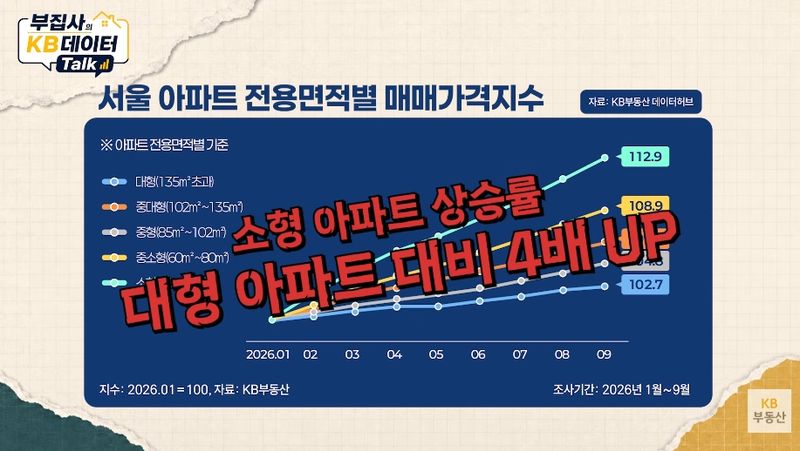
Homes in Seoul Are Getting Smaller ... Small Apartments Account for 47.2% of Transactions
Rising home prices and loan restrictions are also affecting housing choices in Seoul. In the third quarter of this year, small apartments with exclusive-use areas of 60 sq m or less accounted for 47.2% of apartment transactions in Seoul. The share has risen steadily from 39.8% in 2014 and 43.7% last year.
Kim explained, “The share of small apartments in Seoul is gradually increasing. Small units are going to become the trend,” adding, “Larger units have a higher absolute price and also come with maintenance costs, so people may naturally be somewhat reluctant to buy them.”
He added that people in Gyeonggi Province still tend to prefer larger units. “Preferences for small apartments differ between Gyeonggi and Seoul. Home prices in Gyeonggi are naturally lower than in Seoul, so if you’re going to buy, you might as well get a little more space,” Kim said, pointing to the cost factor.
In fact, moving up from a small to a medium-sized apartment in Seoul comes with a considerable price burden. The average price difference between apartments with exclusive-use areas of 60 sq m or less and those of 60 to 85 sq m was about 440 million won in Seoul. In Gyeonggi Province, it was about 150 million won. This suggests that high home prices and loan restrictions are pushing people buying homes to live in to seek homeownership by opting for smaller floor areas.
[email protected] Kim Hee-sun Reporter