44,000 Homes to Be Occupied in the Seoul Metropolitan Area in Q1 Next Year; 284 Changneung 'Equity-Accumulation' Units to Be Supplied
- Input
- 2026-11-13 11:10:00
- Updated
- 2026-11-13 11:10:04
■ 4,000 units to be occupied in Mapo, Seocho and Yongsan; buy a home in Changneung by paying 25% of the sale price
On the 13th, the government held its third regular housing supply briefing at Government Complex Seoul and announced move-in and presale plans, along with the progress of measures to accelerate housing supply.
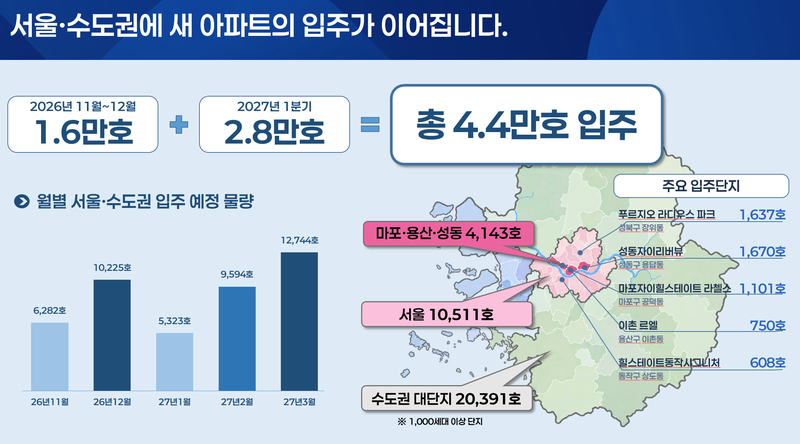
Kim Jin, director of the Economic Coordination Office at the Office for Government Policy Coordination, said, "In particular, at least half of the units scheduled for occupancy in the Seoul metropolitan area in the first quarter are in large complexes with over 1,000 units. Since listings for both jeonse and monthly rentals will also come onto the market as residents move in, we expect this to help stabilize nearby rental markets as well."
Presales will continue. In October, about 16,000 units went on sale, including 1,305 in Seoul's Godeok Gangil, and about 11,000 more are expected to be supplied from this month through year-end. Presales in third-generation new towns are also planned by year-end, including 1,100 units in Goyang Changneung, 400 in Namyangju Wangsuk and 500 in Bucheon Daejang.
Public housing for sale that reduces the upfront financial burden on people buying homes to live in will also be offered. The 284 equity-accumulation public housing units to be supplied in Goyang Changneung this December will allow buyers to pay 25% of the sale price when they move in and acquire the remaining equity in installments over 20 years.
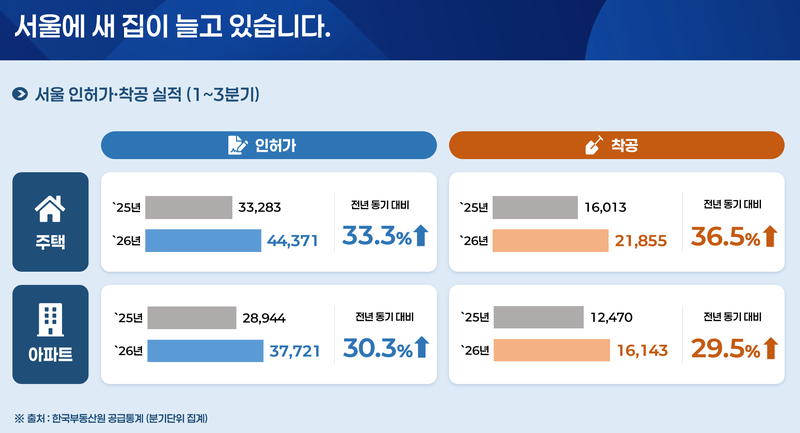
The government assessed that indicators of a downward stabilization in Seoul's housing market, including slower price growth and an increase in listings, were becoming more prevalent. Home prices in Gangnam and Seocho districts fell for 14 consecutive weeks, while the three Gangnam districts, including Songpa, declined for 12 consecutive weeks. Seongdong and Gangdong districts also saw prices turn lower this week.
■ Financing difficulties eased for 6,000 units; LH seeks private-sector partners for 9,000 units
The government is also working to remove obstacles delaying housing projects. Of the 145 regulatory improvement tasks included in the August 13 measures to accelerate housing supply, 65 have been completed and the remaining 80 are underway. Through close monitoring on the ground, it has also resolved financing difficulties at eight project sites involving about 6,000 units.
A notable example is a troubled project in Seoul's Sinchon area that had been suspended. Following its acquisition by a Korea Asset Management Corporation (KAMCO) fund and a restructuring of the project, construction of its 435 units is scheduled to begin next September. The Project Finance and Construction Company Financing Difficulties Relief Center had received 64 cases by the 6th, and consultations and reviews had been completed for 50.
The government is also accelerating land acquisition for third-generation new towns. The average relocation rate in the leading districts—including Namyangju Wangsuk 1 and 2, Goyang Changneung, Bucheon Daejang, Incheon Gyeyang and Hanam Gyosan New Town—rose from 53% in July last year to 91% in October this year. Over the same period, the demolition rate increased from 34% to 70%. In Gwangmyeong-Siheung, surveys and appraisals were conducted concurrently, shortening the time until compensation began by four months compared with the original plan. The government plans to increase compensation costs from 5.5 trillion won to 6.8 trillion won.
In the second half of the year, Korea Land and Housing Corporation (LH) plans to seek private-sector partners for public housing projects across 10 blocks, totaling about 9,000 units. On the day of the briefing, it launched a call for proposals covering 5,782 units across six blocks, including Namyangju Wangsuk 2 A-10, Goyang Changneung A-3, Suwon Dangsu and Siheung Geomo. The projects are worth about 1.6 trillion won, and LH aims to select developers by the end of this year and begin construction next year. Calls for proposals for the remaining four blocks, including the Wirye business district, covering about 3,000 units and worth about 900 billion won, will also be issued in stages by December.
Starting in December, the government plans to fully operate the Integrated Housing Supply Support Center. At the end of the month, it will unveil a digital housing supply dashboard with supply plans and progress updates for each project.
Director Kim said, "Above all, we will closely manage the schedules of key projects so that supply plans lead to actual permits, construction starts, presales and move-ins."
The government holds regular briefings every other week to disclose the progress and results of its housing supply measures. At the first briefing, it presented the outlook for construction starts, presales and move-ins in the Seoul metropolitan area, as well as tasks to stabilize the jeonse and monthly rental markets. At the second, it announced a plan for new housing sites to supply 76,700 units across six locations in the Seoul metropolitan area, including Gimpo Ara.
[email protected] Choi Ga-young Reporter