Seoul Moves to Supply 2,741 'Moa Housing' Units in Yangcheon and Jungnang; Construction to Begin in 2028
- Input
- 2026-11-13 11:15:00
- Updated
- 2026-11-13 11:15:08
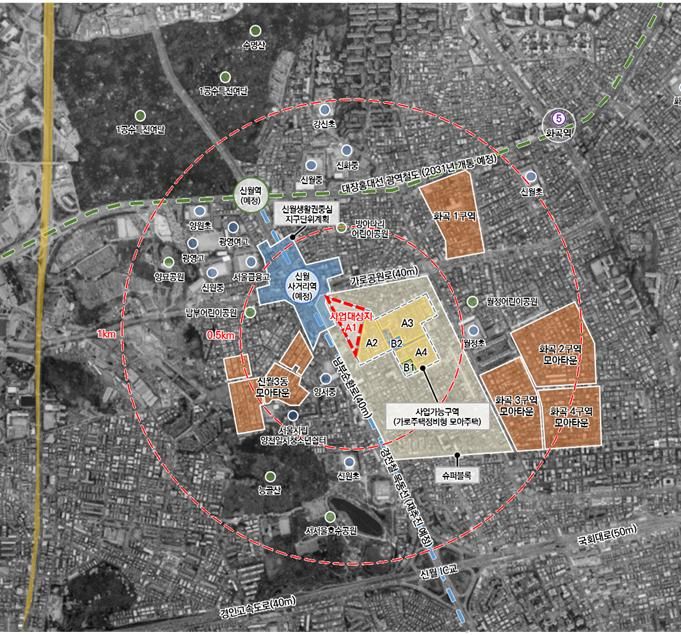
[Financial News] A total of 2,741 Moa Housing units will be supplied around Sinwol-dong in Yangcheon District and Junghwa-dong in Jungnang-gu, Seoul. The Seoul Metropolitan Government plans to accelerate the process, aiming to begin construction in 2028.
According to the Seoul Metropolitan Government on the 13th, the main committee of the 3rd Integrated Review Committee on Small-Scale Housing Improvement, which met the previous day, approved with revisions and conditions the implementation plans for five Moa Housing projects around Sinwol-dong in Yangcheon District and Junghwa-dong in Jungnang-gu, as well as the management plan for a Moa Town around 313-23, Junghwa-dong.
The row-house redevelopment project (Zone A1) around 144-20, Sinwol-dong, Yangcheon District, will comprise 354 units, including 60 rental units. The area is a low-rise residential neighborhood with an aging rate of 80.6%.
The area is subject to height restrictions because it lies within Gimpo International Airport's flight safety zone. In the review, the city approved a plan to upzone it to a Type 3 General Residential Area and develop it with buildings of up to 13 floors and a floor-area ratio capped at 300%.
The project’s viability was improved by incorporating a project feasibility adjustment coefficient, community facilities for residents and compensation for tenant losses. Measures were also drawn up to improve poor infrastructure and residents’ living conditions. The city plans to support the project and proceed with follow-up steps, aiming to begin construction in 2028.
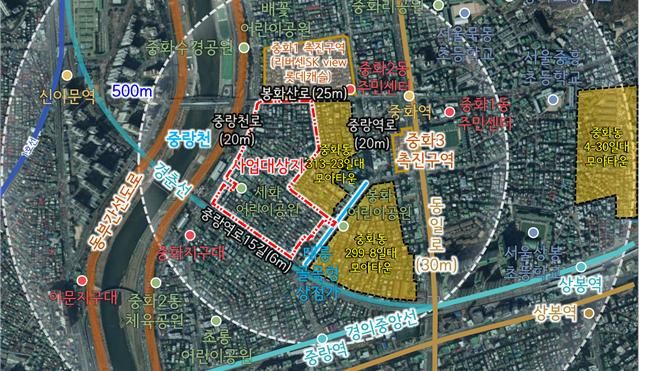
The planned number of units in the four Moa Housing projects in the Moa Town around 329-38, Junghwa-dong, Jungnang-gu, will increase by 75, from 2,312 to 2,387. The increase follows the application of a project feasibility adjustment coefficient and a revision to the management plan.
By zone, the number of units will rise from 561 to 587 in Zone 2-1 and from 560 to 580 in Zone 2-2. It will also increase from 656 to 667 in Zone 2-3 and from 535 to 553 in Zone 2-5.
The area is a low-rise residential neighborhood west of Junghwa Station on Seoul Subway Line 7, between Jungnangcheon and the Gyeongchun Line. Its aging rate is 77.3%, and it is currently home to 1,115 households.
In Zones 2-3 and 2-5, which border the Gyeongchun Line, building layouts will take railway noise and lighting impacts into account. A view corridor toward Jungnangcheon will be secured, and the complex will include a daycare center, a care center, a small library and sports facilities.
Under the revised plan, Zones 2-4 and 2-6 were separated from the existing Moa Town, whose management plan was approved and publicly notified in November 2024. A separate management plan will therefore be drawn up for the area around 313-23, Junghwa-dong.
The new Moa Town will cover 37,437.6 square meters and is expected to contain 1,021 units, 510 more than the 511 in the original plan. It will provide 504 units in Zone 2-4 and 517 in Zone 2-6.
The zones were separated in consideration of the 100,000-square-meter area threshold for a Moa Town management area. As a result, the existing Moa Town around 329-38, Junghwa-dong, will be reduced in area from 99,971.6 to 84,825.4 square meters.
The new Moa Town will also be upzoned from Type 2 General Residential Area and other zones to Type 3 General Residential Area, and the project feasibility adjustment coefficient will be applied. A total of 202 rental units are planned, including 65 units contributed to the public in connection with the upzoning and 137 purchased units.
Nearby roads will also be improved. Bonghwasan-ro 4-gil will be widened from 8 meters to 13.5 meters, Dongil-ro 129-gil from 8 to 10 meters, and Bonghwasan-ro from 25 to 30 meters. A community street with pedestrian space and neighborhood-serving facilities will be developed along Dongil-ro 123-gil, which connects to the adjacent Moa Town.
“This review applies the project feasibility adjustment coefficient to improve the viability of Moa Housing, while also accelerating projects through improvements to roads, pedestrian environments and resident amenities. We will continue to make regulations more reasonable and actively support the swift implementation of Moa Housing and Moa Town projects tailored to local characteristics,” said Myeong No-jun, head of the Seoul Metropolitan Government’s Housing Office.
[email protected] Choi A-young Reporter