'₩3 Billion → ₩8 Billion: You’ll Make ₩5 Billion, So Cough Up ₩400 Million' ... A Site Hit by a Bolt From the Blue [Real Estate A to Z]
- Input
- 2026-11-14 14:00:00
- Updated
- 2026-11-14 14:00:04
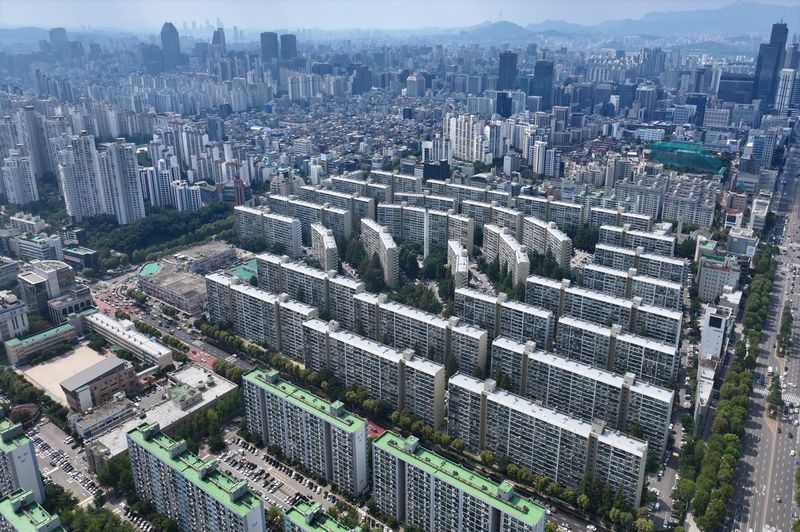
[Financial News] The Reconstruction Excess Profit Recovery System is at the center of controversy. On the deadline for imposing the charge, Seocho-gu says it is the end of this year, while the Ministry of Land, Infrastructure and Transport says it is 2029. That is not all. The charges are unpredictable, and the system also has serious equity issues.
A person in the industry said, “Minor improvements to the system cannot solve the problem,” adding, “The controversy will inevitably continue unless it is abolished.”
Daechi-dong’s Eunma... ‘A look at the system’s calculation formula’
The system’s main aim is to recapture development gains. But it applies only to reconstruction. Large-scale prime redevelopment projects such as Seongsu-dong and Hannam New Town are excluded because they are redevelopment, not reconstruction.
Reconstruction projects also return a certain amount of development gains to the public through contributions in kind during the course of the project. Separately, the system recaptures gains from rising home prices only in reconstruction projects. Take Eunma Town Apartments in Daechi-dong, which was recently notified of its estimated reconstruction charge. The expected charge per person is 463.34 million won.
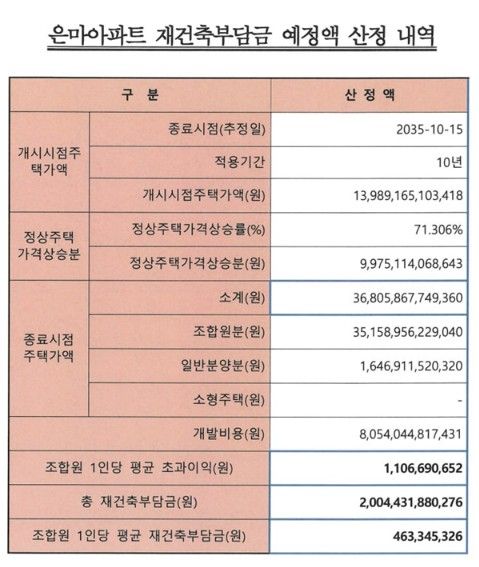
So how was the amount calculated? Based on the home price per association member (4,326 in total), the calculation assumes that a home worth 3 billion won will rise in value to 8 billion won.
The total housing value at the starting point is 13 trillion won. Dividing that by the number of association members puts the value per person at about 3.2 billion won. The endpoint (completion) was set for 2035, 10 years from now. The total housing value at the endpoint, including units allocated to association members and those for general sale, is 36 trillion won. The estimated value per person reaches about 8.5 billion won.
Applying the reconstruction formula to these figures resulted in notices that a charge of around 400 million won per person would be imposed. In other words, the calculation assumes that actual home prices will rise even more than the starting price plus the normal increase in prices.
Equity Concerns... Can Minor Improvements Resolve Them?
In reality, the system has several problems, including an unreasonable calculation formula and the taxation of unrealized gains. Above all, it has serious equity issues. The charge is first notified to the association, which then sets the detailed criteria itself. In short, each association could set different criteria for apportioning the system’s charge.

In principle, the owner at the time of completion pays the charge. For example, someone who has lived in the property for years as an investment strategy and then sells before completion is not liable for the charge. The result is that those who benefit most from development gains paradoxically pay no charge.
In one-to-one reconstruction projects, the system imposes a relatively small charge even if home prices rise sharply after reconstruction. Conversely, under the current system, a project is at a disadvantage if it has a large number of units for general sale, even when home prices do not rise.
The unpredictability is also a problem. Member contributions are determined at the management and disposition stage. By contrast, an estimate of the reconstruction charge is provided at that stage, and the final amount is determined upon completion. That is because completion can take anywhere from five to as many as 10 years after the management and disposition stage.
Kim Ye-rim, a lawyer at Simok Law Firm, said, “Since the reconstruction charge is impossible to predict, it is also difficult to factor it into the sale price,” adding, “The exact amount cannot be known until the project is completed.”
Ko Jun-seok, a professor at Yonsei University, stressed, “If charges actually begin to be imposed, disruption, including large-scale litigation, will be inevitable,” adding, “In Gangbuk, reconstruction projects could come to a complete halt. The abolition of the system should be actively considered as a way to expand housing supply as well.”
[email protected] Lee Jong-bae Reporter