From a Red Dragon Robe to a Yellow Dragon Robe... Two Fire-Scorched Portraits of Sunjong on Display Together
- Input
- 2026-11-13 09:51:03
- Updated
- 2026-11-13 09:51:03
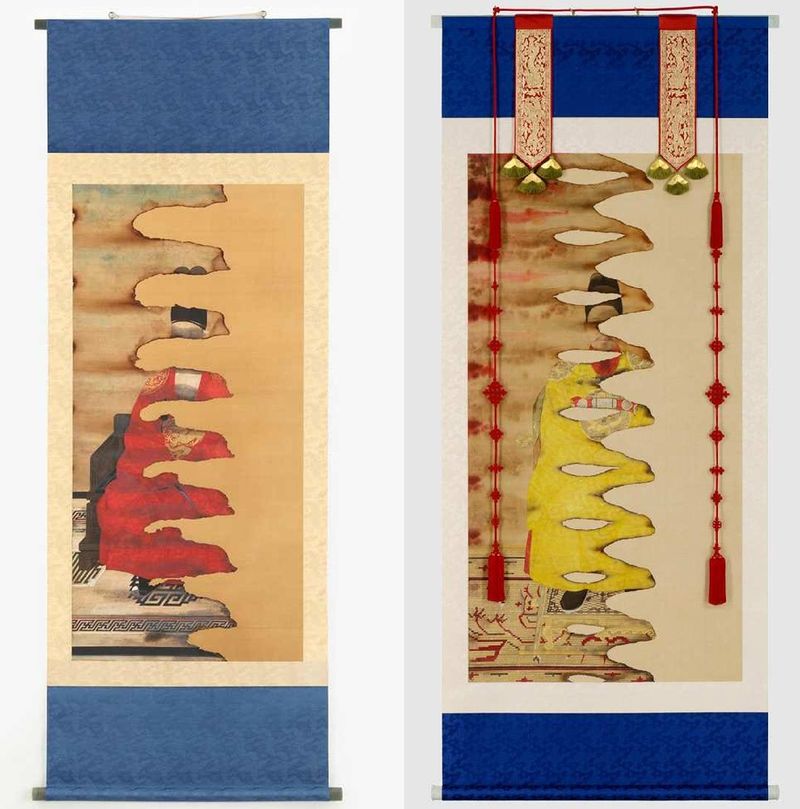
According to the Korea Heritage Service on the 13th, the National Palace Museum of Korea in Seoul’s Jongno District is displaying Sunjong’s royal portraits—paintings of the monarch—and portrait photographs in its “Korean Empire” gallery, part of the permanent exhibition on the first floor, starting that day.
The yejin, a portrait of the crown prince, is being shown for the first time in this exhibition. Cho Seok-jin, An Chungsik and others painted it alongside a royal portrait of Gojong in 1902 to mark the 40th anniversary of Gojong’s accession to the throne. The yejin was enshrined at Punggyeonggung Palace in Pyongyang, where royal portraits were housed and rites were performed.
The two works, moved to Busan during the Korean War, lost about half of their painted surfaces in a 1954 fire at a storage warehouse. Most of the face and the inscription identifying the figure disappeared from the yejin. The museum narrowed down the date of production using clues such as the flower-patterned mat and the furniture. Given that Gojong wore a yellow dragon robe at the time, the museum identified the figure in a red dragon robe as Crown Prince Sunjong.
Kim Eun-ho (1892–1979) completed the emperor’s royal portrait in 1928, two years after Sunjong’s death. According to the museum, he painted the face with reference to a photograph of Sunjong in military uniform taken in 1909. In keeping with the traditional format of royal portraits, he dressed Sunjong in a yellow dragon robe and added a chin beard. In the painting, Sunjong is seated on a gold-colored chair.
This royal portrait, once enshrined at Sinseonwonjeon in Changdeokgung Palace, was first shown in 2015 at the special exhibition “Royal Portraits and Portrait Halls of the Joseon Royal Family” after conservation treatment.
The exhibition also includes portrait photographs from Sunjong’s years as crown prince and emperor. During the Korean Empire, photographs of the imperial family were published in print, bringing the emperor and crown prince to public attention.
Sunjong, the son of Gojong and Empress Myeongseong, became crown prince when the Korean Empire was proclaimed in 1897. In 1907, after Japan used the dispatch of envoys to The Hague as a pretext to force Gojong to abdicate, Sunjong succeeded to the throne. After the Japan–Korea New Agreement was signed, the Residency-General took control of domestic affairs, and in 1910 Japan forcibly annexed the Korean Empire.
Sunjong, demoted to the title of Yi Wang, lived at Changdeokgung Palace until his death in 1926. On June 10 that year, as Sunjong’s funeral procession passed through Jongno in Seoul, students distributed proclamations and shouted for Korean independence. This became known as the June Tenth Movement.
A recreation of Gojong’s grand marshal’s dress uniform will also be displayed in the same gallery. As head of the Board of Marshals, established in 1899, Gojong commanded the Korean Empire’s army and navy. Based on a photograph of Gojong wearing his grand marshal’s uniform, the museum spent more than a year making a complete uniform.
Admission is free. The museum is open from 9:30 a.m. to 5:30 p.m. and stays open until 9 p.m. on Saturdays and the last Wednesday of each month. It is closed regularly on the last Monday of each month.
[email protected] Jang In-seo Reporter