‘Jensen Huang Scandal’ Casts a Shadow Over U.S.-China Leaders’ APEC Talks, Complicating Calculations on Trade-Truce Extension
- Input
- 2026-11-13 09:20:56
- Updated
- 2026-11-13 09:20:56
[Financial News] The scandal involving Jensen Huang, former CEO of NVIDIA, is casting a shadow over next week’s U.S.-China summit.
With intense negotiations between the leaders already expected over extending the U.S.-China trade truce through January next year, the affair involving former CEO Huang has put U.S.-China relations to the test.
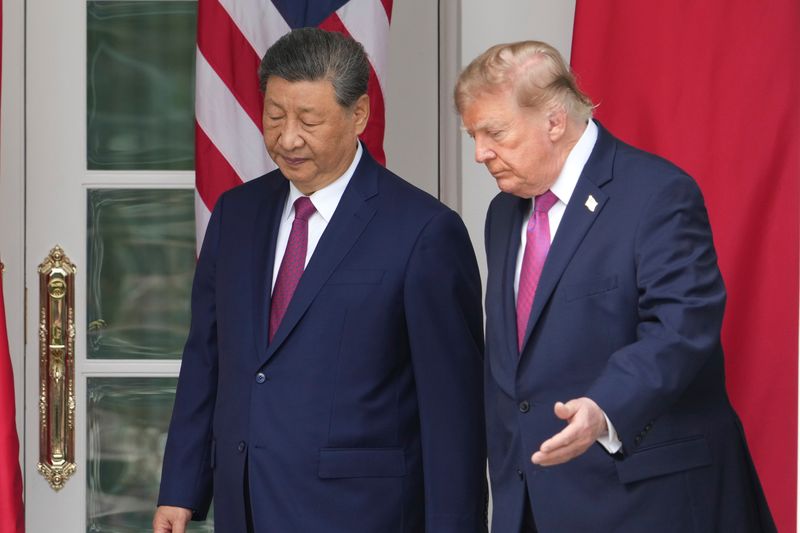
U.S. President Donald Trump and Chinese President Xi Jinping are expected to meet on the sidelines of the Asia-Pacific Economic Cooperation (APEC) summit, which will be held in Shenzhen, China, on the 18th and 19th.
The main agenda item is extending the trade truce, which was virtually the only achievement during Xi’s visit to the United States last September. At the time, the two leaders extended the truce, which had been set to last until November, by just two months, through January 10 next year, and agreed to resume negotiations at APEC.
However, an affair scandal involving former CEO Huang and a woman suspected of being a Chinese spy appears to have emerged as a major factor in negotiations between the U.S. and Chinese leaders.
The key to extending the U.S.-China trade truce is whether common ground can be found between U.S. export controls on China and China’s export controls on rare earths.
Whether an attempt was made to steal AI technology could be a major factor
With the United States urgently seeking access to China’s rare earths and China seeking access to advanced U.S. technology, whether China used a spy to try to steal artificial intelligence (AI) technology from former CEO Huang will inevitably become a major factor.
China has dismissed the allegations as slander, but if technology theft is confirmed, the United States will have no choice but to respond. That would inevitably narrow the scope for negotiations between the two countries.
President Trump said he did not intend to raise former CEO Huang’s affair with Xi, but now faces considerable pressure as the Democrats, having won a landslide victory in the midterm elections, move to uncover the truth and strengthen the response.
The fact that Republicans and Democrats, whose positions diverge on every issue, are united across party lines when it comes to countering China is also a source of pressure for Trump.
Three Republican committee chairs in the House, including the chairs of the Foreign Affairs Committee and the Select Committee on U.S.-China Strategic Competition, have already sent Huang a joint letter demanding that he attend a closed-door joint briefing on the 18th.
The 18th is the day the APEC summit begins. With Trump and Xi set to meet, Republicans in Congress are effectively launching a full-fledged effort to get to the bottom of the matter by taking the lead in summoning Huang.
Could pave the way for tighter U.S. export controls on China
Trump, who has maintained close ties with Huang and eased restrictions on NVIDIA’s exports of advanced semiconductors to China as Huang wished, could also face congressional scrutiny. Democrats are highly likely to focus on probing Trump’s connections to the affair and seek to use it as an opportunity to tighten export controls on China.
China is expected to be watching closely both the scope of the allegations and the bipartisan response taking shape in the U.S. Congress.
The Chinese Ministry of Foreign Affairs’ remarks after a phone call between the U.S. and Chinese foreign ministers on the 11th also appear to be connected to this affair. The ministry stressed the importance of steadily managing U.S.-China relations and said, “We are willing to properly handle differences and sensitive issues.”
If the United States shows signs of tightening export controls on China, China may retaliate by tightening its grip further on rare-earth supplies. There are concerns that the two sides may then struggle to find common ground on extending the trade truce, which expires on January 10 next year.
Jeff Moon, president of China Moon Strategies, a U.S.-based China-focused consulting firm, said, “If Chinese espionage involved stealing or attempting to steal NVIDIA technology, the United States would have to take action. At the heart of the U.S.-China trade truce is the U.S. commitment not to tighten technology restrictions and China’s agreement to supply rare earths. This incident directly strikes at the heart of technology restrictions.”
U.S. Ambassador to China Perdue: “U.S.-China ties are not smooth sailing”
U.S. Ambassador to China David Perdue’s remark on the 11th that U.S.-China relations are “not smooth sailing” can also be seen as a sign that the affair involving former CEO Huang is putting bilateral ties to the test.
Trump’s plan to hold a U.S.-China-Russia summit during this APEC meeting to discuss nuclear arms reduction and tout it as a diplomatic achievement could also face a major setback. China, which was opposed to a U.S.-China-Russia nuclear arms reduction summit from the outset, may refuse to cooperate with Trump and try to use the issue as a bargaining chip in U.S.-China negotiations.
Trump has focused on preventing clashes between the two countries and managing their relations steadily since meeting Xi in Busan in late October last year and agreeing to a trade truce. The two leaders will also meet at the Group of 20 (G20) summit in the United States in December.
[email protected] Lee Seok-woo, international affairs correspondent Reporter