Six Seoul Areas, Including Doksan, Daerim and Cheonho, Named 'Rapid Integrated Planning' Candidates ... District Designation Targeted Within Two Years
- Input
- 2026-11-13 11:15:00
- Updated
- 2026-11-13 11:15:04
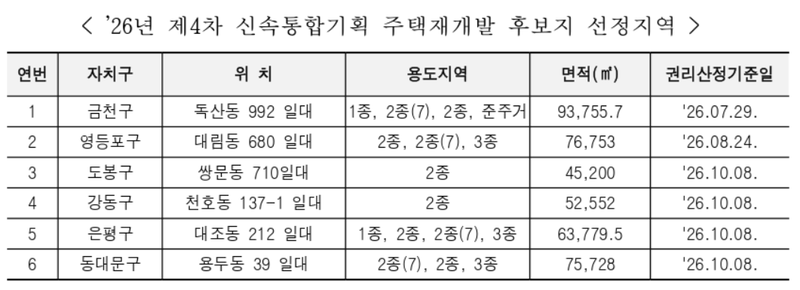
[Financial News] The Seoul Metropolitan Government has added six areas, including Doksan-dong in Geumcheon District and Daerim-dong in Yeongdeungpo District, to its list of candidate sites for housing redevelopment under Rapid Integrated Planning. The city plans to speed up housing supply by streamlining permitting procedures in the selected areas and managing the progress of projects as a whole.
According to the Seoul Metropolitan Government on the 13th, six sites in six autonomous districts were selected as new candidates by the 2026 Fourth Rapid Integrated Planning Housing Redevelopment Candidate Site Selection Committee, which met twice, on October 30 and the 12th of this month.
The selected areas include Doksan-dong 992 in Geumcheon District; Daerim-dong 680 in Yeongdeungpo District; Ssangmun-dong 710 in Dobong District; Cheonho-dong 137-1 in Gangdong District; Daejo-dong 212 in Eunpyeong District; and the area around Yongdu-dong 39 in Dongdaemun District.
The selections focused on areas with a high level of building deterioration and many semi-basement homes, where improvements to residential conditions are urgently needed. The city also comprehensively assessed residents' willingness to participate in projects and the potential to link them with nearby development projects. Conditions in each region were considered to avoid concentrating candidate sites in particular areas.
The areas around Daerim-dong 680 and Cheonho-dong 137-1 are low-rise residential neighborhoods with an aging-building rate of at least 70%, where improvements to residential conditions are urgently needed. In the area around Yongdu-dong 39, at least 70% of residents agreed to pursue redevelopment, indicating a strong willingness to participate in the project.
Redevelopment and other improvement projects are also being pursued near Ssangmun-dong 710, Daejo-dong 212 and Doksan-dong 992. The Seoul Metropolitan Government plans to improve residential conditions by coordinating infrastructure plans, including road widening, with nearby project sites.
Rapid Integrated Planning 2.0 will be applied to the selected areas. Through measures such as streamlining procedures, the city plans to reduce the time typically required for an urban improvement project from 18.5 years to 12 years.
The city also plans to provide subsidies for preparing improvement plans, launch commissioned work on Rapid Integrated Planning and improvement-plan preparation, and complete designation of the improvement districts within two years.
Measures to ensure project feasibility will also be applied. In line with local conditions, the Seoul Metropolitan Government will make use of the business-feasibility adjustment factor, recognition of existing floor area ratios and multi-level parks, introduced under the 2030 Basic Plan for Urban and Residential Environment Improvement, to secure project feasibility and promote the rapid supply of housing.
Measures to prevent speculation will also be implemented. The city will apply anti-speculation measures, including designating the new candidate sites as land transaction permit zones, and announce a reference date for determining rights for each site to prevent the splitting of ownership shares to secure redevelopment sales rights. It will also move to restrict building permits.
Myeong No-jun, head of the Seoul Metropolitan Government's Housing Office, said, "The candidate sites selected this time are aging residential areas with inadequate infrastructure, where improvements to residential conditions are urgently needed. Through the selection of candidate sites, we will secure a stable foundation for housing supply and support efforts to speed up projects through Rapid Integrated Planning so that housing can be supplied at an early date."
[email protected] Choi A-young Reporter