Chey Tae-won Proposes a Korea-Japan Economic Partnership '3-, 5- and 10-Year Plan'... Seeks a Permanent Cooperation Platform
- Input
- 2026-11-13 09:04:11
- Updated
- 2026-11-13 09:04:11
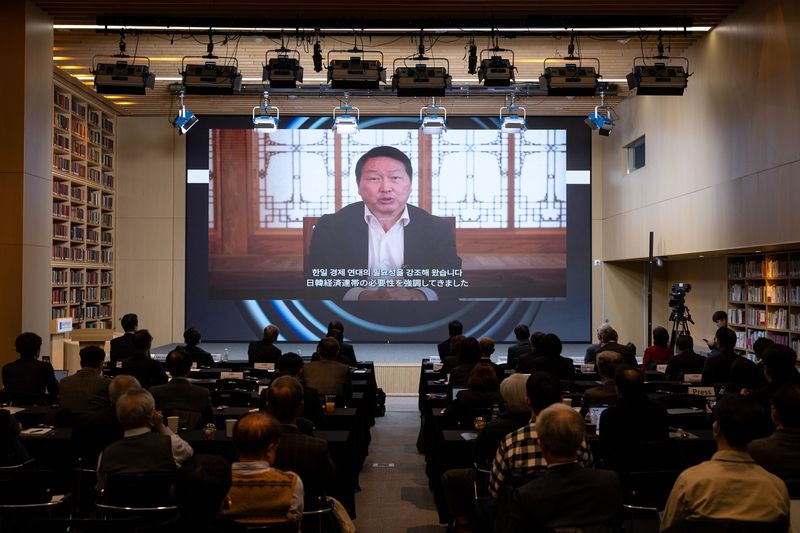
[Financial News] Chey Tae-won, chairman of SK Group, proposed setting concrete goals for the Korea-Japan economic partnership at the three-, five- and 10-year marks and establishing a permanent cooperation platform to implement them. Researchers from the two countries presented a phased roadmap starting with industry-specific cooperation and aiming to institutionalize the economic partnership by 2045.
The Chey Institute for Advanced Studies and the East Asia Institute said on the 13th that they had co-hosted the Korea-Japan Economic Partnership Roadmap Conference: From Vision to Action at the Korea Foundation for Advanced Studies conference hall in Gangnam District, Seoul, on the 12th. The Society for Modern Japanese Studies and Japan's Nakasone Peace Institute also took part, discussing the results of a year of joint research and policy challenges.
Chairman Chey, who heads the Chey Institute for Advanced Studies, proposed in his video keynote address setting phased goals for the level of economic cooperation to be achieved in three years, the industries expected to produce joint results and institutional barriers to be eased in five years, and the benefits businesses and the public would feel in 10 years. The aim is to broaden cooperation starting with areas where it can be put into practice, such as identifying industry-specific opportunities for collaboration and lowering barriers that restrict the movement of people and capital.
He said they were also preparing a permanent, “big tent”-style cooperation platform involving business, academic and research institutions from both countries. The idea is to share the results of cooperation among existing institutions and connect joint projects to policy and business initiatives. “If the roadmap points the way we should go, the platform will be a foundation for pooling the strength to walk that path together,” Chairman Chey said.
Sohn Yul, a professor at Yonsei University, said the two countries needed to pool their capabilities to address their relative decline in economic standing and population decline, and unveiled a three-stage roadmap for 2026–2045.
For the first phase, 2026–2031, he proposed building cooperation outcomes on individual issues and pursuing Korea's accession to the Comprehensive and Progressive Agreement for Trans-Pacific Partnership (CPTPP). In 2032–2036, the idea is to link cooperation to an institutional framework through a Korea-Japan declaration on a comprehensive economic partnership, and in 2037–2045, to establish a Korea-Japan Economic Community Agreement and a long-term strategic plan.
Sohn explained that an ASEAN Economic Community (AEC)-style approach, which respects national sovereignty and intergovernmental consensus, was more realistic than supranational integration modeled on the European Union (EU). The roadmap is a mid- to long-term cooperation proposal put forward by researchers, not a schedule agreed upon by the governments of the two countries.
Takashi Terada, a professor at Doshisha University in Japan, stressed the need for an institutional foundation to ensure cooperation continues despite changes in government or diplomatic tensions. Specifically, he proposed a “Korea-Japan 3+3 Economic Consultative Body” involving the two countries' foreign affairs, industry and trade, and finance authorities.
In the industrial sector, participants discussed ways to combine the two countries' technologies and production bases. Lee Ji-pyeong, a special appointment professor at Hankuk University of Foreign Studies (HUFS), identified incorporating AI and digital technologies into industrial robots already operating on manufacturing floors as a priority for cooperation. Tomonobu Chishima, a professor at Hannan University in Japan, proposed jointly developing energy-efficient AI semiconductors by combining Japan's semiconductor materials and equipment technologies with Korea's mass-production capabilities. Yukiko Fukagawa, a professor at Waseda University in Japan, stressed that cooperation should expand beyond manufacturing-centered trade to services, finance and digital fields.
Participants also discussed ways to jointly address regional decline. Kim Hang, a professor at Yonsei University, proposed “art tourism,” in which small cities in both countries would jointly develop international arts festivals and cultural tourism programs. The idea is to redistribute tourism demand concentrated in major cities to regional areas and connect artists' and young creators' extended stays to local product development and job creation. Lee Jeong-hwan, a professor at Seoul National University, proposed setting up a joint fund and business programs in AI and expanding their scope to development cooperation in third countries. He stressed the need to establish specific funding and implementation frameworks so companies from both countries can work together to bring AI technology to third countries and commercialize it.
[email protected] Park Ji-yeon Reporter