Without Jensen Huang, Will the 'AI Central Bank' Model of Circular Investment in the AI Industry Collapse?
- Input
- 2026-11-13 08:49:43
- Updated
- 2026-11-13 08:49:43
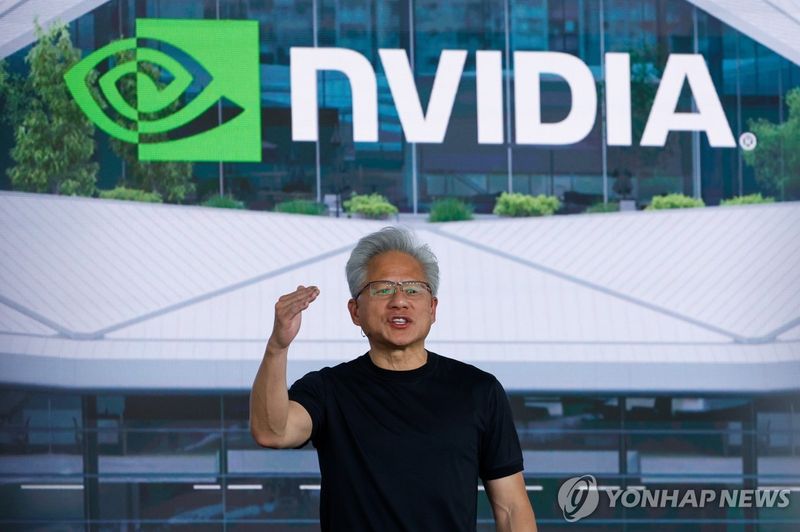
[Financial News] Major repercussions are expected across NVIDIA and the broader artificial intelligence (AI) industry as NVIDIA CEO Jensen Huang steps down on the 12th (local time). Concerns are mounting, first of all, that the AI industry's circular-investment growth model could collapse.
NVIDIA's board officially announced the resignation of former CEO Huang that day and appointed Chief Financial Officer (CFO) Colette Kress as interim CEO.
With NVIDIA's graphics processing units (GPUs) effectively monopolizing the global AI chip market, the sudden departure of the towering CEO who had led the company for 33 years is bound to sap momentum across the AI ecosystem and bring seismic changes.
Will NVIDIA Continue to Play the 'Central Bank of AI' Without Jensen Huang?
NVIDIA will continue to produce GPUs even without former CEO Huang, but it is doubtful that the company can continue to lead the entire industry in his absence after he ran it for 33 years, from its founding in 1993. In particular, if NVIDIA's chips have been the 'accelerators' for AI servers, NVIDIA itself has served as an 'accelerator' for the AI industry.
NVIDIA was a key pillar of the AI industry, supplying not only semiconductors but also acting as a kind of 'central bank' that supported the industry's growth. Using revenue and cash from chip sales, it has provided liquidity by investing in or offering financial guarantees to AI developers such as OpenAI and Anthropic, as well as across the broader industry, including neocloud groups such as CoreWeave.
They then used the investment money they had secured this way to buy NVIDIA chips.
With other executives taking over for him, the founder and CEO, the board will have no choice but to impose strict financial oversight. As a result, NVIDIA's circular-deal practices are likely to be significantly curtailed or adjusted in a more conservative direction.
If NVIDIA stops or slows its efforts to support circular deals in this situation, the AI industry—which must continue making astronomical capital expenditures (CapEx)—will lose the 'accelerator' for the industry as a whole. NVIDIA shares plunged more than 10% shortly after former CEO Huang's dismissal was announced, and this was also why stock prices across the AI industry, including neocloud groups, swung sharply.
Concerns have also been raised persistently that these circular deals, while posing no problem as long as the industry is growing, could become a ticking time bomb that drags the entire industry into a quagmire if the brakes are applied somewhere.
However, some have suggested that other companies could gain even more ground in a crisis, including AMD, which competes with NVIDIA, and Google, which is pushing its tensor processing units (TPUs).
No apparent successor to take over his role ... Concerns mount
After the COVID-19 pandemic, as the Bitcoin mining boom cooled and NVIDIA was briefly in crisis, Huang's decision to make AI accelerators the centerpiece of the company's new strategic direction showed his management ability and vision.
Since then, he has played a decisive role in helping NVIDIA maintain its leadership in the AI industry, unveiling in succession a central processing unit (CPU) for data centers in the age of AI agents, open-source AI models, autonomous driving platforms, and robotics platforms.
Without a clear second-in-command or successor, he effectively monopolized key decision-making, receiving direct daily reports from about 60 executives.
Stephen Witt, the author of Huang's biography, told U.S. broadcaster CNBC, "It's impossible to know what NVIDIA would be worth without Jensen," and noted, "NVIDIA is Jensen Huang." Stacy Rasgon, a senior analyst at investment bank Bernstein, also said, "He is NVIDIA itself."
Brad Gastwirth, global head of research at Circular Technology, had earlier predicted that former CEO Huang would wield enormous influence in processes such as choosing his successor, since he held the largest individual stake, at 3.58%.
[email protected] Lee Seok-woo, international affairs specialist Reporter