Teen Brains Were More 'Sensitive' ... Repeated Bullying, 26–28% Increase in Signals in the Adolescent Amygdala and Hippocampus [Health Check]
- Input
- 2026-11-13 08:35:10
- Updated
- 2026-11-13 08:35:10
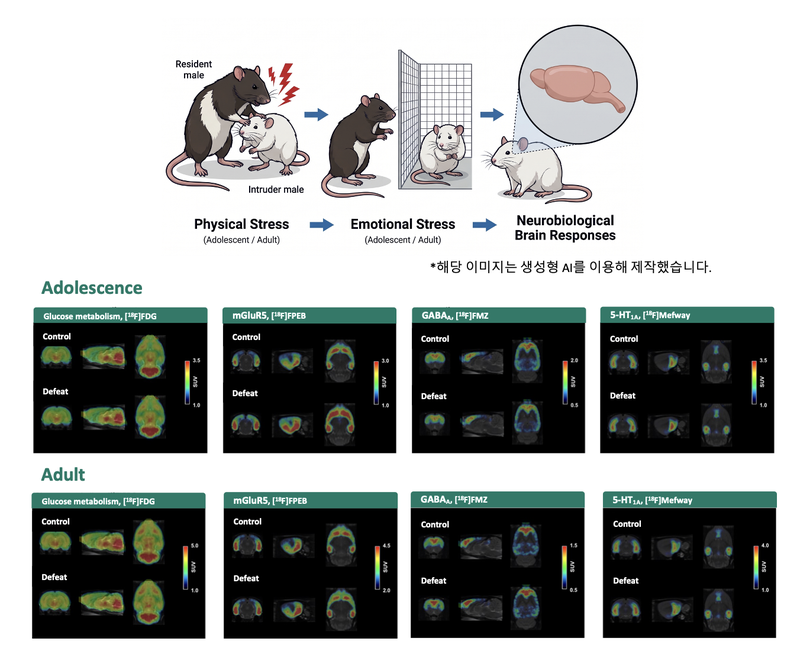
[Financial News] An animal study has confirmed that, even when subjected to the same bullying, adolescents’ brains may respond differently from adults’ brains.
The Korea Institute of Radiological and Medical Sciences said on the 13th that a research team led by Dr. Choi Jae-yong confirmed through rat experiments and positron emission tomography (PET) brain imaging that “social defeat stress,” involving repeated attacks and submission, triggers different neurobiological responses during adolescence and adulthood.
Repeated interpersonal stress, such as school violence, bullying, or workplace harassment, is closely linked to mental health problems. Adolescence is a period when the amygdala, which processes emotions, develops rapidly, while the frontal lobe, which regulates emotions, matures slowly. This is why the brain may respond differently to the same stress during adolescence and adulthood. However, few studies have compared the two stages using images of the living brain.
The research team divided 16 adolescent male rats and 14 adult male rats into stress and control groups. For five days, the stress-group rats were placed in the cage of an aggressive rat once a day, where they were attacked and experienced submission. This is a widely used experimental method for reproducing human social stress in animals.
Physiological and behavioral changes were similar regardless of age. Compared with the control group, the stress group had higher levels of stress hormones in their blood and a lower rate of weight gain. In behavioral tests, they spent less time near an unfamiliar rat on the other side of a wire mesh, showed less inclination to explore new objects, and spent longer floating without swimming in a tank of water. Both age groups showed signs of avoiding other rats, having poorer memory, and passively enduring difficult situations.
The difference emerged in the brain scans. In adolescent rats exposed to stress, activity of the receptor that receives the neurotransmitter glutamate, “mGluR5 (metabotropic glutamate receptor 5),” was about 26% higher in the amygdala, which processes threat and fear, and about 28% higher in the hippocampus, which is responsible for memory, than in the control group. mGluR5 is found in abundance in brain regions involved in emotion and memory, and is a receptor that has been widely studied in relation to stress responses. By contrast, no such difference was seen in adult rats. Neither age group showed significant stress-related changes in brain glucose metabolism or in receptors in the inhibitory and serotonin systems.
The significance of this study is that brain imaging in living animals confirmed that, even when outward responses are similar, underlying neural network responses can differ substantially depending on the stage of development. The research team said that social stress during adolescence may have excessively activated neural signaling systems in brain regions responsible for fear and emotional regulation. However, further research is needed to determine whether these changes directly cause depression and avoidance behavior, or are a compensatory defense mechanism by which the brain responds to stress.
Dr. Choi said, “We hope this achievement will serve as foundational data for developing diagnostic methods for mental disorders and tailored treatments that reflect age-specific characteristics.”
The study was conducted as part of a Korea Institute of Radiological and Medical Sciences project funded by the Ministry of Science and ICT, and the results were published in the November issue of the international neuroscience journal Neurobiology of Disease.
[email protected] Jung Myung-jin, Medical Correspondent Reporter