“If Homes in Gangbuk District Cost 1.1 Billion Won, Where Can You Go?” ... Seongbuk Apartments in the 800-Million-Won Range Become ‘A Different World’ in Just One Year
- Input
- 2026-11-13 16:00:00
- Updated
- 2026-11-13 16:00:01
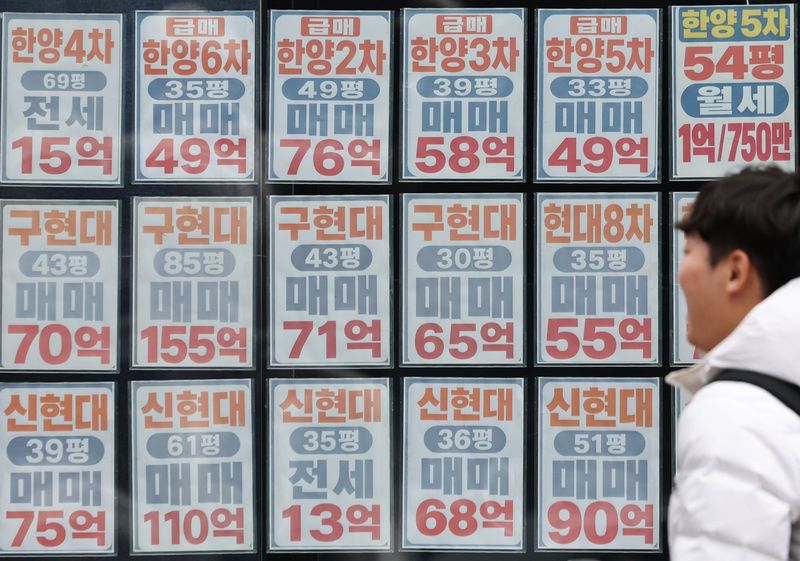
[Financial News] Jeonse and monthly rental prices in mid- to lower-priced areas have risen particularly sharply since the new administration took office, an analysis has found. This is attributed to the combined effects of owner-occupancy policies, such as the land transaction permit system, and regulations on owners of multiple homes.
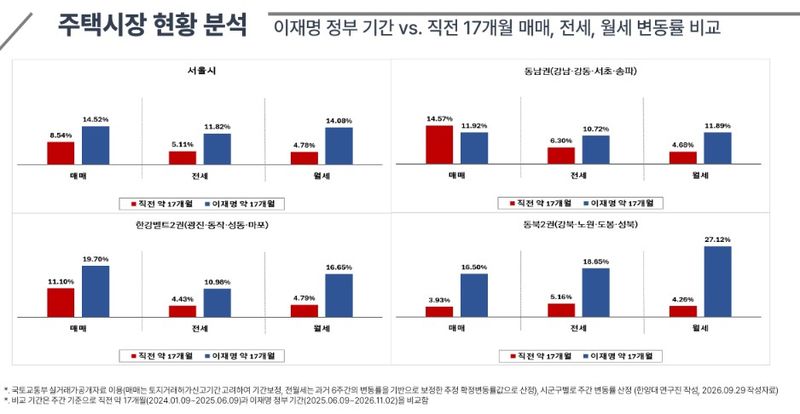
According to a report released recently by a research team led by Hanyang University Professor Chang-Moo Lee, titled “Stronger Regulation of the Home-Sales Market and Instability in the Jeonse and Monthly Rental Markets,” housing jeonse and monthly rental prices in Seoul have risen sharply, with outlying areas leading the increases.
According to the report, over the 17 months since the current administration took office (June 9, 2025, to November 2, 2026), monthly rents for homes in Nodogang (a portmanteau of Nowon-gu, Dobong-gu, and Gangbuk-gu in Seoul) and Seongbuk District rose 27.12%. The increase in the preceding 17 months (January 9, 2024, to June 9, 2025) was 4.26%. That means the rate of increase was about 6.4 times as high.
Outlying areas also led the rise in jeonse prices. During the new administration’s 17 months, jeonse prices for homes in Nodogang and Seongbuk District jumped 18.65%. The increase over the same period immediately before was just 5.16%.
Ministry of Land, Infrastructure and Transport data show that jeonse prices for standard-sized apartments in outlying areas have also topped 1 billion won. A lease was signed in May this year for a 84-square-meter unit at Lotte Castle Classia in Gireum-dong, Seongbuk District, at a record 1.1 billion won. Another jeonse deal was made in June for 1.03 billion won. A year ago, jeonse prices were in the 700-million-to-800-million-won range. Monthly-rent transactions of 3 million won or more are also not uncommon.
Jeonse and monthly rental prices have risen sharply across Seoul since the new administration took office. Over its first 17 months, average increases in Seoul were 11.82% for jeonse and 14.08% for monthly rents. In the same period immediately before, increases were in the 4% to 5% range. With instability in the jeonse and monthly rental market persisting, price increases have been particularly pronounced in outlying areas.
The research team cited the paradox of regulation as the reason. A series of policies, including expanding land transaction permit zones and tightening regulations on owners of multiple homes, has reduced the number of properties listed for sale, in turn pushing prices up. The team said mid- to lower-priced and outlying areas are being hit particularly hard.
Professor Chang-Moo Lee said, “The consequences of tighter regulations extend beyond the side effect of a sharp rise in home-sale prices through the balloon effect: owner-occupancy policies are causing the jeonse and monthly rental market to collapse,” adding, “Regulations on the home-sales market are also hurting the jeonse and monthly rental market.”
Professor Lee stressed, “The positive role of owners of multiple homes is clear as well. We need to be able to embrace their legitimate and beneficial role, including by normalizing private rental businesses,” adding, “An exit strategy is needed for policies that are making the jeonse and monthly rental market unstable.”
[email protected] Jong-bae Lee Reporter