From the Yalu River to the Tumen River... Reading the North Korea–China Border [Let’s Read a Book]
- Input
- 2026-11-12 18:18:18
- Updated
- 2026-11-12 19:07:29
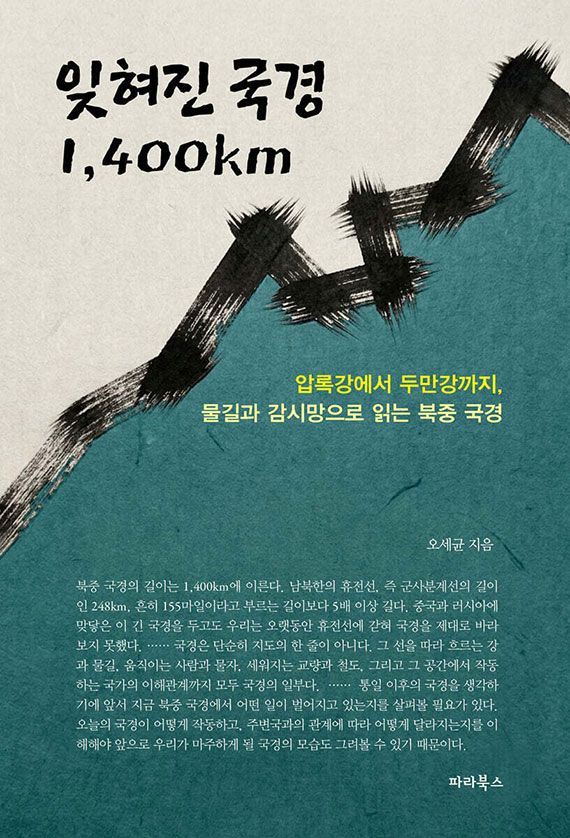
In ‘Forgotten Border: 1,400 km’ (Para Books), Oh Se-gyun, a former KBS correspondent in China, argues that sediment accumulated during a three-year halt in dredging due to COVID-19 narrowed the waterway and increased the risk of collisions. After serving as a correspondent in Beijing, he was based in Shenyang for four years starting in 2020. Drawing on field reporting and public sources, the book examines the North Korea–China border, which is more than five times the length of the 248-km Military Demarcation Line between North and South Korea.
When the Yalu River rose in July 2024, Dandong erected temporary flood barriers along the riverbank. Across the river, homes and farmland on Wihwa Island in Sinuiju were submerged. After the flooding, North Korea raised embankments and built new homes. The author points out that sediment on the riverbed must also be removed to reduce the risk of flooding.
According to the book, Hwanggumpyong, North Korean territory at the mouth of the Yalu River, expanded from 10.4 square kilometers at the time of the 1962 China–North Korea Border Treaty to about 11.94 square kilometers. After the waterway once used by boats silted up, an artificial channel about 10 meters wide and a barbed-wire fence came to separate Hwanggumpyong from mainland China.
North Korea claimed that the Hacheom sandbar had formed as a result of Chinese dike construction. The two countries’ disagreement over how it formed became an obstacle to border negotiations for more than 30 years.
The New Yalu River Bridge linking Dandong and Sinuiju opened on October 15, 12 years after its main structure was completed. On the existing China–North Korea Friendship Bridge, trucks could cross in only one direction at a time. The book also recounts how China shut down an oil pipeline beneath the Yalu River in 2003, cutting off crude oil supplies to North Korea for three days. The author interprets this as a move to pressure North Korea to participate in nuclear negotiations.
When overland traffic was suspended due to COVID-19, brokers continued informal trade by moving goods by sea. The return home of North Korean workers dispatched to China was delayed.
The Chinese city of Tumen installed bird-deterrent netting over its border fence. The book also describes a case in which the Chinese military repurposed cameras developed to observe Siberian tigers and leopards for border surveillance.
An analysis by Human Rights Watch of satellite images covering 321 km of North Korea’s northern border found that the length of new fences installed by North Korea from 2020 to 2023 totaled 482 km across multiple layers. A total of 6,820 security installations, including guard posts and watchtowers, were also identified.
In the foreword, the author wrote, “At the border, there may be changes one cannot read, but no changes are insignificant.” He believes that understanding the North Korea–China border, which opens and closes depending on relations with neighboring countries, is the starting point for preparing for the Korea–China border that will be encountered after reunification.
[email protected] Jang In-seo Reporter