China pushes back on NVIDIA spy scandal: “US is creating a pretext for a tech blockade”
- Input
- 2026-11-12 18:09:11
- Updated
- 2026-11-12 18:09:11
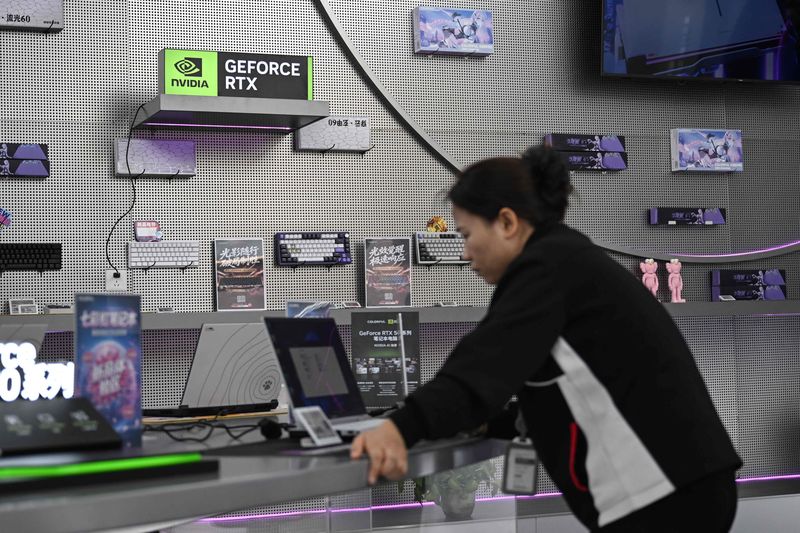
[Financial News] The Chinese government has issued an official position on the spy scandal involving NVIDIA, the US artificial intelligence (AI) semiconductor company. China claims the US is creating a pretext to block exports of advanced technology to China.
At a briefing on the 12th, Mao Ning, a spokesperson for China’s Ministry of Foreign Affairs, referred to the scandal involving NVIDIA CEO Jensen Huang. In a report on the 29th of last month, The New York Times (NYT) claimed that Jensen Huang was having an affair with Alice Huang (Chinese name Huang Le), an ethnic Chinese businesswoman suspected of being a spy for China’s Ministry of State Security. Western media later reported that Alice Huang had passed information about Jensen Huang and NVIDIA to China, and had used her ties to Jensen Huang to smuggle US NVIDIA AI semiconductors whose exports were restricted into China. In response, opposition figures in the US Congress warned that they would investigate NVIDIA’s semiconductor exports to China.
Asked how China planned to respond if the incident led to US restrictions on exports of advanced technology to China, Mao Ning said, “China’s scientific and technological progress is driven by independent innovation and open cooperation.” She added, “The US should stop fabricating the so-called ‘spy’ narrative and seeking a pretext to impose a scientific and technological blockade.”
Mao Ning said, “China and the United States are maintaining close communication about exchanges between the leaders of the two countries,” and emphasized, “We are willing to work with the United States to properly implement the important agreements reached by the leaders of the two countries and to advance the establishment of a constructive, strategically stable China-US relationship based on respect, fairness and equality.”
Western media previously reported that Northwestern Polytechnical University, known in China for its military technology research, purchased two NVIDIA H200 AI accelerators last month for 874,700 yuan (about 175.95 million won). The H200 is subject to US export licensing. The purchase could be evidence that Chinese institutions linked to the military have obtained US-made AI computing resources through suppliers in China. Asked about the purchase, Mao Ning said, “I don’t know the specific circumstances,” but added, “China’s position on US semiconductor exports to China is consistent. At the same time, we firmly oppose the US overgeneralizing the concept of national security and unfairly suppressing Chinese institutions by creating discriminatory lists under various pretexts.”
Mao Ning also responded to foreign media reports that Alice Huang had returned to her home country, China, and was staying in Beijing, saying, “I am not aware of the circumstances you [the reporter] mentioned.”
The same day, the Propaganda Department of the Zhejiang Provincial Committee of the Communist Party of China mentioned the Jensen Huang case on social media. Zhejiang Province is a center of China’s technology industry, with many IT hubs including Hangzhou, Ningbo and Wenzhou. The Zhejiang Propaganda Department claimed that the scandal had attracted attention in the US because the country was anxious about AI. It also stressed, “It is worth considering why now, and why Jensen Huang in particular.”
The Propaganda Department said the case was raised around the US midterm elections on the 3rd, and concluded that the Democrats had targeted Jensen Huang, once a close associate of Donald Trump, to weaken the US president and push for a hard-line policy toward China. It added, “The United States has felt increasingly pressured by the development of China’s AI in recent years.”
[email protected] Park Jong-won Reporter