Real-Time EEG Measurement Tailored to My Head... Custom-Fit Helmet Developed [Health LAB]
- Input
- 2026-11-13 05:00:00
- Updated
- 2026-11-13 05:00:06
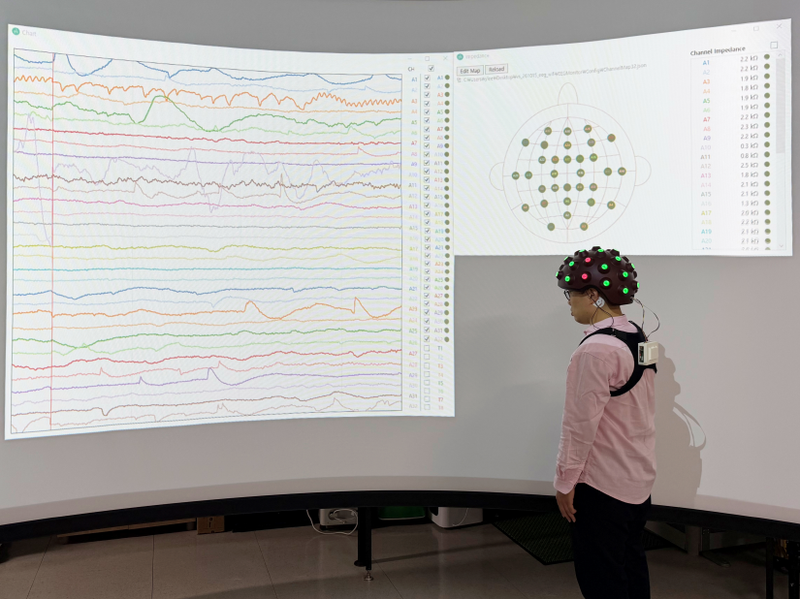
[Financial News] A custom-fit electroencephalography (EEG) monitoring helmet has been developed to make EEG measurements easier and more reliable in a range of settings, including hospitals, rehabilitation and brain-computer interfaces. It reduces measurement variations caused by differences in users’ head shapes and hair conditions, improving reliability.
On the 13th, KIMM said that the helmet developed by a team led by senior researcher Lee Seung-chan at the Diagnostic Sensor Research Lab of its Daegyeong Regional Convergence Research Division can simultaneously measure 32 channels of EEG signals 500 times per second. Its key feature is that it integrates into a single system everything from detecting electrode contact to mechanically adjusting electrode positions and checking contact again. The 32 channels measure signals from multiple locations on the scalp, making it easier to identify spatial patterns of brain activity, while 500 Hz sampling enables precise recording of changes in EEG over time.
The custom-fit EEG monitoring helmet combines a high-resolution EEG measurement device with 32 channels and a 500 Hz sampling rate with technology that automatically adjusts electrode positions. A bias electrode estimates the contact between the electrodes and the scalp in real time, and electrodes with unstable contact are automatically moved to maintain proper contact. The system uses closed-loop control, which stops each electrode from moving once it reaches its target condition, along with an algorithm that monitors contact in real time. This enables stable EEG signal acquisition in multichannel settings, regardless of users’ head shapes and hair conditions.
With conventional EEG measurements, whether using wet or dry electrodes, a skilled operator had to adjust the position of each electrode and manually check its contact with the scalp. If the user moved or the fit changed during measurement, the electrodes had to be readjusted. These limitations meant that poor contact in some channels caused contact variations and reduced measurement reliability. The newly developed technology analyzes the contact status of each electrode in real time and automatically adjusts only those that need it, achieving uniform signal quality even in multichannel settings.
Once the helmet is worn, contact checks and electrode adjustments are performed automatically, reducing reliance on skilled operators and cutting measurement preparation time. It also makes real-time adjustments if contact changes during measurement. The system is designed to stop electrode movement once the target contact condition is reached, reducing skin irritation and discomfort from excessive pressure. This makes it well suited to settings such as rehabilitation training and brain-computer interfaces, where the same user needs to be measured repeatedly, and helps ensure stable, reproducible signals.
This achievement lays the groundwork for automating and standardizing EEG measurements, which have relied on skilled operators and static experimental settings, and expanding their use to research and training environments involving movement or requiring repeated measurements. After further performance testing and field validation, the technology could be applied to motor rehabilitation, brain-computer interfaces (BCI), virtual reality-based cognitive and human factors research, and studies analyzing workers’ attention and fatigue. By reducing contact variations among users, it is expected to help build EEG big data sets with consistent data and improve the reliability of AI-based analytical models.
Senior researcher Lee Seung-chan of KIMM’s Diagnostic Sensor Research Lab in the Daegyeong Regional Convergence Research Division said, “EEG has significant value in medicine and healthcare, as well as cognitive science, but the process of achieving proper electrode contact has been complex, and signal quality can vary from user to user. This technology automatically assesses and adjusts electrode contact in real time, laying the groundwork for obtaining EEG data more easily and consistently, even in settings where repeated measurements are needed.”
A patent application was filed for this research achievement under the title “EEG Measurement System for Adjusting the Position of Measurement Electrodes Based on Electrode-Scalp Contact Status and Method for Operating the Same.”
[email protected] Yeon Ji-an Reporter