Mahler Is the BRSO’s DNA...Simon Rattle Explores Death and Resurrection
- Input
- 2026-11-13 00:29:58
- Updated
- 2026-11-13 00:31:22
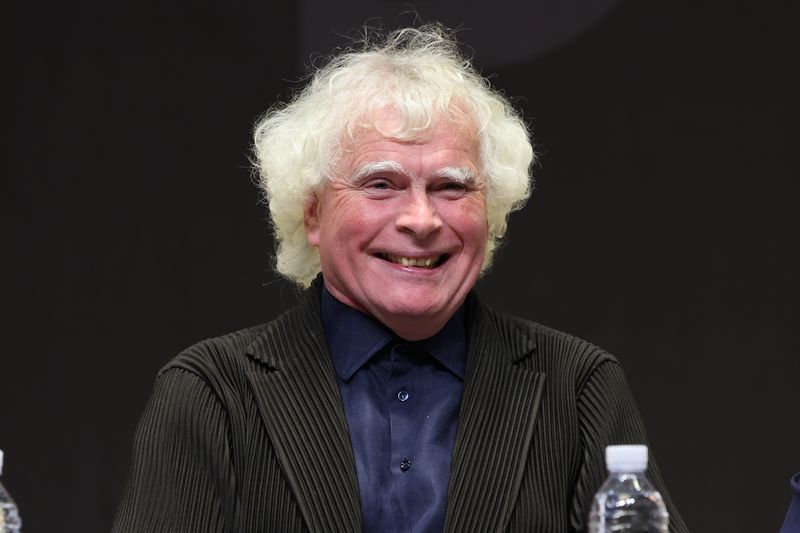
[Financial News] “I, too, had never thought of putting Schubert and Stravinsky on the same program. When I looked at the two works together at the suggestion of the Korean concert organizers, I found they shared the fact that they both speak of death.”
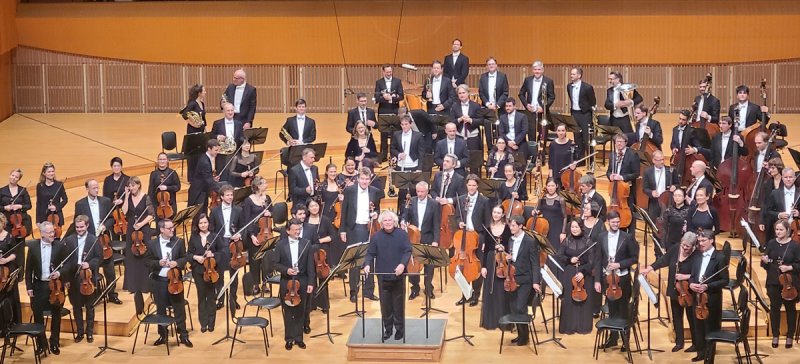
Sir Simon Rattle and the Bavarian Radio Symphony Orchestra performed Schubert’s Symphony No. 9, “The Great,” and Stravinsky’s The Rite of Spring at the Seoul Arts Center Concert Hall on the 12th. On the 13th, they will perform Mahler’s Symphony No. 2, “Resurrection.”
From the dance of death to the chorus of resurrection
At a press conference held on the 11th at Rode Arts Center in Seocho District, Seoul, Rattle explained, “In The Rite of Spring, the maiden chosen as a sacrifice dances until she dies,” adding, “Alongside the tragic death, there is also a rough, primal joy.” He also found a dark mood in “The Great.” “The slow movement heads toward a dark place that evokes Winterreise,” he said. “At the end, it’s impossible to tell whether Schubert is dancing for joy or dancing joyfully toward death.”
Mahler’s “Resurrection,” which they will perform on the 13th, brings this journey to a close. It begins with a funeral march, looks back on memories and the pain of life, then moves toward resurrection and hope with the chorus.
Rattle said, “Great music lets you discover something new every time you open the score,” adding that “‘Resurrection’ is also a work that offers a new surprise each time it is performed.”
For this performance, the focus was on weaving the beauty and grotesquerie of Mahler’s music into a single structure, so that the work as a whole would feel like one journey.
“Mahler is the orchestra’s DNA” ... next Korea visit to feature late trilogy
Mahler also has a special place in the history of the Bavarian Radio Symphony Orchestra. With Rafael Kubelík, who served as its chief conductor from 1961 to 1979, the orchestra established a tradition of distinctive interpretations by becoming the first German orchestra to record a cycle of Mahler’s symphonies. Rattle has carried on that tradition, performing and recording the Ninth Symphony in 2021 before taking up the post, followed in succession by Symphonies Nos. 6 and 7 and No. 2, “Resurrection.”
Rattle recalled, “As soon as the first rehearsal began, I could tell how deeply this music was embedded in the orchestra’s DNA.”
On his next visit to Korea, he plans to present as a single series three late works that Mahler never heard performed during his lifetime: The Song of the Earth, which he completed but which premiered after his death; Symphony No. 9; and the unfinished Symphony No. 10, which Deryck Cooke prepared in a performing edition.
The idea began with a chance incident after Rattle performed Mahler’s Symphony No. 9 with the Vienna Philharmonic long ago. He requested a recording of the concert, and on the tape he received, a faint trace of The Song of the Earth, recorded earlier, could be heard beneath the Ninth Symphony.
Rattle said, “It occurred to me that the three late works could be performed as a single cycle,” and previewed that it “will form the basis of the next Korean tour.”
From period instruments to contemporary music...Rattle expands the BRSO’s horizons
The Bavarian Radio Symphony Orchestra’s distinction goes beyond Mahler. The orchestra has regularly introduced contemporary music as a major ensemble in Musica Viva, the Bavarian Broadcasting’s contemporary music series. In addition, in February 2025, Rattle launched BRSO Baroque, a period-instrument ensemble. He explained that experience performing early music influences not only how musicians interpret Baroque music but also their approach to later works by composers such as Schumann and Bruckner, as well as the sound of the orchestra as a whole.
Another distinctive feature of the BRSO is its tradition of collaboration, in which the conductor and orchestra members shape a musical vision together.
Rattle said, “There is a strong sense of community in this orchestra—we’re all in the same boat,” adding, “The musicians bring the conductor’s vision to life, and the conductor helps the performers draw even more on their abilities.”
Natalie Schwabe, the orchestra members’ representative, described Rattle as a conductor who helps the orchestra grow. She said, “Rattle makes every performance a special and unique experience,” adding, “He pushes us to our musical limits and takes us out of our comfort zone.”
Rattle’s ability to temper intense musical demands with humor is also characteristic of his leadership. Schwabe said with a laugh, “He leads us through all of this with humor,” adding, “The musicians’ English has also improved a lot over the past two years, so now we can understand his jokes better.”
Speaking about conducting that day, Rattle borrowed a phrase from Samuel Beckett, describing it as “the work of hoping that, even if you fail, you’ll fail better next time.”
[email protected] Shin Jin-a Reporter