“AI’s spread means further declines in youth employment”... Economic Research Association examines real estate, labor and taxation in the AI era
- Input
- 2026-11-12 17:58:29
- Updated
- 2026-11-12 17:58:29
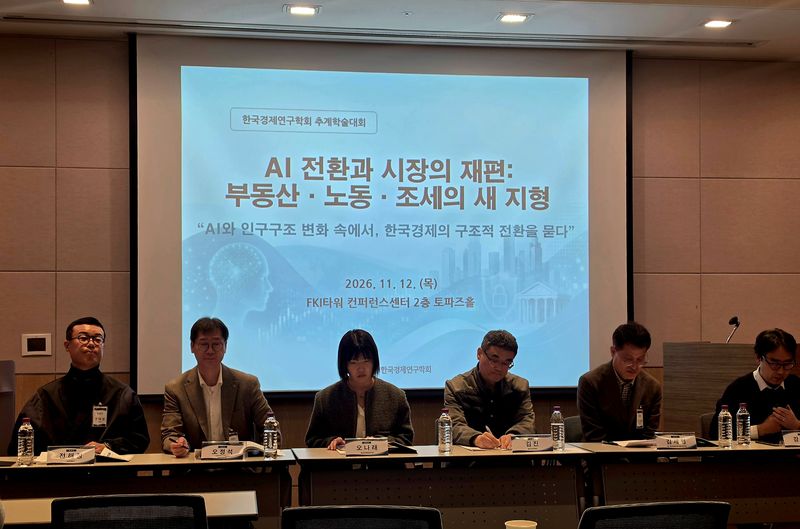
[Financial News] A study has found that young people's employment is becoming less stable as rising productivity from artificial intelligence (AI) reduces opportunities to gain first-job experience.
The Korean Economic Research Association examined changes in youth employment amid the spread of AI and policies to support occupational transitions. It also proposed ways to narrow the wealth gap through changes to the structure of the real estate market and tax reform, while emphasizing the need to boost manufacturing productivity with AI and make complementary investments.
On the 12th, the Korean Economic Research Association held its 2026 fall academic conference at FKI Tower in Yeouido, Seoul, under the theme “AI Transition and the Reshaping of Markets: New Terrain for Real Estate, Labor and Taxation.” The conference focused on challenges in the structural transformation of the Korean economy, including housing prices, household debt, the wealth gap and youth employment. It examined major changes brought about by the rapid spread of AI. More specifically, participants explored policy alternatives to support productivity gains, changes in employment, corporate innovation capacity and the development of young people's careers.
Occupations with high AI exposure declined first, but a causal link is difficult to establish
The conference was held in two sessions. Song Heon-jae, a professor at the University of Seoul, chaired the session “AI Transition and Structural Changes in the Labor Market.” Participants discussed the relationships between the spread of AI and changes in employment, young people's career development and corporate productivity. Bang Hyeong-jun, a senior research fellow at the Korea Labor Institute, said in a presentation, “When increases in informal employment and demographic changes are taken into account in analyses of employment changes due to AI, no clear employment decline caused by AI or impact on the youth labor market has been confirmed.” Instead, an upward trend in employment was observed in occupations with high AI complementarity. An upward trend in wages was also seen in occupations with high exposure to generative AI.Oh Sam-il, head of the Employment Research Team in the Bank of Korea's Research Department, explained that “the recent decline in youth employment has been concentrated in industries with high AI exposure.” From June 2022 to June 2026, the number of jobs held by young people aged 15 to 29 fell by 285,000, with 268,000 of those jobs—about 94%—lost in industries with high AI exposure. However, Oh added, “It is difficult to attribute these changes definitively to the causal effects of AI,” and noted that “adjustments to overhiring after the pandemic, a preference for experienced workers, and weaker in-house corporate training may also have played a role.”
Professor Lee Gi-hwan of Incheon National University found that “manufacturing firms using AI had about 21% higher productivity, but no statistically significant effects were found among small firms or in the service sector.” The need for complementary investments in infrastructure, skilled personnel and data capabilities, in addition to AI adoption, was also raised.
The conference also hosted the first Outstanding Paper Award ceremony. The winner in the general category was “Analysis of the Greenhouse Gas Reduction and Social Welfare Effects of the Carbon Border Adjustment Mechanism,” by Oh Se-sin, a research fellow at the Korea Energy Economics Institute, and Kim Sang-gi, a professor in the Department of International Business at Chungbuk National University. The paper analyzed the mechanism's effects on greenhouse gas reduction, competition between countries and social welfare, offering insights for the development of climate and trade policies.
The student-category award went to “The Effects of Mandatory Retirement at Age 60 and Union Membership Rates on Employment Volatility: The Moderating Effect of Employment Stabilization Factors,” by Lee Eun-gyeong, a master's student in the Department of Economics at Kangwon National University. The paper empirically demonstrated that the increase in employment volatility associated with mandatory retirement could be mitigated depending on union membership rates, contributing to discussions on raising the retirement age and employment-stability policies.
Jeonse is a private financial system... tenants should take note
The session “Structural Changes in the Real Estate Market and Taxation and Policy” discussed how changes in housing prices affect the wealth gap and the connections among housing finance, the rental market and housing supply policies. In the session chaired by Professor Kim Jin of Dongduk Women's University, Lee Seon-hwa, a senior research fellow at the National Assembly Futures Institution, noted, “The distributional effects of rising housing prices have been amplified by the combination of wealth concentrated in real estate, concentration in Seoul, increased borrowing and intergenerational transfers of assets.” Some also argued that the monetary cap on the special deduction for long-term ownership should be maintained while the residency requirement is removed. One proposal was to improve both the fairness and efficiency of asset taxation by ending temporary property-tax relief and revising the standards for officially assessed property values.Professor Lee Hu-bin of Kangwon National University said, “Differences in gains and losses among households buying their first home with borrowed money are related not only to their choices at the time of purchase but also to structural factors such as rental deposits and residential location.” Professor Yoo Seung-dong of Sangmyung University presented research findings that “changes in the apartment jeonse-to-price ratio have a statistically significant effect on housing starts,” based on research examining jeonse as a means of investment financing. The findings empirically showed that jeonse is being used as a form of private financial system. He pointed to the link between the rental and housing supply markets and warned that landlords' investment risks could be passed on to tenants.
In opening remarks, Seo Eun-suk, chair of the Korean Economic Research Council, said that “the Korean economy has now entered a more fundamental period of structural transition, beyond cyclical problems,” and explained that the conference was organized to ask, “What should the Korean economy's new growth and employment model be amid AI and demographic change?”
[email protected] Park Mun-su Reporter