“Jeonse is a private financial system” ... Tenants should beware of landlords’ investment risks being passed on to them
- Input
- 2026-11-12 17:58:19
- Updated
- 2026-11-12 17:58:19
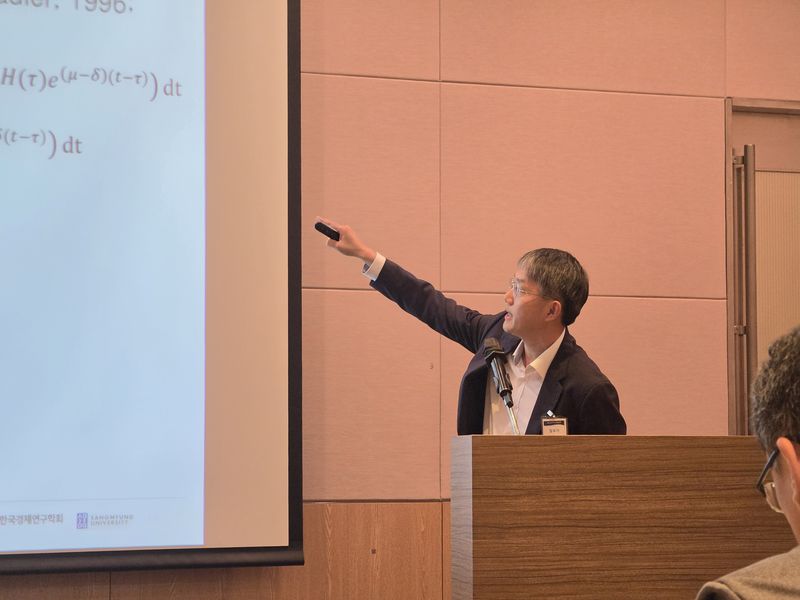
Speaking at the 2026 fall academic conference hosted by the Korean Economic Research Association at FKI Tower in Yeouido on the 12th, Yoo Seung-dong, a professor in the Department of Economics and Finance at Sangmyung University, said, “There is debate over whether jeonse should disappear or whether it will disappear, but decisions that take the rental market into account are needed to ensure housing supply.”
Professor Yoo’s research, which views jeonse as a means of investment financing, showed the link between the housing rental market and the housing supply market. He examined the decision-making of jeonse gap investors theoretically and, based on empirical findings that changes in the apartment jeonse-to-sale price ratio have a statistically significant effect on housing starts, suggested that the rental market should also be considered when formulating housing supply policies.
Professor Yoo explained the background to the research, saying, “There have been continued studies arguing that jeonse can be beneficial to tenants, including research describing it as a ladder to homeownership and studies finding that jeonse tenants accumulate more assets than monthly renters.” He added, “Meanwhile, although jeonse has often been mentioned as a financing tool for landlords, there has been almost no research on it.”
“I think jeonse may be a financial system that the private sector created on its own when financial markets were not well developed,” he said. “We built a model in which landlords invest using jeonse, and, since we were unable to obtain individual-level data, we are compiling macroeconomic data to conduct the paper (research).”
Professor Yoo examined whether the use of jeonse affects the timing of investment. “When a developer or investor invests on the basis of a jeonse contract, they invest a little earlier,” he said. “When jeonse is available, investors start investing even at lower prices. In other words, they decide to invest sooner.”
But with this effect now established, it has also become clear that tenants may end up bearing the risk. If home prices fall below the deposit and the landlord cannot return the money, tenants may find it difficult to recover the full amount they paid, even if they take over the property.
In his investment model, Professor Yoo incorporated findings from an earlier paper that said landlords may transfer the property to tenants if home prices fall below the jeonse price. “Because default can occur under the private financial system that is jeonse, investors can avoid risk, making faster housing supply possible,” he said.
He added, “We were able to derive a macro-level finding that housing starts increase as the jeonse-to-sale price ratio—that is, the jeonse price as a share of an apartment’s sale price—increases.” He said, “It can be viewed as closer to a theoretical paper, with limitations in its empirical analysis.”
The study took into account not only housing prices but also land prices, construction costs and interest rates. To reduce the number of variables, it controlled for housing price volatility and the effects of the COVID-19 period. Regarding the data analysis, Professor Yoo explained, “Data on the apartment jeonse-to-sale price ratio have been available since 2005, so we used them. When deciding whether to start construction, people look at the ratio and take it into account.” Housing starts refers to the beginning of construction on a home.
Professor Yoo emphasized that the study “showed that investment through jeonse can increase people’s incentive to invest.” He added, “Because housing starts and investment are affected by the rental market, that market should also be considered in order to supply housing.”
The ensuing discussion highlighted the need to consider both jeonse’s financial function and tenant protection. Jeon Hae-jeong, a professor in the Department of Real Estate at Sangmyung University, said, “It is important to ensure that jeonse deposits can be returned safely.” She added, “The risks differ between landlords with sufficient financial resources and those who rely heavily on the next tenant’s deposit.”
[email protected] Park Moon-soo Reporter