Tests it 300 times in virtual space to prevent collisions... Duksung Women's University students develop logistics robot technology
- Input
- 2026-11-12 16:47:52
- Updated
- 2026-11-12 16:47:52
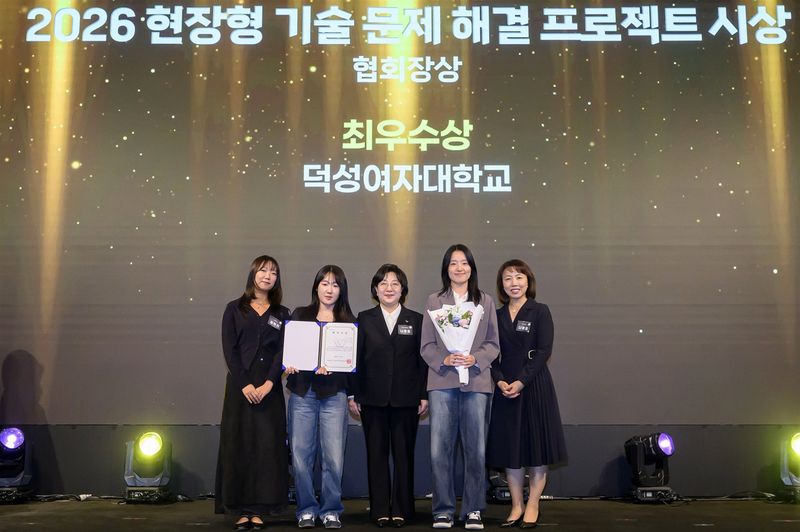
[Financial News] University students who developed technology that reduces collision risks and costs by testing robot movements hundreds of times in a virtual computer environment before deploying the robots in actual logistics warehouses won the top prize in a government-hosted competition.
Duksung Women's University announced on the 12th that a research team of five fourth-year students majoring in IT and Media Engineering—Jo Ye-ryeong, Kim Min-ji, Baek Seo-jin, Lee Chae-jin and Ahn Yu-bin—developed a “Logistics Environment Simulation System” combining artificial intelligence (AI) and digital-twin technology and won the top prize in the “2026 Field-Oriented Technology Problem-Solving Project.”
Team leader Jo Ye-ryeong said, “At first, I had no experience working with robot hardware, but with guidance from our professor and corporate mentor, and through collaboration with my teammates, we were able to operate a real robot.” She added, “I will continue to develop my interdisciplinary capabilities spanning hardware and software.”
The competition was part of an industry-academia collaboration program hosted by the Ministry of Trade, Industry and Energy and the Korea Institute for Advancement of Technology and organized by the Korean Association of Women Engineers and Technologists. The awards ceremony was held on the 6th at El Tower in Yangjae-dong, Seoul.
The core of the technology developed by the research team is to validate work processes in advance so that a robot arm can move objects accurately without hitting obstacles in complex logistics environments where the objects' locations frequently change. Previously, robots had to be deployed at the site and tested repeatedly to identify errors, requiring considerable time and money. The research team addressed this problem by reproducing the actual logistics site in a virtual environment and checking safety first.
The team also demonstrated the system's performance. After conducting 300 simulations under challenging virtual conditions, including moving obstacles, the research team successfully moved objects to their target locations without collisions 286 times, for a success rate of 95.3%.
The technology works much like giving a robot “smart eyes” and a “virtual training ground.” The students used real-time AI object-recognition technology and a special camera that determines three-dimensional positions to identify objects, then connected these to a virtual-environment program to calculate the robot arm's movements and the possibility of collisions in advance. In particular, they corrected camera measurement errors and accurately incorporated the actual robot arm's joint structure into the virtual model, narrowing the gap between reality and the virtual environment.
The achievement was the result of industry-academia collaboration, with the university and a company working together. Under the guidance of Professor Na Jeong-jo of the Department of VR Convergence Engineering, Moon Jun-hyeon, chief technology officer at PBI, took part as a mentor, and they worked together to address technical challenges in the field.
[email protected] Kim Man-gi Reporter