Next-generation semiconductors to cut AI power consumption... ‘Memristor’ technology draws attention at Jeju National University
- Input
- 2026-11-12 16:36:42
- Updated
- 2026-11-12 16:36:42
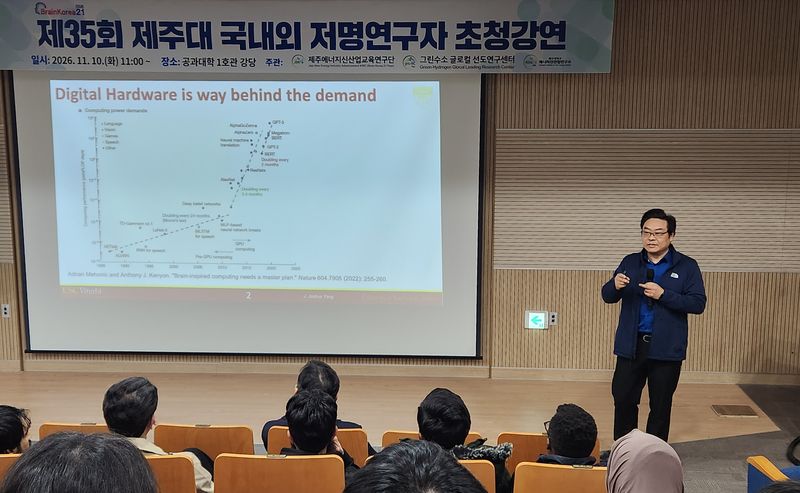
【Financial News, Jeju = Jeong Yong-bok】 As the spread of artificial intelligence (AI) drives a sharp increase in data center power demand, next-generation semiconductor technology that can reduce power consumption has been introduced at Jeju National University. The technology, called a “memristor,” performs computation in the memory where data is stored and is drawing attention as an alternative that could improve the energy efficiency of AI semiconductors.
On the 12th, Jeju National University said that endowed professor Joshua Yang (J. Joshua Yang) of the Department of Electrical and Computer Engineering at the University of Southern California (USC) delivered a lecture titled “Memristor Design for Efficient and Robust Artificial Intelligence” at the 35th Lecture by Distinguished Researchers from Korea and Abroad, held on the 10th in the auditorium of Engineering Building 1.
Professor Yang is a researcher in memristors and neuromorphic computing and leads a research center for neuromorphic computing at USC that is supported by the U.S. Air Force. He has conducted research and technology development in memory devices and AI computing hardware.
A memristor is a semiconductor device whose resistance changes in response to electrical stimuli and that retains that state. Unlike conventional computers, which repeatedly transfer data between memory and processing units, it can perform computation where the data is stored.
AI requires repeated calculations on vast amounts of data. In conventional semiconductor architectures, considerable power and time are also consumed in moving data. Memristor-based in-memory computing reduces data movement to improve computational efficiency.
The importance of improving AI power efficiency is also growing. In a report released this April, the International Energy Agency (IEA) projected that annual electricity consumption by data centers worldwide would rise from 485 terawatt-hours (TWh) in 2025 to about 950 TWh in 2030. The spread of AI is a major driver of the increase.
In his lecture, Professor Yang explained in-memory computation using memristors, as well as parallel and analog computing technologies. These approaches process multiple data items simultaneously while reducing the energy consumed by data movement.
Neuromorphic computing was also introduced as a major area of research. Neuromorphic technology implements in semiconductors the operating principles of neurons in the human brain and synapses, the connections between nerve cells.
Professor Yang outlined how controlling the movement of ions within memristors can implement the information-processing methods of the brain’s nervous system, and discussed directions for developing intelligent systems that combine sensing and computation.
This technology could improve the power efficiency of AI semiconductors, but issues including performance variation among devices, computational accuracy, and long-term reliability must be addressed. Technical validation is also still needed before it can be applied to large-scale AI computing.
The lecture was jointly organized by Jeju National University’s Jeju Energy New Industry Education and Research Group (BK21; headed by Choi Su-seok), the Green Hydrogen Glocal Leading Research Center (RLRC; directed by Kim Sang-jae), and the Research Institute for Energy New Industries (RINEI; directed by Kim Sang-jae).
Jeju National University is pursuing research in energy new industries, including renewable energy and green hydrogen. The lecture was organized to share next-generation semiconductor technologies that reduce power consumption during AI computation, strengthen graduate students’ capacity for interdisciplinary research, and broaden the basis for international academic exchange.
[email protected] Jeong Yong-bok Reporter