Rogoff: “Stimulus through more debt will bring a deeper downturn ... South Korea will suffer greatly if the AI bubble bursts”
- Input
- 2026-11-12 16:32:54
- Updated
- 2026-11-12 16:32:54
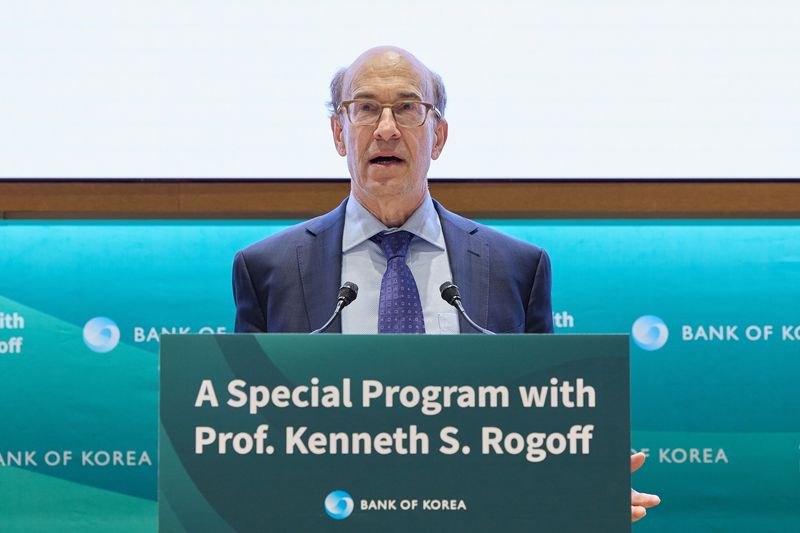
[Financial News] World-renowned macroeconomist and Harvard University professor Kenneth Rogoff warned at a lecture hosted by the Bank of Korea on the 12th that “soaring national debt and rising real interest rates could combine to trigger a major economic crisis.”
The warning is that policies that prop up consumption with debt, without raising taxes or cutting spending, under the illusion that interest rates will remain low forever could bring about an even deeper downturn instead of preventing a prolonged slump.
Professor Rogoff made these remarks at a lecture titled “Debt Supercycle versus Secular Stagnation” at the Bank of Korea’s annex building in Seoul’s Jung District that day.
Professor Rogoff is a world authority on national debt, economic growth and the history of financial crises, and is widely regarded as a rational, centrist proponent of fiscal responsibility who prioritizes sound public finances. The lecture was reportedly proposed personally by BOK Governor Hyun Song Shin.
Professor Rogoff bluntly criticized the idea, saying, “The notion that debt is a free lunch, which has permeated politics and the economy today, is fundamentally wrong.”
Professor Rogoff argues that the belief held by optimistic advocates of fiscal expansion, including politicians and some economists—that national debt can keep growing because low interest rates and low inflation will last forever—is both a “temporary illusion” left by the massive shock of the 2008 Global Financial Crisis (GFC) and the result of a “debt supercycle (successive periods of low interest rates and low growth across multiple countries).”
The fiscal expansionist view of the time—that governments should boost the economy by increasing public debt without limit when interest rates are near zero—became the dominant theory in economics from the 2010s onward. Professor Rogoff argued that this was “merely a temporary phenomenon of the financial crisis” and called for fiscal soundness, but was also criticized as an unrealistic advocate of austerity. Since then, however, as US national debt has grown to $40 trillion and Treasury yields have surged to record highs, Rogoff’s predictions are coming true.
In his book King Dollar: The Past and Future of the World’s Dominant Currency (Our Dollar, Your Problem), which warned about America’s growing national debt and the façade of a strong dollar, Professor Rogoff also wrote, “As the dollar’s dominance went from strength to strength, US politicians and some economists fell into the illusion that ultra-low interest rates would remain the norm in the future.” He warned that the greatest threat to the dollar’s dominance lay within the United States, not outside it.
He said there was ample scope for the United States to deliberately use inflation to reduce the real value of its ballooning debt, even without formally declaring a default.
Professor Rogoff warned that, according to economic models, real interest rates rise in tandem with 1% productivity growth. As a result, countries with government debt well above 100% of GDP, such as the United States (126.8%), cannot avoid fiscal pain: as tax revenues rise, so too will interest costs on government bonds.
Professor Rogoff cautioned against the optimistic view that technological innovation, including artificial intelligence (AI), would resolve national debt problems and spur fiscal stimulus. He said, “South Korea, the biggest beneficiary of the AI semiconductor boom, could suffer greatly when the AI bubble bursts,” and stressed that how much room a country has to increase its national debt is a crucial question, underscoring the importance of effective fiscal spending and “fiscal space.”
Referring to South Korea’s rapidly aging population, Professor Rogoff advised that “the government debt ratio is likely to rise further, and we need to carefully weigh the costs and benefits when deciding how to use the revenue from the AI and semiconductor boom.”
Professor Rogoff’s warning has significant implications for South Korea’s current economic reality: riding the tailwinds of a semiconductor supercycle, the country is going all in on “ultra-expansionary fiscal policy.” According to the 2026–2030 National Fiscal Management Plan announced by the Ministry of Planning and Budget, cumulative fiscal spending over the five-year term of the Lee Jae Myung administration will amount to at least 4.5 quadrillion won. National debt is projected to reach 1.734 quadrillion won, or 49% of GDP.
The problem is that this plan relies on the optimistic assumption that, as the semiconductor boom and economic growth continue, national tax revenues—including corporate and income taxes—will rise by an average of 13.4% a year. The government believes there is no cause for concern because economic growth will keep the debt-to-GDP ratio below 50%. But even if the semiconductor boom ends earlier than expected and tax revenues plunge, it will be difficult to manage the resulting increase in spending: amid rapid population aging and a sharp decline in the working-age population, the government cannot cut various fixed, cash-based social welfare payments, which account for more than half (53%) of fiscal spending. This is also the context for BOK Governor Shin’s recent criticism at a press briefing that “the government’s expansionary fiscal policy increases aggregate demand and inflationary pressures in the short term,” as well as his criticism of the low fiscal multiplier of government transfer payments (around 0.2) and inefficient spending that is difficult to reverse once disbursed.
The policy mismatch is bound to deepen: the government is injecting massive fiscal resources to hold down prices, while the BOK must tighten its high-interest-rate stance to rein in surging inflation. The burden will fall on ordinary households and marginal businesses already struggling with the double blow of high prices and high interest rates.
[email protected] Jung Sang-gyun Reporter