43.9% of Jeju elementary school students say they “hardly ever use Jeju language” ... Discussion on systematizing specialist instructor training and teaching materials
- Input
- 2026-11-12 16:15:20
- Updated
- 2026-11-12 16:15:20
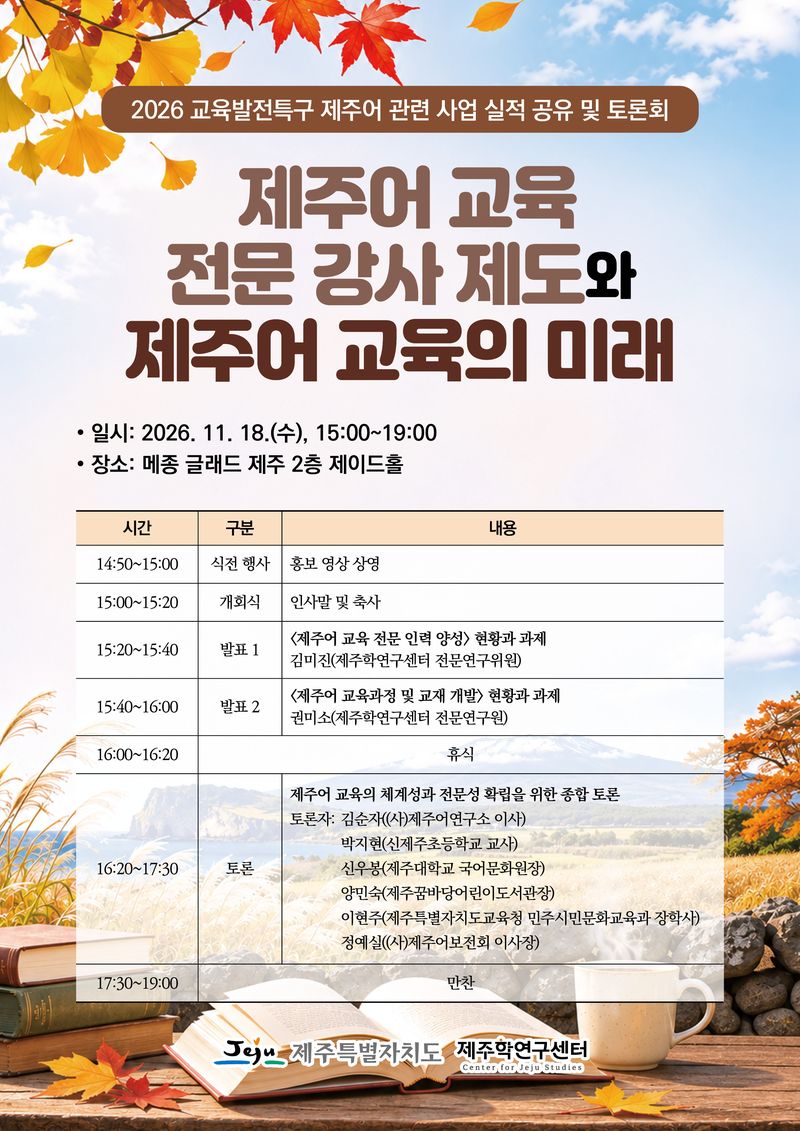
【Financial News, Jeju — Reporter Jeong Yong-bok】 Ways to systematize specialist instructor training and the development of curricula and teaching materials are being discussed to pass on Jeju language, which is at risk of extinction, to the next generation. A key challenge is to move away from an approach to Jeju-language education that has relied on individual instructors’ abilities and education provided separately by each institution, and instead operate it according to common standards.
According to the Jeju Studies Research Center of Jeju Special Self-Governing Province on the 12th, the “2026 Education Development Special Zone Jeju Language-Related Project Results Sharing and Discussion Forum” will be held at 3 p.m. on the 18th in Jade Hall at Maison Glad Jeju in Jeju City.
At the forum, held under the theme “The Specialist Instructor System for Jeju Language Education and the Future of Jeju Language Education,” participants will review the results of specialist workforce training and curriculum and teaching-material development carried out through the Education Development Special Zone project.
In 2010, UNESCO classified Jeju language as a language facing a serious risk of extinction. Its use, concentrated among older people, and the weakening of transmission between generations have long been cited as major challenges.
In a survey conducted last year by the Jeju Studies Research Center of 1,759 elementary, middle and high school students in the province, 43.9% of elementary school respondents said they “hardly ever use Jeju language.” The figures were 22.2% for middle school students and 20.5% for high school students.
This is why there have been calls to improve the education system in schools, as well as expand the use of Jeju language at home and in the community, to ensure the sustainability of Jeju-language education.
Last year, the Jeju Studies Research Center designed a specialist instructor certification system and a standardized training program through the Education Development Special Zone project. In April this year, it published three research reports covering the current state of education, demand for instructors, domestic and international training cases, and plans for operating a certification system.
In curriculum development, the center also selected about 1,600 basic Jeju-language vocabulary items and established a framework for curricula suited to various learning environments, including schools and the community. However, the specialist instructor certification system is still a proposed design developed through research, and further review is needed before qualifications can actually be awarded and the system implemented in educational settings.
The current Ordinance on the Preservation and Promotion of the Jeju Language stipulates that local governments are responsible for providing courses, developing teaching materials and training experts. It also provides a basis for cooperation between Jeju Province and the education office to promote Jeju-language education in schools.
At the forum, Kim Mi-jin, a specialist research fellow at the Jeju Studies Research Center, will present “The Current State and Challenges of Training Specialists in Jeju-Language Education,” while specialist researcher Kwon Mi-so will present “The Current State and Challenges of Developing Jeju-Language Curricula and Teaching Materials.”
They will be followed by a discussion with Kim Sun-ja, a board member of the Jeju Language Research Institute; Park Ji-hyeon, a teacher at Sinjeju Elementary School; Shin U-bong, head of Jeju National University’s Korean Language and Culture Center; Yang Min-suk, director of Jeju Kkumbadang Children’s Library; Lee Hyeon-ju, a supervisor at the Jejudo Office of Education; and Jeong Ye-sil, chair of the Jeju Language Preservation Association. They will discuss ways to enhance the professionalism and sustainability of education.
Key challenges include how to operate the specialist instructor training system, how to use curricula and teaching materials in educational settings, and how to divide responsibilities between schools and community education institutions. Anyone interested in Jeju-language education may attend the forum.
Kim Mi-jin, a specialist research fellow, described it as “a forum to explore sustainable future directions for Jeju-language education” and said, “I hope various institutions and experts will work together to discuss ways to systematize and professionalize Jeju-language education.”
[email protected] Jeong Yong-bok Reporter