Jeju BRT decision pushed to December; residents to debate fate of island-platform stops on the 18th
- Input
- 2026-11-12 16:06:56
- Updated
- 2026-11-12 16:06:56
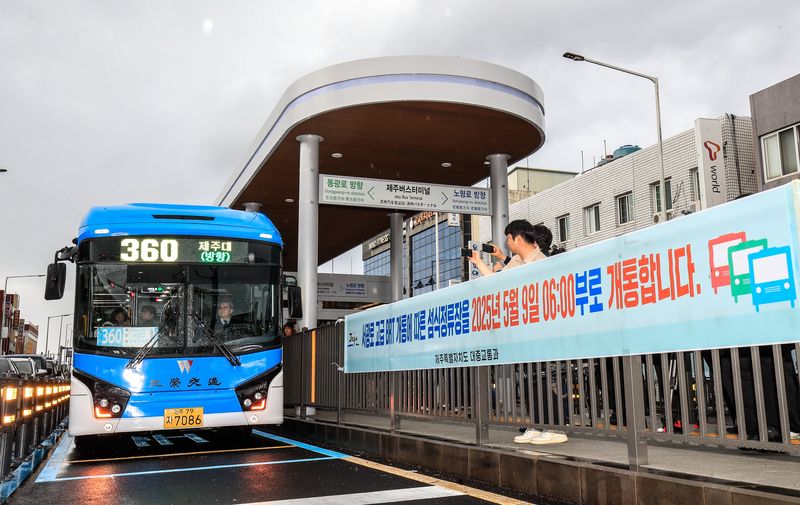
【Financial News, Jeju = Jeong Yong-bok, Reporter】 A decision on whether to retain the island-platform stops in Jeju’s Bus Rapid Transit (BRT) system and how to proceed with the suspended follow-up project will be made in December. Ahead of the decision, initially announced for November, Jeju Province plans to hold a public debate to review ways to improve the project and its effects on transport and public finances.
According to Jeju Special Self-Governing Province on the 12th, the BRT Policy Advisory Panel will hold the “Jeju Bus Rapid Transit Policy Public Debate” at 2 p.m. on the 18th in the main conference room on the second floor of the Jeju Hondi Nurim Center on Seogwang-ro in Jeju City. Anyone may take part, regardless of whether they support or oppose the project.
BRT is a public transport system that improves bus lanes, stops and traffic operations to increase buses’ punctuality and speed. In Jeju, six island-platform stops—where passengers traveling in either direction share stops in the middle of the road—opened along a 3.1-km stretch of Seogwang-ro in May last year, the first such stops in the country. The province also introduced buses with doors on both sides.
After the stops opened, concerns were raised about the inconvenience of having to choose between central and roadside stops depending on the bus route, as well as pedestrian safety and traffic congestion. Jeju Province halted construction on the next section and is reviewing how the existing facilities are operated.
At the same time, improvements in bus speeds have also been confirmed. An analysis by the Jeju Research Institute, released by Jeju Province last March, found that the average speed of buses on Seogwang-ro during the morning commute rose from 10.8 km/h before the stops opened to 15.5 km/h. Average speeds for regular vehicles also improved, from 12.6 km/h to 17.5 km/h.
The central question is whether to retain the island-platform stops already in place or convert them to stops with separate platforms for each direction or to roadside stops. Whether the existing facilities are retained or changed will affect passenger routes, bus operating efficiency and additional construction costs.
On September 30, Jeju Province formed a policy advisory panel of 13 civilian members, including transport experts, civic group members and residents’ representatives. The panel is analyzing current operations on Seogwang-ro, road conditions along the planned project sections, traffic data and public complaints.
An in-person survey of 1,000 people is also underway to gauge residents’ views. The survey includes 450 public transport users, 450 non-users and 100 stakeholders, including businesses along Seogwang-ro. It asks about the direction of the BRT project, how bus-only lanes are operated and ways to improve Seogwang-ro.
Representation and transparency in the policy decision-making process are also at issue. Jeju Action for Nuclear Phaseout and the Climate Crisis criticized the panel’s formation and operations on the 28th of last month, saying they had not been disclosed sufficiently, and called for a public deliberation body involving residents, bus users and civil society.
At the debate, Policy Advisory Panel Chair Oh Jeong-hun will outline the panel’s work to date, followed by a presentation on the status of the BRT project. Representatives from civic groups, the media and the transport industry, a youth representative and the chair of a residents’ self-governing committee in the project area will take part in a moderated discussion. General residents will also have an opportunity to speak freely.
The policy advisory panel will draw up recommendations this month after considering the survey, interviews with stakeholders and views expressed at the debate. Jeju Province plans to assess the transport effects and financial burden of each option before deciding on its final policy direction in December.
“This debate is intended to share the diverse perspectives and opinions of residents on Jeju’s Bus Rapid Transit system and reflect them in policy,” said Policy Advisory Panel Chair Oh Jeong-hun. “I hope many residents will take part and freely share their views, regardless of whether they support or oppose the project.”
The upcoming decision must consider not only whether to use the existing facilities, but also whether to resume work on the suspended sections, the scale of additional investment and ways to make public transport more convenient. How residents’ views are reflected in actual policy decisions is also a major point of interest.
[email protected] Jeong Yong-bok Reporter