“Permitting: 10 months → 80 days”... South Chungcheong Province’s ‘lightning-fast administration’ pays off
- Input
- 2026-11-12 16:18:32
- Updated
- 2026-11-12 16:18:32
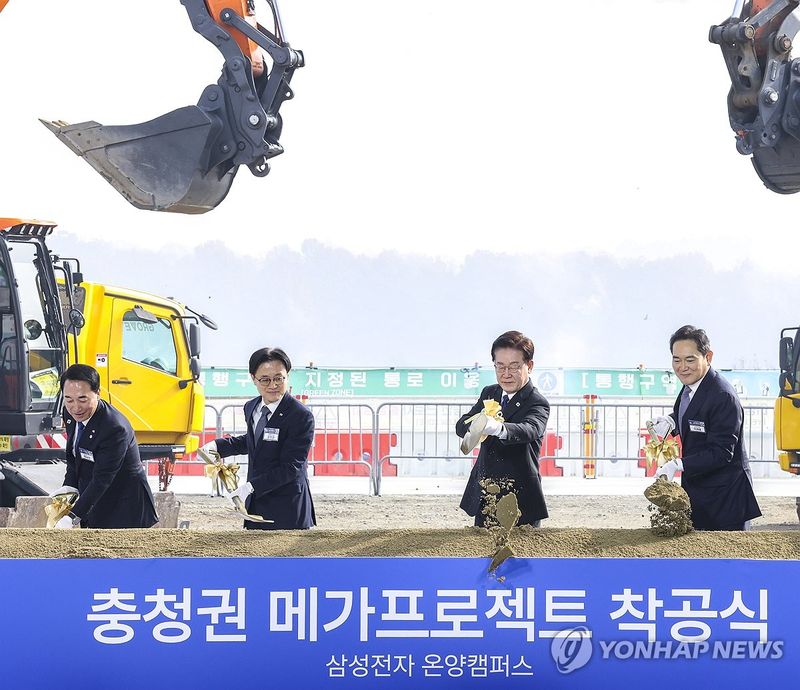
According to South Chungcheong Province on the 12th, the groundbreaking ceremony for the Chungcheong region mega-project and the fourth public-private joint inspection meeting were held in succession at the construction site and research building of Samsung Electronics’ Asan campus (Onyang Campus). Attendees included President Lee Jae-myung, South Chungcheong Province Governor Park Su-hyeon, Samsung Electronics Chairman Lee Jae-yong, ministers from relevant government departments, mayors and provincial governors from Daejeon, Sejong City and North Chungcheong Province, and representatives of major companies including SK hynix.
The Chungcheong region mega-project is a massive initiative in which major companies, including Samsung and SK Group, will invest a total of 392 trillion won in key sectors of future advanced industries, such as semiconductors, displays, secondary batteries and artificial intelligence (AI) data centers. More than half of that investment—202 trillion won—will be concentrated in South Chungcheong Province. The Samsung Electronics Asan campus, where groundbreaking took place this time, will house a new fabrication plant (FAB) and supporting facilities to expand production capacity for high-performance AI semiconductors, including high-bandwidth memory (HBM).
A major factor behind the early groundbreaking was an unprecedented drive to speed up administrative procedures. South Chungcheong Province and Asan City cut the time needed for factory establishment and building permits from around 10 months to 80 days, a 75% reduction. This was the result of launching the “South Chungcheong Advanced Strategic Industries Great Leap Task Force (TF)” immediately after signing an investment agreement last July and establishing a parallel processing system covering the entire cycle, from permits to groundbreaking and operation. They fully implemented fast-track procedures, conducting prior consultations on environmental, disaster and national heritage impact assessments simultaneously and cutting a month from the review period of the urban planning committee. Previously, permits for Samsung Display to resume construction were also shortened from four months to one.
At the public-private joint inspection meeting held after the groundbreaking ceremony, Governor Park presented “the results of support for the mega-project and plans going forward” as a representative of local governments. Highlighting South Chungcheong Province’s strengths—including “AI Initiative Chungnam,” “three-pronged innovation to prepare for future investment” and “Chungnam-style AI transformation”—he said the province would work as “one team” with central government ministries and cities and counties to address potential post-permitting issues involving transportation and power infrastructure, industrial water and sites, and the supply of skilled workers. He also called for national-level support, including designation of Cheonan and Asan as startup cities, to maximize the impact of the investment and promote balanced regional development.
The groundbreaking of the new line at the Asan campus is seen as a key strategic move to maintain South Korea’s overwhelming lead in the semiconductor supply chain as global competition for dominance in AI semiconductors intensifies. With demand for HBM surging amid the race among big tech companies to expand their AI data centers, how quickly companies can secure production bases has become directly linked to their survival. In particular, as production capacity at Onyang Campus—where packaging and testing processes are concentrated—is expanded, the synergy and process efficiency of the central region’s “K-semiconductor belt,” stretching from Hwaseong and Pyeongtaek to Cheonan and Asan, are expected to increase further.
“More important than the 202 trillion won in investment in South Chungcheong Province is ensuring that the investment is actually realized and its benefits spread throughout the region,” Governor Park said. “We will build an industrial ecosystem in which local communities grow alongside businesses as they invest, work closely with the central government and bring all the capabilities of local government to bear.”
[email protected] Kim Won-jun Reporter