“Cyber Pandemic” ... FISCON 2026 Voices Unite in Calling for a Major Overhaul of Financial Security in the AI Era
- Input
- 2026-11-12 17:31:25
- Updated
- 2026-11-12 17:31:25
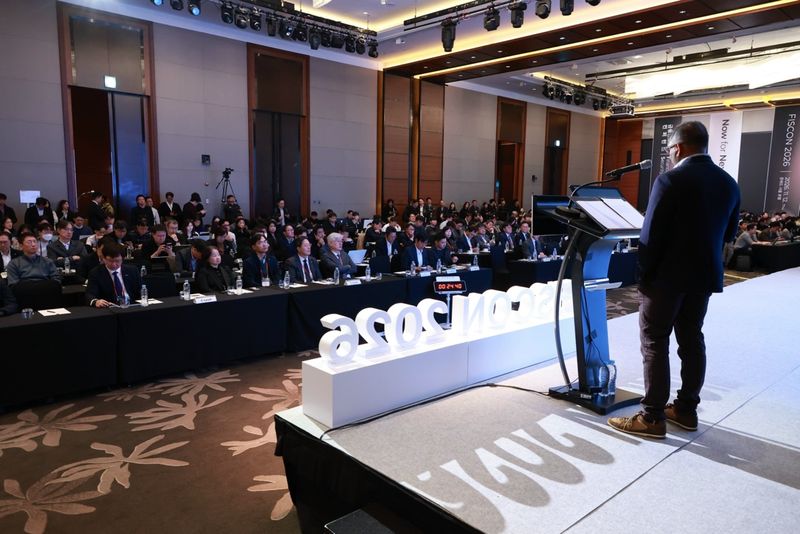
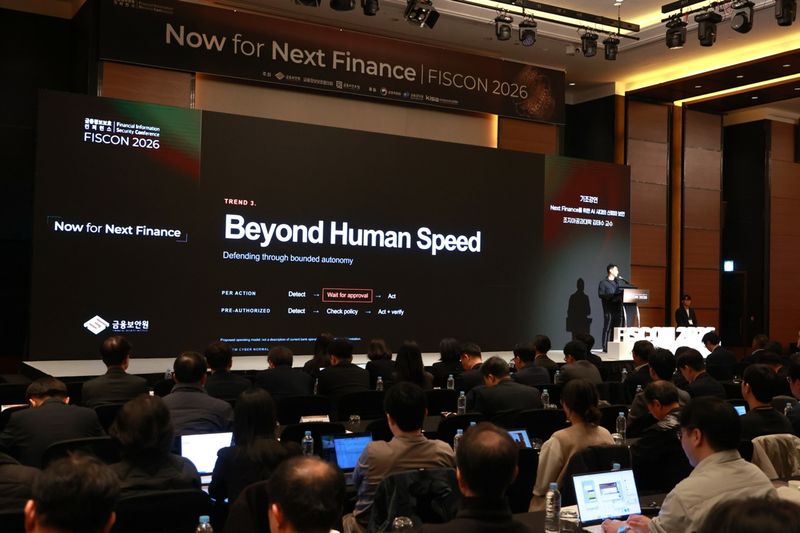
Kim Jin-hwi, an executive vice president at NAVER Cloud, who gave a special lecture at the Financial Information Security Conference (FISCON 2026), held at the Conrad Hotel in Yeouido, Yeongdeungpo District, Seoul, on the 12th, said, “Even NAVER Cloud can’t be sure our network is secure. It’s hard to know whether an actual hack has happened without our realizing it, or whether there simply hasn’t been an attack yet.” It was a candid assessment that even Kim, who oversees security at NAVER Cloud, is unsettled by the wave of AI-powered cyberattacks.
Security staff work overtime every day
“If we don’t use AI, we can’t survive any longer,” Kim said. “Patching a vulnerability takes two or three months when done by people, but with AI it can be done in 45 minutes.” He added, “Some practitioners are considering leaving because the burden of security work has grown,” and “every employee on every team is working more than 52 hours a week.”
NAVER Cloud is therefore looking for ways to improve time efficiency. It is working to build a system that uses AI to find vulnerabilities early while also preventing them from spreading after an intrusion. To avoid relying on overseas AI models, it has formed a consortium with 44 institutions, including the Financial Security Institute, to develop AI specialized in cybersecurity. The plan is to apply it to the financial sector and establish an AI security framework encompassing both attack and defense. Kim said NAVER Cloud had already invested 200 billion won in building the system. The results of the second performance evaluation are expected to be released in February 2027.
Kim said, “As OpenAI has already disclosed to the media, swarm attacks are becoming a reality,” adding, “The term ‘swarm attacks’ sent me into a state of real panic.” He continued, “It has already come to light that an AI that went rogue, with hacking as its only playbook, carried out an actual hacking attack involving 700 agents. If South Korea lacks the ability to withstand attacks involving 1,000 or more—or 10,000 or more—agents in the future, that would literally be a cyber pandemic.”
Kim added, “The financial sector will be the first target of attacks,” explaining that “China was the most common among past attackers, and finance was the sector they targeted.” At the conference, calls were made to change how hacking incidents are handled. As AI-powered vulnerability discovery and attacks accelerate, the financial sector must not stop at completely preventing intrusions; it must also ensure that damage does not spread when an attack occurs.
Attackers target just one vulnerability
In his keynote address, Professor Kim Tae-su of the Georgia Institute of Technology in the United States said, “AI-based tools are already showing vulnerability-discovery capabilities on a par with professional hackers.” He said the number of bugs Microsoft found and fixed using AI had risen from 70–80 a month to 2,000.The problem is that discovered vulnerabilities can be used in real attacks. Professor Kim said AI could enable even people without professional training to attempt attacks at the level of skilled hackers in the past. Attackers need to find only one vulnerability, while defenders first have to determine whether that vulnerability affects their own systems. “The moment a human gets involved, it’s already a losing game,” he said, explaining that “the longer the process takes for people to assess and approve each step, from finding a vulnerability to responding to it, the harder it may be for defenses to keep up with the speed of attacks.”
Illumio Vice President Raghu Nandakumara added, “Attacks using AI happen at machine speed, so people can’t keep up with them by detecting and responding at human speed.” He continued, “What matters now is not ‘how quickly can we detect an attack?’ but ‘how far can it spread?’”
He recommended that “financial institutions design their security systems on the assumption that a breach is possible.” In an environment where connections between systems have multiplied through cloud services, AI, SaaS, remote development and open banking, the focus should be not on stopping every attack but on determining how far an attacker could move if a breach occurred and how quickly they could be stopped. To that end, he proposed zero-trust and microsegmentation strategies that map connections between systems and allow only essential access. “You should identify what needs protection, such as payment services, and allow only the connections necessary for business functions and assets—not based on IP addresses or infrastructure,” he said.
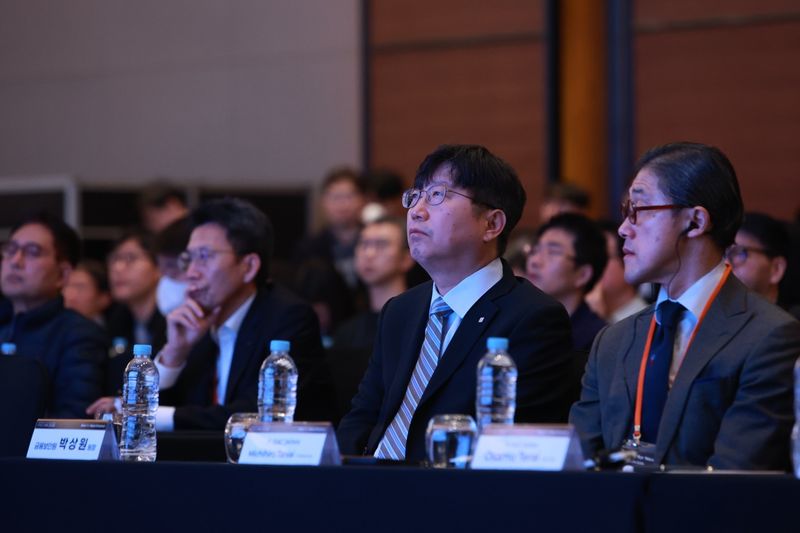
Shortly after the event began, Financial Security Institute President Park Sang-won formally apologized for the data leak that occurred on the 9th. “We are thoroughly investigating whether there have been any further leaks and the cause of the incident,” he said. “We will comprehensively inspect all systems and develop fundamental measures to prevent a recurrence.” He apologized again, saying, “We will take this incident as a lesson, make further thorough improvements across our information-protection systems, and continue to support the security of the financial sector.”
[email protected] Park Mun-su Reporter