Oh Se-hoon calls government’s real estate policy “a disaster,” blames it for surging rents
- Input
- 2026-11-12 16:22:17
- Updated
- 2026-11-12 16:22:17
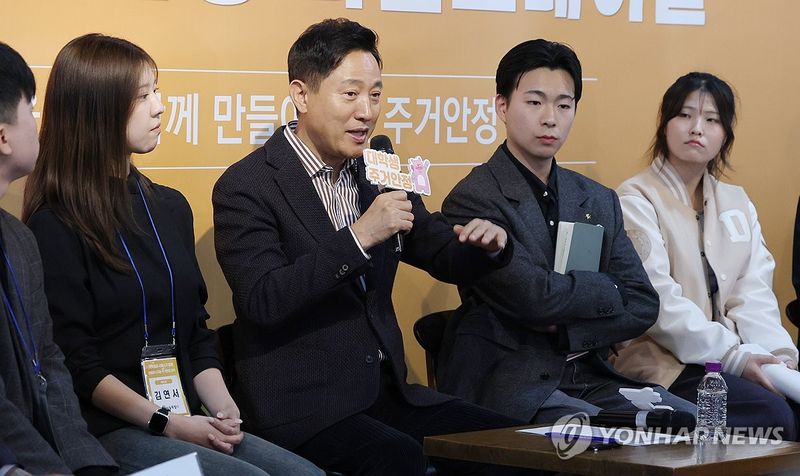
[Financial News] Seoul Mayor Oh Se-hoon strongly criticized the government’s real estate policy, saying it was driving up jeonse and monthly rental prices.
Mayor Oh said at the “University Student Housing Stability Roundtable,” held at Wonheung Hall at Dongguk University on the 12th, that policies placing excessive emphasis on owner-occupancy were adding to instability in the rental market, as he discussed housing issues with university students.
University students, landlords and experts attended the roundtable to discuss the burden of rising monthly rents and maintenance fees, as well as ways to expand the supply of housing for young people.
When a student asked how the Seoul Metropolitan Government would respond to rising jeonse and monthly rental prices, Mayor Oh identified the government’s owner-occupancy-focused policy as a major cause of the price increases, criticizing it as “policy failure, policy disaster.”
Mayor Oh pointed out that taxes imposed on landlords and various regulations could ultimately increase tenants’ housing costs. He said the government was not properly considering how the market works, adding, “The president is the only one who doesn’t understand this simple principle. It’s like talking to a brick wall.” He also said the Seoul Metropolitan Government would focus its policy efforts on expanding the housing supply as much as possible.
When university students complained that their housing conditions had worsened as monthly rents and maintenance fees had risen together in recent months, he also proposed expanding support for young people’s housing costs. Some said they had to choose older housing to cut costs or work longer part-time hours to cover their living expenses.
Mayor Oh said an amendment to the relevant ordinance was being pursued to allow maintenance fees to be covered in addition to existing monthly rent support, and that support would begin in the second half of next year.
He also stressed the need to secure local government funding to expand support for young people. In response to a request to prioritize support for university students, Mayor Oh said, “Support focused on university students would provoke social resistance,” but added, “We will adjust budget priorities so that you (young people) can enjoy greater benefits.”
Mayor Oh went on to emphasize that local governments need sufficient fiscal capacity to meaningfully expand support for young people.
The Seoul Metropolitan Government plans to continue its existing monthly rent support program while expanding its coverage to ease young people’s housing costs. The Youth Monthly Rent Support Program, launched in 2020 for 5,000 people, expanded to 36,000 people in 2022 and 44,000 in 2024; 32,000 people received support this year. The income eligibility threshold was raised from 120% of median income to 150% or below, and the maximum deposit for eligible homes was increased from 50 million won to 80 million won.
The Seoul Metropolitan Government is also pursuing financial support to reduce the upfront housing costs of Youth Safe Housing residents. It included funding in its 2027 budget proposal for a program providing interest-free support of up to 45 million won toward deposits.
The Seoul Metropolitan Government is also accelerating efforts to expand the housing supply. Under its youth housing stability measures announced last March, it plans to supply 74,000 homes tailored to different life stages over the five years from 2026 to 2030.
By the end of September this year, about 11,000 youth housing units had been supplied, reaching 84% of the annual target of 13,000. These included 7,586 Youth Safe Housing units and 2,565 Mirinae House public housing program units, among others.
Seoul-style shared housing for university students is set to provide 6,000 units by 2030. Acquisition reviews have been completed for 540 units—more than double this year’s public acquisition target of 250—and purchase agreements are expected to be signed by the end of the year.
The Seoul Metropolitan Government is also pursuing the development of “Youth Future Town” using large, underused sites. It plans to designate the site of the former National Institute of Health as the flagship project site and gradually develop youth housing, employment and startup support facilities, and cultural and leisure spaces at four locations, including Shinnae Vehicle Depot, Susaek Vehicle Depot and Tancheon Water Reclamation Center.
Landlords and experts who attended also said that stricter requirements for taking out rental deposit guarantee insurance following jeonse fraud cases, along with heavier taxes on owners of multiple homes, were putting pressure on studio apartments to switch to monthly rentals and pushing rents upward.
Mayor Oh said, “We will incorporate the opinions you shared today into the housing policies the Seoul Metropolitan Government is pursuing,” adding, “We will ensure a continuous supply of housing for young people so that their housing ladder can be restored, and pursue comprehensive support for housing costs.”
[email protected] Seong Cho-rong Reporter