‘Drugs detected instantly in five minutes, even in urine mixed with waste products’: AI-nanotechnology platform developed
- Input
- 2026-11-12 15:26:10
- Updated
- 2026-11-12 15:26:10
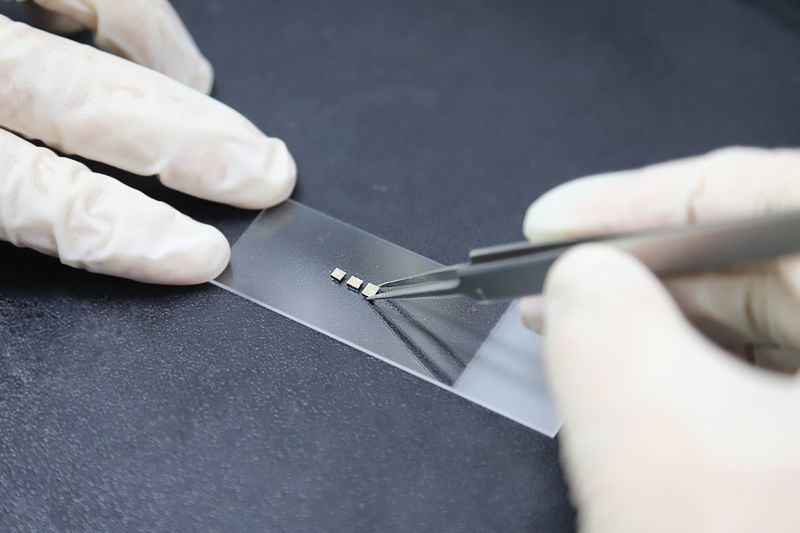
[Financial News] A platform has been developed that can detect drug use with 80% accuracy, even in urine mixed with other drugs and waste products. Detection is possible in just five minutes using a single drop of urine.
The Korea Research Institute of Bioscience and Biotechnology announced on the 12th that a research team led by Dr. Im Eun-gyeong of its Bio-Nano Research Center had jointly developed a nano-AI diagnostic platform with Professor Kim Tae-hwan of Daegu Catholic University, Professor Lee Jun-hee of Seoul National University Bundang Hospital, and the Stone Lab AI Research Center. The platform can precisely analyze urine without any chemical pretreatment and determine whether drugs have been taken in just five minutes.
Conventional confirmatory drug tests can produce accurate results, but samples must undergo multiple processing steps and be analyzed with specialized equipment. On-site rapid test kits, by contrast, offer the advantage of quick results, but their accuracy is limited—for example, when sample volumes are small or they react incorrectly to other drugs with similar properties.
The research team developed a nano-substrate capable of amplifying the faint optical signals emitted by drug compounds by several million times or more. By densely arranging tiny pillars like blades of grass on a thin gold plate and roughening its surface, the team made the characteristic optical vibrational signals of drug molecules emerge strongly when they land on the substrate, enabling even trace amounts of drug compounds to be clearly identified.
The team also used an artificial intelligence model (LightGBM) to precisely distinguish the unique “signal fingerprint” produced by drugs from ordinary signals in the complex waveforms found in urine. This overcame a technical limitation that had made it difficult to isolate drug compounds from the various waste products and pharmaceutical metabolites in urine.
Tests using actual urine samples showed that the AI-powered platform could accurately identify positive drug results with around 80% accuracy, even in urine from people who had taken painkillers or combination medications. Experiments in rats also demonstrated that drug compounds could be analyzed in urine collected within six hours after the drugs were administered.
The achievement is considered significant because the researchers secured core foundational technology that combines the advantages of conventional large-scale precision analyzers and rapid test kits, enabling fast and precise on-site drug testing using just a drop of urine, without pretreating the sample. Once further developed into a portable, compact measuring device, the technology is expected to be widely used in a range of medical and forensic fields, including on-site drug enforcement by investigative agencies and rapid diagnosis of drug intoxication in hospital emergency rooms.
Dr. Im Eun-gyeong, the study’s lead researcher, said, “This study demonstrates that nanotechnology and explainable AI algorithms can be combined to classify drug compounds precisely and quickly, even in complex bodily fluids.” The researcher added, “I expect the technology to be further developed into a portable diagnostic device suitable for field use, potentially ushering in a new paradigm for on-site drug enforcement and emergency diagnosis.”
The findings were published in the September 2026 issue of the international journal ACS Measurement Science Au (IF 14.7).
[email protected] Yeon Ji-an Reporter