“Companies Should Be Allowed to Choose Rather Than Face an Excessive Extension of the Retirement Age” [1st Senior Industry Conference]
- Input
- 2026-11-12 19:07:57
- Updated
- 2026-11-12 19:07:57

[Financial News] A warning has been issued that the government's push to raise the retirement age to 65 could instead deepen employment polarization between large companies and SMEs and even shrink job opportunities for young people. Given the stark differences in employment conditions between large companies and SMEs, forcing through a uniform increase in the retirement age could have the adverse effect of benefiting only permanent employees at large companies. Japanese experts, whose country entered a super-aged society before South Korea, recommended designing a system that allows companies to choose ways to extend employment according to their individual circumstances, rather than raising the statutory retirement age.
■“An excessive extension of the retirement age is poison for SMEs”At a panel discussion at the “2026 fn Senior Industry Conference,” hosted by Financial News at Bankers' Hall in Jung District, Seoul, on the 12th, MJ Kim, a senior researcher at NLI, recommended introducing a system that allows companies to choose, rather than pursuing an excessive retirement-age extension policy.
Explaining why caution is needed about extending the retirement age, Kim, the senior researcher, said, “If the retirement age of 60 is being properly observed, as in Japan, there may be a need to consider raising it to 65. But in Korea, the actual retirement age is around 50, and many people look for short-term jobs afterward.” He added, “If the retirement age is extended excessively, large companies with labor unions may be fine, but SMEs without unions could instead find themselves in an even more difficult situation.” He continued, “This could lead to differences in retirement ages among companies.”
Kim Gyeong-seon, president of the Korea Population, Health and Welfare Association and moderator of the discussion, also noted, “Although there is much discussion about uniformly raising the retirement age to 65 or older, given the wide gap between large companies and SMEs, mandatorily extending the retirement age at the large companies and public institutions that young people want to work for would have a greater impact on youth employment than in Japan.”
Japan, in fact, has allowed companies to choose how to extend employment—by raising or abolishing the retirement age, or rehiring workers after retirement—instead of uniformly raising the statutory retirement age to 65. Conflicts have sometimes arisen during reemployment as wages and working conditions decline, but there are also many cases in which companies have sought solutions by reforming job and pay systems while increasing youth recruitment.
Korea's business community has raised concerns about extending the statutory retirement age, citing Japan's experience. Last March, the Korea Enterprises Federation visited Japan's Ministry of Health, Labour and Welfare, the Japan Business Federation (Keidanren), and local companies to study policies on employing older people and the status of measures to secure their employment. It highlighted a system in which reemployed workers accept wage cuts, companies revise their pay systems, and the government subsidizes part of the wage reduction. It then called for labor and management to be allowed to choose an approach autonomously through consultation, arguing that a statutory extension of the retirement age could lead to fewer jobs for young people.
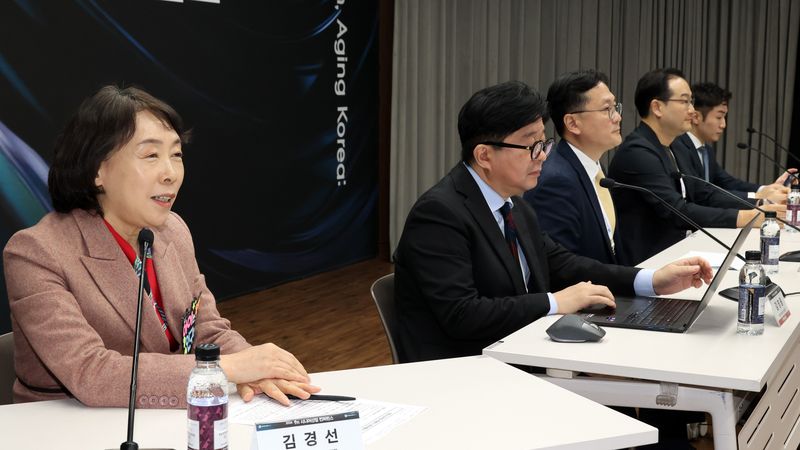
Kim Ik-yong, a professor at Wonju Yonsei Medical Center, criticized the lack of infrastructure, saying, “We need to help older people with financial means maintain their health, directly assess their needs, and connect them to industry. The shape of an aging society may differ from previous predictions as a result, but we lack health and medical infrastructure to prepare for these changes.” Oh Sang-hwan, a professor in the Department of Dental Hygiene at Konyang University and president of the Korean Academy of Oral Hygiene Management, said, “There are wide disparities in eldercare and residential facilities, so universal programs need to be proposed.”
Park Jun, a director at IMM Private Equity, recommended easing regulations so ownership and operations can be separated. “Franchising eldercare facilities currently requires large-scale development and real estate ownership, which entails significant risk and makes investment less attractive,” he said.
On eldercare facilities, Lee Man-hee, chair of the National Assembly's Health and Welfare Committee, and Kim Jin-oh, vice chair of the Presidential Population Strategy Committee, who attended the conference, also raised the need for institutional improvements, including expanded financial support.
However, some said that actual demand for senior housing, including “silver housing,” remains uncertain because, beyond institutional shortcomings, many people strongly prefer to stay in their own homes. Cho Yong-beom, CEO of KB Golden Life Care, said, “In Korea, people have a strong preference for staying in their own homes, so it is not easy to give away the home they own and move into a senior residence. Many people who use our facilities also keep a separate home and go back and forth.”
[email protected] Kim Yun-ho, Kim Dong-chan, Lim Su-bin Reporter