Seoul to provide support for young people’s maintenance fees; interest-free deposit support of up to 45 million won also planned
- Input
- 2026-11-12 15:06:00
- Updated
- 2026-11-12 15:06:00
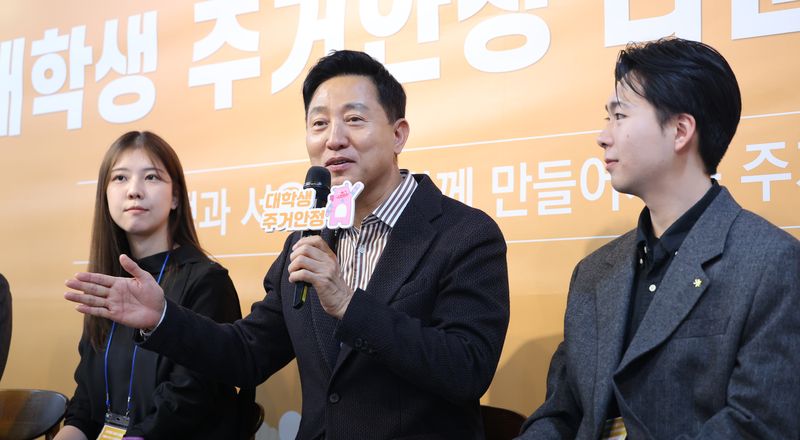
[Financial News] The Seoul Metropolitan Government plans to provide maintenance-fee assistance starting in the second half of next year to ease the housing-cost burden on university students and young people. It is also preparing a plan to provide interest-free support of up to 45 million won for deposits paid by residents of Youth Safe Housing. The Seoul Metropolitan Government said it held the University Student Housing Stability Roundtable on the 12th at Wonheung Hall at Dongguk University, with Seoul Mayor Oh Se-hoon, university students, landlords and experts in attendance.
The roundtable discussed the housing burden on university students amid rising monthly rents and maintenance fees, as well as ways to expand the supply of youth housing. Students described the difficulties of having to choose smaller, older homes or work more hours at part-time jobs because of housing costs.
Mayor Oh said the city would continue its existing monthly rent assistance for young people and pursue maintenance-fee support starting in the second half of next year. Funding for a program to provide interest-free support of up to 45 million won for Youth Safe Housing deposits was also included in the 2027 budget proposal.
The Seoul Metropolitan Government has expanded its monthly rent assistance for young people since launching the program in 2020 for 5,000 people. It provided assistance to 36,000 people in 2022, 44,000 in 2024 and 32,000 this year. It also eased the income eligibility limit from 120% to no more than 150% of median income, and raised the maximum deposit for eligible homes from 50 million won to 80 million won.
The city will also expand the supply of youth housing. Under its youth housing stability plan announced in March, the Seoul Metropolitan Government plans to supply 74,000 homes tailored to different stages of life over five years, from 2026 to 2030.
By the end of September this year, about 11,000 youth housing units had been supplied, reaching 84% of the annual target of 13,000. These included 7,586 Youth Safe Housing units and 2,565 Mirinae House public housing program units, among others.
The city plans to supply 6,000 Seoul-style shared housing units for university students by 2030. The Seoul Metropolitan Government has completed acquisition reviews for 540 units—more than double its public-purchase target of 250 units for this year—and plans to sign purchase agreements by year-end.
Shared housing will be supplied through various means, including public acquisition, donation to the public, public-private partnerships and private rentals. The city is also considering a public-private partnership in which the Seoul Metropolitan Government provides the land and the Korea Advancing Schools Foundation handles construction and operations. Public parking lots and unused railway land have been mentioned as potential sites.
The city is also pushing ahead with plans to develop “Youth Future Town” using large tracts of unused land. The Seoul Metropolitan Government plans to designate the former National Institute of Health site as a pilot project site and gradually develop youth housing, employment and startup support facilities, and cultural and leisure spaces at four locations, including Sinnae Vehicle Depot, Susaek Vehicle Depot and Tancheon Sewage Treatment Center.
Landlords and experts who attended the roundtable also said that stricter requirements for obtaining guarantee insurance introduced after jeonse fraud, along with heavier taxes on owners of multiple homes, were contributing to the conversion of one-room units to monthly rentals and putting upward pressure on rents. They called for policy changes to ease the burden of monthly rent.
Mayor Oh said, “We will incorporate the views you shared today into the housing policies the Seoul Metropolitan Government is pursuing,” adding, “We will ensure a steady supply of youth housing and pursue housing-cost support and other measures comprehensively so that young people’s housing ladder can be restored.”
[email protected] Seong Cho-rong Reporter