GS Caltex holds Production Division firefighting drill contest for 31st consecutive year ... bolsters safety capabilities
- Input
- 2026-11-12 15:03:02
- Updated
- 2026-11-12 15:03:02
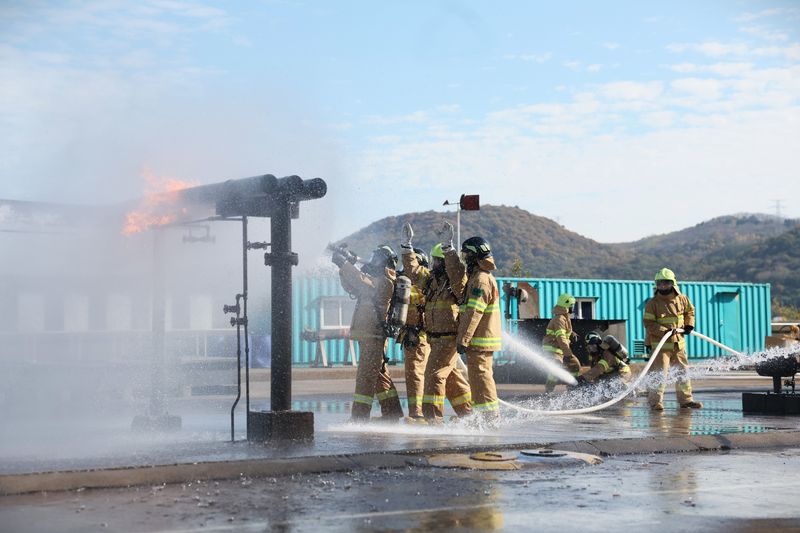
【Financial News, Yeosu = Hwang Tae-jong, reporter】GS Caltex has been conducting practical firefighting drills for the 31st consecutive year to prevent fires at its facilities, continuously strengthening its safety capabilities.
In particular, the company has recently been focusing on upgrading its smart firefighting and disaster prevention system through collaboration between advanced tracked robots and on-site personnel, drawing attention.
According to GS Caltex on the 12th, the company has held a firefighting training competition every year since 1992. This year, it again held the 31st Production Division Firefighting Training Competition that day at the firefighting training ground at its Yeosu Plant, preparing for complex emergencies such as fires, explosions and gas leaks. The cumulative number of participants has reached approximately 3,400.
Kim Seong-min, GS Caltex's CSEO/co-CEO and head of the Production Division, stressed, “Safety goes beyond how well we respond when an accident occurs; it starts with how thoroughly we prevent accidents from happening. Through the firefighting training competition, which has continued for more than 30 years, we are raising employees' safety awareness and on-site response capabilities.”
He added, “Along with firefighting drills, we also work to prevent fires through regular inspections for potential hazards in processes and equipment, safety training for employees, and joint emergency response drills with partner companies.”
Eight teams from production and support departments, comprising 72 employees, took part in this firefighting training competition and conducted a five-stage practical emergency response drill: reporting a fire, applying water with a portable monitor, forcible entry (shutting off a valve on a leaking pipe), rescuing casualties and performing CPR, and reporting that the fire had been extinguished.
Reflecting the characteristics of refining and petrochemical processes, the competition simulated a drum fire for Group A and an overhead pipe rack (O/H Pipe Rack Flange Gasket) fire for Group B. Participants tested their on-site response capabilities through advanced suppression drills, including forcible-entry tactics that minimize the time initial responders spend in hazardous areas when the risk of fire spreading and explosion is high. Scores combined the preliminary drills (30%) and the main competition (70%). External specialists in rescue and firefighting judged casualty rescue, CPR, and safety in hose and nozzle operation, among other areas, enhancing the evaluation's objectivity and expertise.
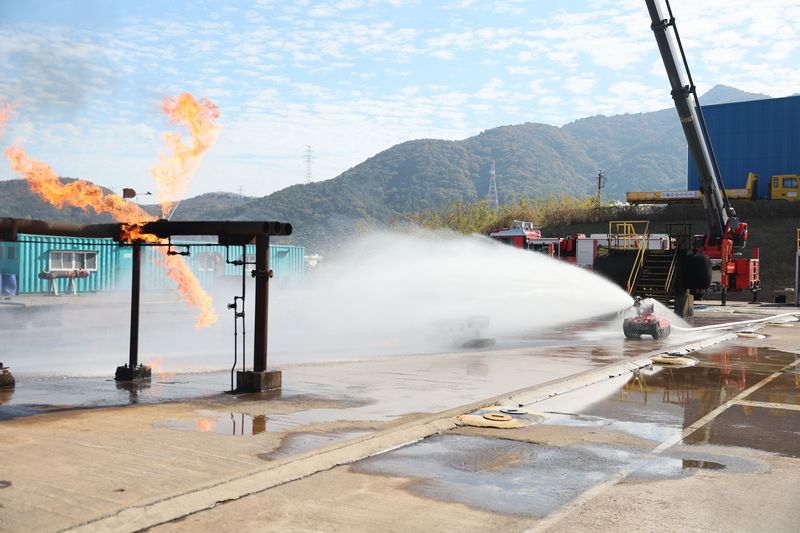
In particular, demonstrations of advanced firefighting equipment drew attention at this competition, including an emergency-response tracked robot approaching a fire site and spraying water precisely. The robot can be deployed in areas that are difficult for personnel to enter because of high temperatures, toxic gases or the risk of explosions.
Kim Seong-min, GS Caltex's CSEO/co-CEO and head of the Production Division, said, “Through collaboration between advanced robotic technology and skilled firefighting personnel, we reduced the risk of casualties and confirmed the potential for developing a smart firefighting and disaster prevention system. Going forward, we will continue to advance our firefighting equipment and emergency response systems to ensure comprehensive safety at our facilities in any crisis.”
In addition to its annual firefighting training competition, GS Caltex regularly conducts emergency-response mobilization drills involving all employees (at least eight times a year), emergency command system response drills (once every six months), and emergency evacuation drills at its facilities, including partner companies (several times each quarter), strengthening its prevention-focused safety management system.
[email protected] Hwang Tae-jong Reporter