Serious Crimes Investigation Agency’s case assignments mirror the Prosecution Service’s; external oversight remains a challenge despite added safeguards
- Input
- 2026-11-12 15:04:54
- Updated
- 2026-11-12 15:04:54
[Financial News] The Serious Crimes Investigation Agency assigns cases to units based on factors such as expertise and relevance, and allows the chief and other senior officials to directly designate units for important cases. The system resembles the one used by the former Prosecution Service, but safeguards have also been introduced, including recording the reasons for assignments and conducting regular reviews. However, because the chief and other senior officials are granted broad discretion, establishing an oversight system to ensure fair and transparent case assignments remains a challenge.
According to legal circles on the 12th, the Serious Crimes Investigation Agency adopted its Guidelines for Case Assignment Operations on the 7th of last month. The guidelines set out four basic principles for assigning cases: dedicated handling and expertise, relevance, reasonableness and fairness, and timeliness and appropriateness. Cases are assigned to units with the necessary expertise based on their nature, while cases related to existing ones are to remain with the investigation teams already handling them. The guidelines also require consideration of each unit’s caseload and case complexity, the number of suspects, and investigators’ workloads and capabilities.
Under the system, the chief and other senior officials designate the investigative bureau responsible for a case, and the bureau chief assigns it to a division or team. However, they may assign a case directly to a particular unit if it is closely related to an existing case, requires a high degree of expertise, attracts significant public interest or requires a swift investigation, or if they otherwise consider a direct assignment necessary. For important cases with major national or social ramifications, the reporting structure must be established at the same time as the assignment.
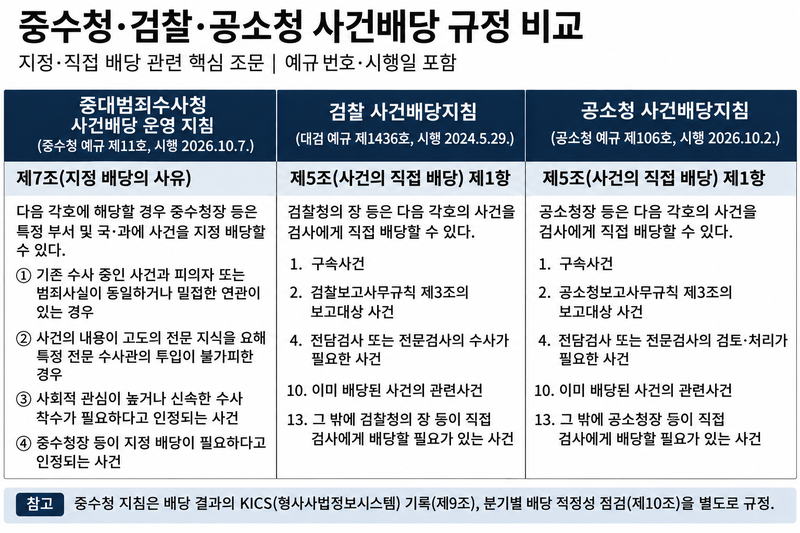
The Serious Crimes Investigation Agency has also introduced measures to improve transparency in case assignments. It records all assignment outcomes in the Korea Information System of Criminal Justice Services (KICS), including specific reasons for direct assignments and reassignments. The head of the case-assignment division reviews the allocation of cases across units every quarter and may recommend corrective action or reconsideration to the chief if an improper assignment is found.
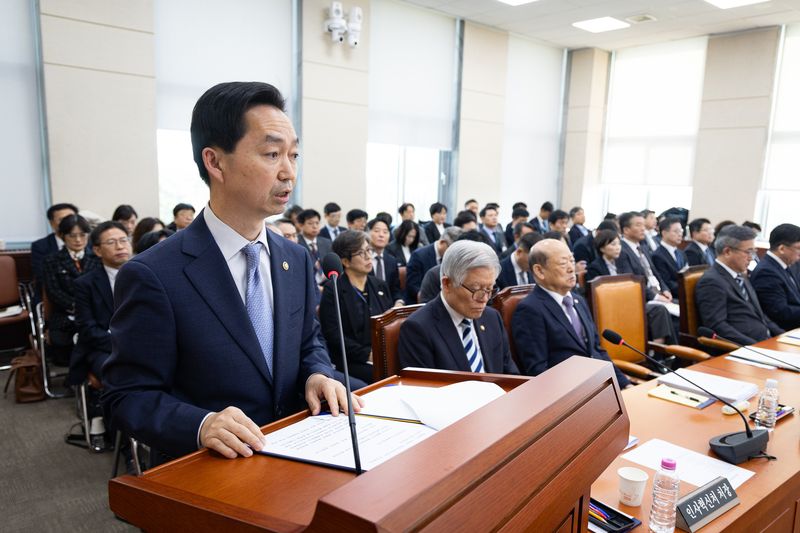
Kim Ji-yong, chief of the Serious Crimes Investigation Agency, also stressed the importance of fair case assignments in written answers to questions at last month’s National Assembly confirmation hearing. Regarding the assignment of individual cases, he said, “The chief’s involvement should be avoided as much as possible,” and added, “Even when the chief is involved, I will ensure that there is post-assignment review by upholding investigators’ right to object and making the inspector and the Investigation Review Committee function effectively.”
Experts said that direct assignments are necessary for efficient investigations, but that oversight of how discretion is exercised is also important. Yang Hongseok, an attorney at Igong Law Firm, said, “Some authority to make internal adjustments is necessary to ensure that cases are handled properly,” but added, “The question is how often and how forcefully it is exercised. It should be used only in cases where necessary.” On reviews of whether assignments are appropriate, he added, “The system needs to be improved so that substantive reviews of case content can be conducted, going beyond quantitative checks at the level of the head of the case-assignment division.”
Professor Lee Chang-on of Ewha Law School also said, “In investigations of serious cases, direct assignments are in some respects unavoidable, given the need to consider expertise and resource allocation.” He stressed, “What matters is transparency. A mechanism is needed to allow outside bodies, including the National Assembly, to scrutinize case assignment records through parliamentary audits and other means.”
[email protected] Choi Eun-sol Reporter