Unfazed by a shower of rook droppings, Ulsan’s Samho Bamboo Grove is a “natural hotel” for migratory birds
- Input
- 2026-11-12 14:52:03
- Updated
- 2026-11-12 14:52:03

【Financial News, Ulsan = Reporter Choi Soo-sang】 An analysis has found that the key reasons up to 110,000 rooks choose the Taehwagang River in Ulsan as their wintering ground are the optimal habitat at Samho Bamboo Grove and bamboo’s strong ecological resilience.
Seo Jeong-ho, a professor at Ulsan College, said as much in his keynote address at the forum “The Future and Coexistence of Ulsan’s Biodiversity in the Era of Climate Crisis,” held at the University of Ulsan on the 12th and hosted by the Ulsan Biodiversity Center.
According to the results of Professor Seo’s AI-based precise population survey, as many as 114,119 rooks visited Ulsan during the 2025–2026 winter season, as of the end of February. He cited four key reasons the rooks come to Ulsan each year: the safe communal roost in the dense Samho Bamboo Grove; abundant food—including fallen grain, earthworms and beetle grubs—in nearby farmland in Ulju County, Gyeongju and Yeongcheon; easy access to water along the Taehwagang River; and the ability to avoid predators by living in groups.
In his lecture, Professor Seo described Samho Bamboo Grove as a “natural hotel” for migratory birds. The dense bamboo grove blocks cold northwesterly winds and creates a microclimate that retains the flock’s heat, reducing the birds’ energy use at night. It also serves as a refuge that keeps predators such as Eurasian eagle-owls at bay, as well as an information hub where birds exchange information about feeding grounds for the following day.
In particular, Samho Bamboo Grove is a habitat used in rotation by different migratory birds depending on the season. In spring and summer (March–August), it serves as a communal breeding ground where about 8,000 individuals from seven species of herons and egrets, including grey herons, great egrets and little egrets, nest. In fall and winter (October–February), it becomes a communal roost for more than 110,000 rooks.
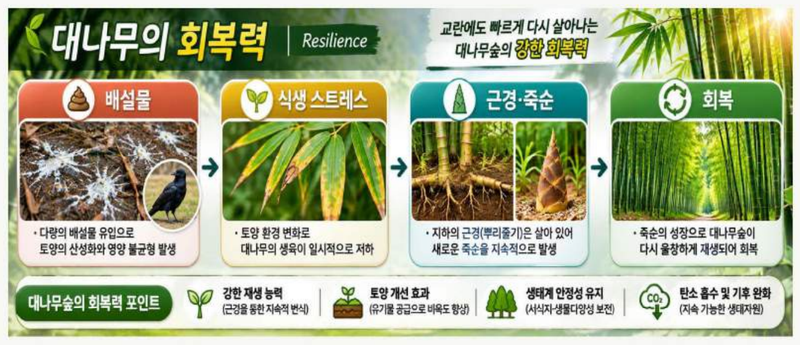
Bamboo’s inherent “resilience” was cited as the secret to keeping the grove healthy despite its year-round use by large numbers of migratory birds. Even when large quantities of bird droppings temporarily acidify the soil and hamper growth, the underground rhizomes remain alive, sending up new bamboo shoots the following year and restoring the dense grove. The droppings, which initially stress the vegetation, also break down into organic matter over time, helping enrich the soil.
Professor Seo said, “A city that migratory birds return to is an indicator of an ecological environment where people and nature can coexist. We should reduce everyday inconveniences such as droppings and noise while developing rooks into an ecotourism asset unique to Ulsan.”
[email protected] Choi Soo-sang Reporter