‘Alarm over falling cabbage prices’... Gwangju Special City steps up supply-and-demand stabilization measures
- Input
- 2026-11-12 13:39:49
- Updated
- 2026-11-12 13:39:49
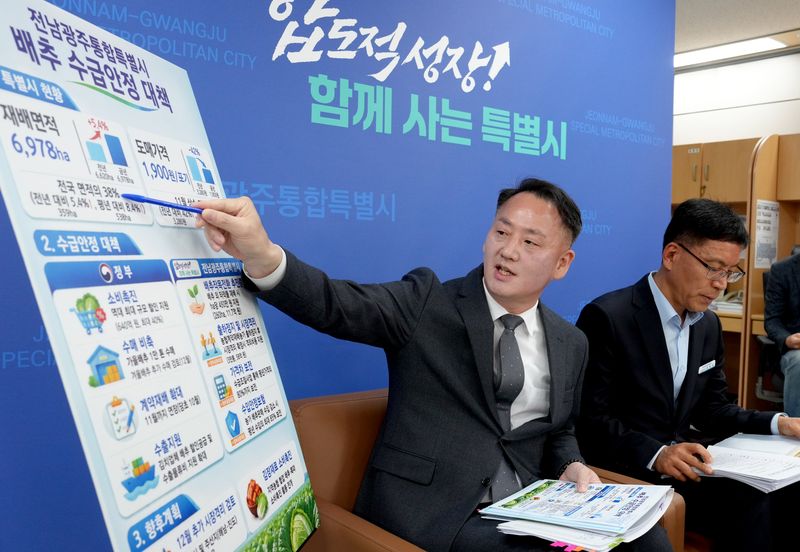
【Financial News, Jeonnam-Gwangju = Reporter Hwang Tae-jong】Jeonnam-Gwangju Integrated Special City (Gwangju Special City) is stepping up measures in coordination with the government to stabilize supply and demand and prevent cabbage prices from falling.
Key measures include support for suspending shipments, switching crops and boosting consumption, as the city plans to respond actively to price declines caused by increased cabbage production and weak demand during the kimchi-making season.
Son Myeong-do, director of Gwangju Special City’s Agriculture, Livestock and Food Bureau, said at a press briefing at the Muan government complex on the 12th, “As farmers face growing difficulties due to falling prices caused by an oversupply of cabbage, we will actively work to stabilize supply and demand through market withdrawals and efforts to boost consumption in coordination with government policies.”
According to Gwangju Special City, as of early November, the wholesale price of cabbage was 1,900 won per head, 42% lower than the same period last year and 32% below the average in a typical year.
In particular, the Korea Rural Economic Institute (KREI) forecasts that this year’s autumn and winter cabbage production will be up 3% and 11%, respectively, from the average in a typical year, raising concerns about an oversupply during the kimchi-making season.
To prepare for an oversupply of cabbage and encourage appropriate levels of cultivation, the city is carrying out a crop-switching project covering 260 hectares, with a budget of 1.2 billion won. It has also decided to provide 5.8 billion won in support for suspending shipments (market withdrawal) of 30,000 tonnes of cabbage in coordination with government measures. It also plans to offset operating costs through the Agricultural Product Supply and Demand Management Project (Agricultural Products Stable Production and Supply Support Project) and agricultural revenue stabilization insurance.
The city will also work with the Jeonnam Regional Headquarters of NongHyup Agribusiness Group Inc. on efforts to boost consumption, including sales promotions for local food and Nonghyup Hanaro Mart and discounts on kimchi-making ingredients. If prices continue to fall after the kimchi-making season, it will consider additional market withdrawals.
Son Myeong-do, director of the Agriculture, Livestock and Food Bureau, said, “From now on, we will do our utmost to ensure that the cabbage carefully grown by farmers receives a fair price through systematic supply-and-demand management from production through shipment.”
Meanwhile, the Ministry of Agriculture, Food and Rural Affairs had earlier announced measures to stabilize cabbage supply and demand. They include promoting kimchi-making season consumption nationwide; a record 64 billion won in discounts on agricultural and livestock products (up to 40%); purchasing and stockpiling 10,000 tonnes of autumn cabbage and considering additional stockpiling of winter cabbage; market withdrawal of 30,000 tonnes; expanding contract farming by NongHyup; and discounted supplies and export support for kimchi companies.
[email protected] Hwang Tae-jong Reporter