Jeonse and monthly rents buoy Seoul home prices; 2027 home-sale price gains forecast to slow to 3%
- Input
- 2026-11-12 14:00:00
- Updated
- 2026-11-12 14:00:08
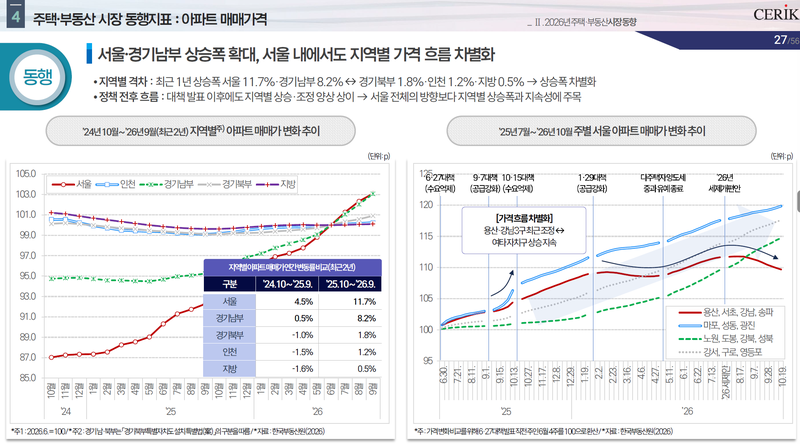
On the 11th, the Korea Research Institute for Construction Industry forecast that home-sale prices in the Seoul metropolitan area would rise 3.0% over 2027. That would be a smaller increase than this year’s annual forecast of 4.8%. It also forecast that the nationwide home-sale price increase would ease from this year’s projected 2.5% to 2.0% next year.
■ Homebuyer demand in Seoul to hold steady... interest rates and loan limits to constrain the pace of gains
The institute cited rising jeonse and monthly rents and homebuyer demand centered on Seoul as factors supporting home prices in the Seoul metropolitan area. Its analysis is that higher rental costs could push some demand into the home-sale market, helping to put a floor under prices.
However, it expects high mortgage rates and limits on borrowing to constrain buyers’ ability to make additional purchases, given that home prices have already risen substantially. It said there was also a possibility that listings could increase in response to policy changes, including tax measures, leaving the price outlook uncertain.
Differences are also expected within the Seoul metropolitan area, depending on the industrial base. The institute said that Suwon’s Yeongtong, Hwaseong’s Dongtan and Yongin’s Giheung, which are affected by the semiconductor industry, could see price trends diverge from those in nearby areas depending on factors that improve purchasing power, such as special pay.
■ High home prices keep households in the rental market... concern over rising jeonse and monthly rent burdens
The rental market is expected to face greater upward pressure than the home-sale market. The institute forecast that nationwide jeonse prices for homes would rise 4.5% next year, a larger increase than this year’s projected 3.6%.
On the supply side, it said the decline in housing starts in 2023 would lead to fewer completions and move-ins, making it difficult for new jeonse supply to increase sufficiently. It also cited the market’s shift toward owner-occupiers who own one home as a factor reducing the number of jeonse listings.
On the demand side, it expects households that have put off buying homes because of high sale prices, lending restrictions and interest costs to remain in the rental market. The result, it said, is greater upward pressure on prices as jeonse supply remains limited while rental demand holds steady.
The institute said that as the burden of raising a jeonse deposit grows, more renters could turn to monthly leases with a deposit, putting upward pressure on monthly rents. Its analysis is that instability in the rental market could support home-sale prices while also increasing housing costs for renter households.
However, the increase in move-in supply in the Seoul metropolitan area in the second half of next year is expected to ease upward pressure on jeonse prices to some extent. The number of multifamily housing units scheduled for occupancy in the Seoul metropolitan area will rise from 50,000 in the first half to 72,000 in the second half. The institute recommended distinguishing trends in individual areas, since supply and demand conditions vary by location and move-in timing, and also taking into account relocation demand from redevelopment projects and the available stock of rental housing.
■ Buyers await new-home subscription opportunities in prime Seoul locations... sales performance likely to hinge on price competitiveness
Demand from buyers waiting to apply for new homes in prime locations in Seoul and the wider metropolitan area is also expected to hold steady. Preference for newly built apartments and constraints on trading existing homes will support demand, but actual contract results could vary depending on sale prices and borrowing costs.
In particular, the institute expects application and contract results to differ between competitively priced complexes, including those in areas subject to the price ceiling system, and those without such an advantage. It emphasized that sold-out complexes and projects with unsold units could coexist even in the same area, making it important to distinguish application competition rates from actual contract results.
The number of nationwide approvals for multifamily housing sales next year is expected to reach 240,000 units, up from this year’s forecast of 230,000. However, the government’s target of 246,000 housing units supplied in the Seoul metropolitan area next year is based on construction starts and should be distinguished from the number of sales approvals or move-in units in that year.
Sunghwan Kim, a research fellow at the Korea Research Institute for Construction Industry, said, “It is necessary to monitor whether supply plans lead to actual construction starts and move-ins, and to develop policies tailored to regional demand and the housing cost burden on renter households.” He added, “In areas where demand remains strong but supply is insufficient, we need to address factors delaying new supply and redevelopment projects and manage short-term rental supply and demand.”
[email protected] Choi Ga-young Reporter