Foreign tourist arrivals in Korea top 20 million for the first time... Tourism spending up 47.7% in January–September
- Input
- 2026-11-12 13:00:52
- Updated
- 2026-11-12 13:07:50
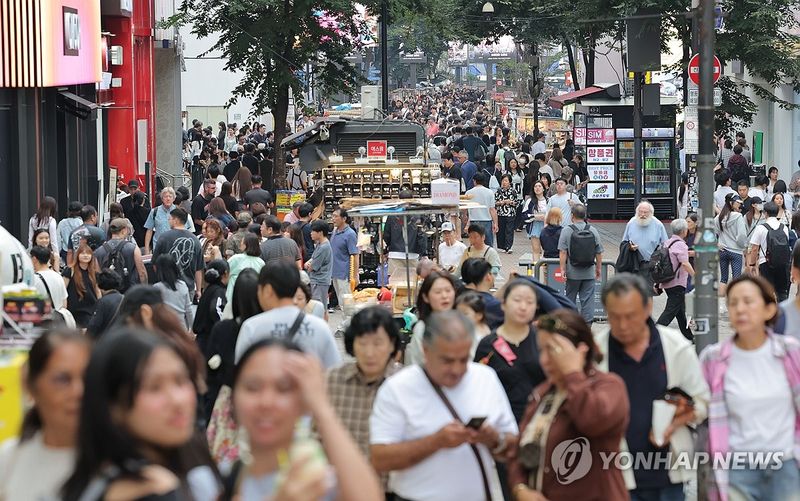
Annual arrivals to Korea, which stood at 17.5 million in 2019 before the COVID-19 pandemic, declined as the infectious disease spread, then recovered to 16.37 million by 2024. Last year, the total reached 18.94 million, a new annual record. On the 27th of last month, the MCST estimated that this year’s arrivals had surpassed that record. It forecast at the time that, if the upward trend continued, arrivals could reach 23 million by year’s end.
From January to September this year, foreign tourists spent 15.9416 trillion won by card in Korea’s tourism sector, up 47.7% from 10.794 trillion won in the same period last year. Arrivals over the same period rose 21.5%, from 14.08 million last year to 17.11 million this year. The increase in card spending was more than twice the increase in the number of arrivals.
By September, 3.24 million tourists had entered Korea through airports outside the capital region, including Gimhae, Jeju, Cheongju and Daegu, accounting for 19.0% of all arrivals. Arrivals through ports outside the capital region, including Busan, Jeju, Seogwipo, Yeosu and Gunsan, totaled 1.58 million (9.2%). Compared with the same period a year earlier, arrivals through airports rose 37.4%, while those through ports increased 14.5%.■ Hallyu’s spread and expansion of international flights at regional airportsThe MCST cited the spread of Hallyu as a factor behind the increase in arrivals. In the “2026 Overseas Hallyu Survey,” conducted with the Korean Foundation for International Cultural Exchange (KOFICE), 55% and 53% of respondents, respectively, said Korean food and beauty were popular in their countries. Those figures were similar to the shares for music (54%), television dramas (51%) and films (49%).
The survey was conducted among 27,400 people who had encountered Korean cultural content in 30 countries and regions overseas during November and December last year. The share who said Hallyu had a positive impact on their purchases of Korean products and services rose over the past three years, from 58% to 64% and then 65%.
At the 11th National Tourism Strategy Meeting on February 25, the government proposed improving immigration procedures, expanding international flights at regional airports and strengthening penalties for price gouging. The plans also included introducing expedited screening for cruise ships calling at multiple ports in Korea and expanding onboard screening for large cruise ships.
It also proposed launching domestic flights to regional airports and increasing their frequency to help arrivals at Incheon International Airport travel to other regions, as well as extending late-night airport bus routes to the Chungcheong and Gangwon regions.
Kim Dae-hyun, the MCST’s second vice minister, is scheduled to welcome arriving passengers at Incheon International Airport today. The MCST plans to hold a commemorative event, a meeting with tourism industry representatives, welcome events for passengers arriving at regional international airports, and events linked to the Korea Grand Sale.
MCST Minister Choi Hwi-young said, “We will work thoroughly to prepare our capacity to welcome visitors as we strive to reach the era of 30 million inbound tourists and move toward the 40 million era.”
[email protected] Jang In-seo Reporter