“Did I really do the right thing?” ... 27 Years of Kim Hu-gon, Former Chief of the Seoul High Prosecutors’ Office
- Input
- 2026-11-12 14:36:15
- Updated
- 2026-11-12 14:40:29
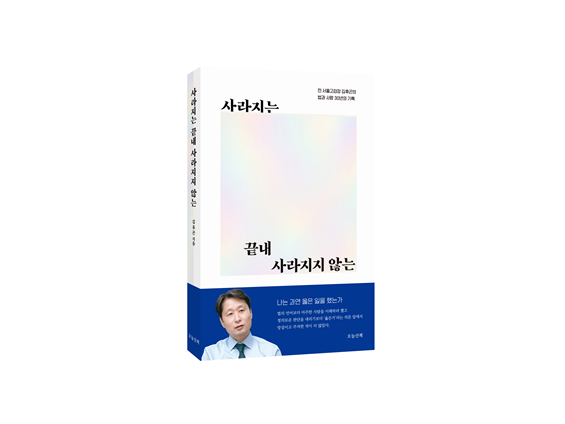
[Financial News] Kim Hu-gon, former chief of the Seoul High Prosecutors’ Office, said the first case that came to mind as he completed 27 years as a prosecutor was that of a taxi driver for whom he had sought an arrest warrant early in his career. The driver was detained for more than 10 days and released after another prosecutor identified the actual culprit. On the day of his release, Kim went to see him and apologized. The taxi driver said he was relieved to be able to return to work and repeatedly thanked the prosecutor who had cleared him of suspicion. He even smiled at the prosecutor who had sought a warrant for his arrest.
Kim’s essay, “Disappearing, Yet Never Quite Gone” (Oneul Sanchaek), recounts the people he encountered while working as a prosecutor and a lawyer, including the taxi driver he apologized to that day. He began his prosecutorial career in 1996 at the Northern Branch of the Seoul District Prosecutors’ Office and went on to serve as chief of Special Investigation Division 1 at the Seoul Central District Prosecutors’ Office, spokesperson for the Supreme Prosecutors’ Office, director general of planning and coordination at the Ministry of Justice, and chief of the Seoul Northern District Prosecutors’ Office. He retired in September 2022 after serving as chief of the Seoul High Prosecutors’ Office and now heads the criminal group at Lee & Ko.
“Did I really do the right thing?” is the question the author poses at the beginning of the book. He writes that as his career as a prosecutor progressed, so too did his doubts that some of the people involved in cases he handled might have been wronged. After becoming a division chief and then a chief prosecutor, he reviewed cases through the approval process. His recollection is that, even when the records raised suspicions, he usually ended up believing his judgment had been right. A fellow prosecutor found the mistake in the taxi driver’s case, but among the many cases he handled, there were some he could no longer even remember.
The book recounts circumstances that would have been hard to understand from the records alone. One day, while giving a lesson on obeying the law to girls who had run away from home, the author told them to understand their friends’ difficulties and share their pain. Only later did he realize that the girls sitting right in front of him were hungry. He hurriedly ended the lesson and prepared a meal for them. An elderly woman who used to come to the front of the prosecutors’ office reportedly stopped showing up the day after a prosecutor listened to her story for two hours and she said she had nothing left to wish for. The author writes that perhaps all she wanted was a chance to properly explain her circumstances to a government agency.
The book also looks back at the limits of the authority he exercised. When the wives of detained union officials at a shipbuilding company came to protest, he arranged for the officials to meet their families in his office. Several more meetings followed whenever he received word of another planned protest visit. The author writes that he believed it was important for the families to see one another face to face, but by the standards of the justice system, it was “an overreach and an unprecedented move.”
The book also records major events in modern Korean history that he witnessed at close hand. In 2004, while serving as a prosecutor in the Litigation Division of the Ministry of Justice during the impeachment trial of President Roh Moo-hyun, the author helped draft the government’s written opinion. When he was chief of the Seoul Northern District Prosecutors’ Office, he filed on his own authority for a retrial in the case of the late Lee So-seon, mother of labor activist Jeon Tae-il, who had been charged with violating the martial-law proclamation. Lee was acquitted 41 years later. He also recounts erecting a memorial in the forecourt of the Seoul Northern District Prosecutors’ Office in honor of three colleagues who died while in service. At the memorial service in December 2020, flowers sent by their families and colleagues lay on the dry grass.
While heading the Geochang Branch, the author took the stage with members of a local acoustic guitar club. He invited poets to the branch’s monthly staff meetings. As a high school student, he had found solace in a literary club while struggling to adjust to life in Seoul, and he remained close to music and literature throughout his years as a prosecutor. The book also includes the friendships he shared with acquaintances at his regular Chungmuro haunt, “Haengbokhan Gongwon Golbaengi,” his connection with the indie band Huckleberry Finn, and the story of a plum tree he secretly planted at the Supreme Prosecutors’ Office.
The issues he encountered after becoming a lawyer lead to questions readers might face in everyday life. The book considers how far the things a client confides in a lawyer should be protected, and what conversations on a mobile phone mean in an age when digital records serve as evidence in investigations. It also discusses what clients expect from a lawyer they retain and the problems a settlement can leave for the parties involved in a case.
Last October, the Prosecution Service was abolished and the Public Prosecution Office and Serious Crimes Investigation Agency (SCIA) were launched. The author, who says he had been skeptical of separating investigation from prosecution, identified political neutrality and expertise as key challenges for the new investigative agency. He also calls for investigative agencies to be able to question and review their own judgments. The name of the organization to which he devoted 27 years has disappeared, but the work of listening to people’s grievances and resolving them must continue—that is the meaning the author has put into the title of his book: “Disappearing, Yet Never Quite Gone.”
[email protected] Yu Seon-jun Reporter