Brother who left home at 16 during the Korean War returns to his hometown in Jeju after 75 years: “I cried endlessly, wondering if it was a dream”
- Input
- 2026-11-12 14:07:00
- Updated
- 2026-11-12 14:07:27
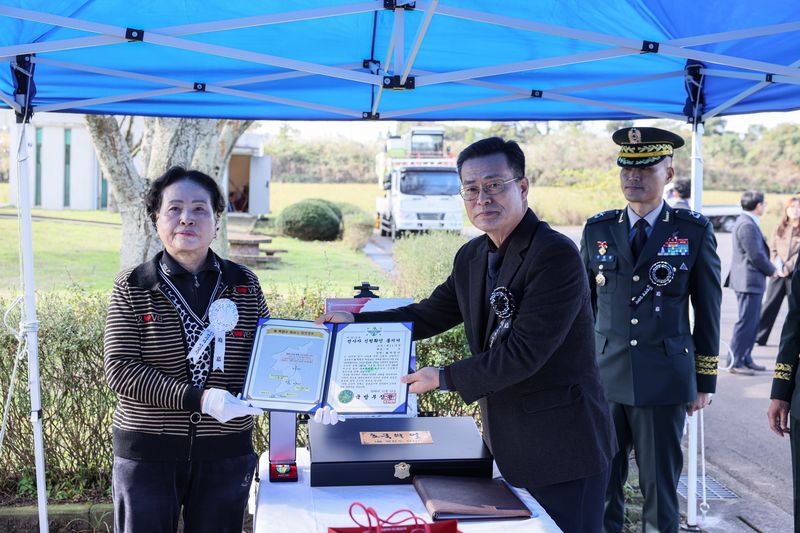
The Ministry of National Defense’s Agency for KIA Recovery and Identification (MAKRI) said it held an interment ceremony for the late Staff Sergeant Park Jang-su on the morning of the 12th at the National Jeju Patriots and Veterans Cemetery, attended by around 150 people, including bereaved family members, senior military officials, Jeju Province’s vice governor for administration and veterans’ organizations. Staff Sergeant Park is the 12th Korean War hero whose identity MAKRI has confirmed this year and the 280th fallen South Korean soldier to be returned to his family since the remains recovery project began in April 2000.
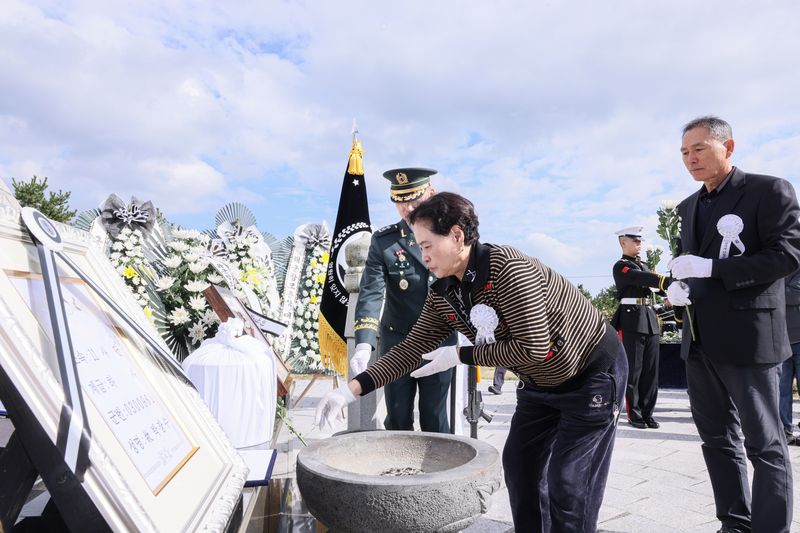
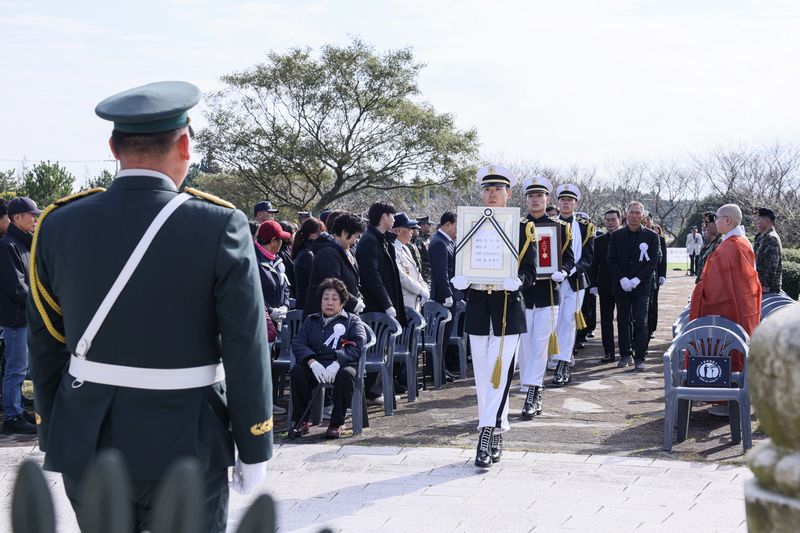
The interment ceremony was arranged with due honors in response to the family’s request to lay him to rest in Jeju, his hometown where he lived during his lifetime. Before the ceremony began, MAKRI head Jeon Byeong-hui presented the Hero’s Homecoming plaque, an identity confirmation notice and a “Spirit of Patriotism” box containing personal effects recovered from the site to the deceased’s youngest sister, Park Jang-suk (74), who represented the family. The solemn ceremony then proceeded with the arrival of the remains, a salute to the deceased, a memorial address, the laying of flowers and the burning of incense, a procession to the burial site, lowering the remains and covering them with earth, a rifle salute and a moment of silence.
Ms. Park, the youngest sister, who was born in 1952, the year after her brother was killed in action, and had never even seen his face during his lifetime, said, “When I heard that they had found my brother’s remains, I cried endlessly, wondering, ‘Is this a dream or reality?’” She added, “I will make sure he is laid to rest peacefully at the cemetery for fallen patriots in Pyoseon-myeon, where my brother lived. I am grateful to the Ministry of National Defense for finding his remains.”
The deceased was born in February 1935 in Pyoseon-myeon, Seogwipo City, Jeju Province, the eldest of nine children (five sons and four daughters). When the Korean War broke out, he volunteered for military service on September 1, 1950, at the age of 16. Assigned to the 11th Division of the Republic of Korea Army, he was deployed the following year, on May 13, 1951, to the “Yangyang-Ganseong Advance Operation.” He fought fiercely against the enemy and was killed in action. In recognition of his service, the government awarded him the Hwarang Order of Military Merit in 1954.
The “Yangyang-Ganseong Advance Operation (May 26–31, 1951),” in which the deceased was killed, was the UN forces’ third counteroffensive. It was launched to advance to the “Kansas Line,” running from the Imjin River through Jeongok and Hwacheon Reservoir to Yangyang, after the 11th Division of the Republic of Korea Army blocked the retreat of communist forces that had infiltrated the central-eastern front and annihilated them.
The remains came to light thanks to clues from accounts by Korean War veterans and local residents. MAKRI received reports from residents who said, “We heard there was a battle and that villagers had buried the remains of South Korean soldiers.” Based on those reports, a specialist recovery team was deployed in September 2011 and recovered partial remains, including a femur and tibia, in the area around Sinseonbong in Dowon-ri, Toseong-myeon, Goseong County, Gangwon Province.
However, because no family DNA samples were available at the time, his identity could not be confirmed for nearly 15 years. The breakthrough came through the persistent efforts of MAKRI’s family-tracing team. To improve the identification rate for fallen soldiers from Jeju, MAKRI conducted a special “Jeju Island Family Intensive Search” in March, dispatching 11 investigators. A DNA sample was collected from Mr. Park’s younger sister during the search, leading to confirmation of his identity through a blood relative after 75 years.
MAKRI head Jeon Byeong-hui said, “I express my deepest respect for the noble sacrifice and devotion of the deceased, who left his hometown at a young age and willingly gave his life on an unfamiliar battlefield in Gangwon Province,” adding, “I hope he can now at last rest in peace in his hometown, by his family’s side.”
MAKRI stressed that the public’s active interest and participation are urgently needed to identify Korean War fallen soldiers who gave their lives for the Republic of Korea but have yet to return to their families.
Family members of Korean War fallen soldiers can provide DNA samples at public health centers and military hospitals nationwide. A reward is paid if an identity is confirmed. Those who have difficulty visiting a facility can request an in-person sample collection by contacting MAKRI’s main number.
[email protected] Lee Jong-yoon Reporter