Intel to Build a “K-AI Full-Stack” Ecosystem, Partnering with 23 Korean AI Companies
- Input
- 2026-11-12 15:17:00
- Updated
- 2026-11-12 15:17:02
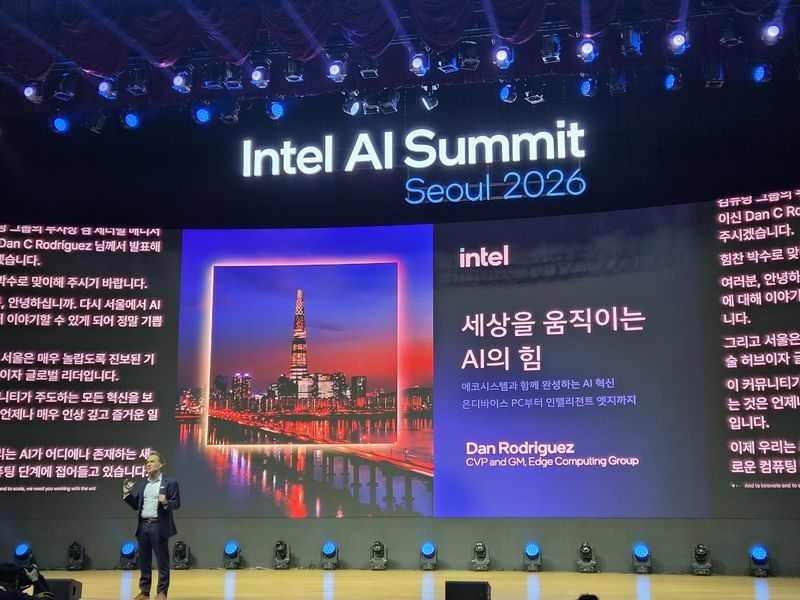
Intel Korea held the “2026 Intel AI Summit Seoul” at COEX in Gangnam District, Seoul, on the 12th, sharing its AI technology strategy and examples of industry-specific applications. The event drew 52 companies from Korea and abroad, along with five government and public institutions. Major participating companies included Lenovo Group Ltd., LG Electronics, SK hynix, SK Telecom Co., Ltd. (SKT) and Samsung Electronics.
23 Korean Companies Join...AI Technology Partnership Launched
Intel Korea held a launch ceremony that day for the “K-AI Full-stack Alliance,” aimed at strengthening the technological competitiveness of Korea’s AI industry. Twenty-three companies joined the alliance as founding participants. Its goal is to build a Korean AI technology ecosystem encompassing sovereign AI and physical AI. The participating companies plan to cooperate on hardware, software, and industry-specific AI solutions and services.Intel Korea focused on establishing a foundation for cooperation among companies so they can respond to rapidly evolving AI technologies and the needs of industrial settings. The aim is to strengthen the foundations of the AI ecosystem around domestically made servers and enhance the technological competitiveness of Korean companies.
In his opening remarks that day, Intel Korea President and CEO Bae Tae-won said, “Intel considers it very important to grow alongside Korea’s AI ecosystem.” He emphasized, “The launch of the K-AI Full-stack Alliance is a commitment for Korean companies to create new innovations with AI sovereignty, on open infrastructure and an ecosystem based on domestically made servers.”
Intel Korea also signed a memorandum of understanding (MOU) with the Seoul AI Hub to support the technological competitiveness and growth of Korean AI startups. The two sides plan to strengthen promising Korean AI startups’ capabilities in solution development and validation, and expand opportunities for technical cooperation.
In congratulatory remarks, Lee Do-gyu, head of the Information and Communications Policy Office at the Ministry of Science and ICT, said, “It is highly significant that Intel is building open AI infrastructure together with Korean-made AI semiconductors and domestic server and software companies.” He added, “I hope this cooperation will expand step by step from technology validation to software collaboration and become a good model for Korean companies seeking to enter overseas markets.”
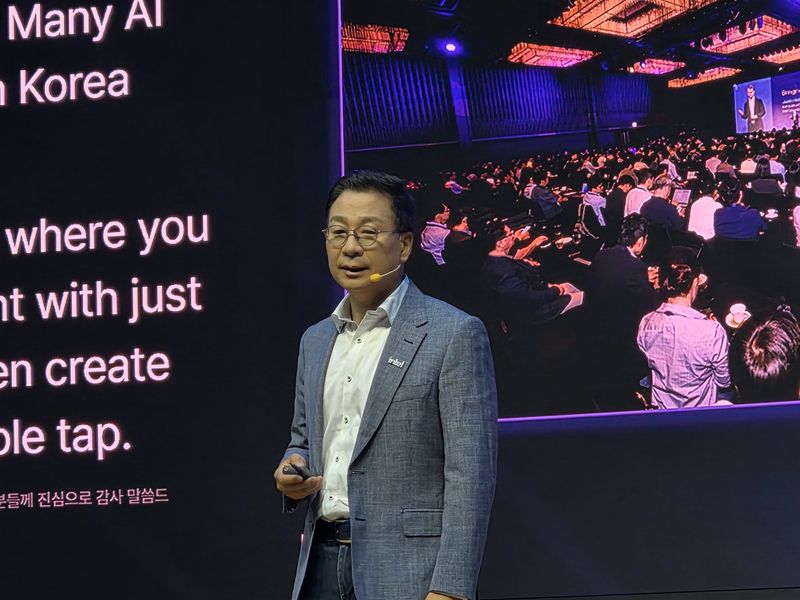
Spotlight on Korea’s Strengths in Semiconductors and Robotics...Global Cooperation to Expand
At the event, Intel outlined its technology strategy around five key areas: sovereign AI and heterogeneous AI infrastructure; application-specific integrated circuits (ASICs); edge AI and physical AI; and agentic AI and AI PCs.Santhosh Viswanathan, Intel’s regional head for Asia Pacific, identified sovereign AI and personalized AI as key areas for cooperation with Korea. He said that Korea’s memory semiconductor technology and AI infrastructure capabilities could be used to build AI systems suited to local conditions, and that there were also opportunities to cooperate on technologies that run AI on PCs and devices themselves.
Viswanathan said, “You do not need to directly control every infrastructure component to achieve true sovereign AI.” He emphasized, “There is an opportunity to use technologies in which Korea has strengths to build AI infrastructure suited to the country.”
Shin Kyu-sik, head of Lenovo Korea Ltd., who presented at the event, outlined a hybrid AI strategy with Intel that connects everything from AI PCs to data centers and the edge. Shin said, “What businesses need is not a single environment, but hybrid AI that flexibly connects the cloud, data centers and the edge.” He added, “Lenovo Group Ltd. and Intel will work together to build the foundation for the next era of AI.”
Dan C. Rodriguez, Intel’s corporate vice president and general manager of the Edge Computing Group, also discussed AI’s expansion beyond PCs into industrial settings and stressed the importance of cooperation among companies. He said, “AI is driving a transformation in computing, from PCs to the edge.” He added, “This transformation will be realized through open ecosystems, trusted partnerships and scalable platforms.”
[email protected] Yoon Hong-jip Reporter