Charges brought by the Special Prosecutor’s Team for Kim Keon Hee in ‘Butler Gate’ invalidated one after another by Supreme Court... “No connection to matters under investigation”
- Input
- 2026-11-12 11:25:24
- Updated
- 2026-11-12 11:25:24
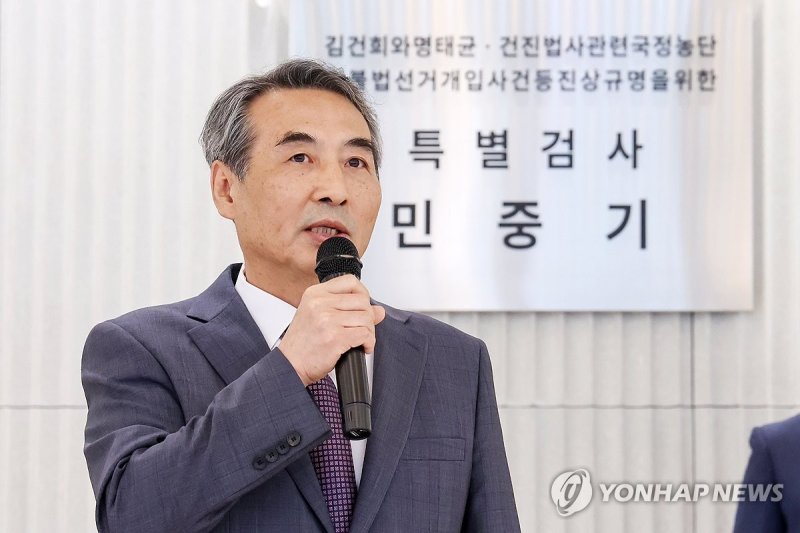
[Financial News] Kim Keon Hee’s Special Prosecutor’s Team (Special Counsel Min Joung-kie) has been found to have brought charges that, in significant part, fell outside its investigative mandate after uncovering them while investigating ‘Butler Gate.’ The court held that if a connection to the allegations under investigation is not established, the indictments themselves are invalid.
The Supreme Court’s Second Division, with Justice Kwon Young-jun as the presiding justice, on the 12th dismissed all appeals by the special prosecutor in the final appeals of five people, including Cho Young-tak, CEO of Bimaicar, who had been indicted on charges of breach of trust and embezzlement under the Act on the Aggravated Punishment, etc. of Specific Economic Crimes, occupational embezzlement, violating the Act on External Audit of Stock Companies, etc., instigating the concealment of evidence, and receiving or giving bribes in breach of trust. As a result, Cho’s acquittals on breach of trust, violating the external audit law, embezzlement under the pretext of a loan, and instigating the concealment of evidence became final, as did the dismissal of the remaining embezzlement charges and the charge of giving a bribe in breach of trust. An outside director identified as Min was acquitted, while the prosecutions of Jeong, the spouse of a person identified as Kim, and Kang, a former reporter for this newspaper, were dismissed. The only conviction that remained was that of a Bimaicar director identified as Mo, who was fined 7 million won for concealing evidence.
The special prosecutor began investigating in July last year allegations that a person identified as Kim, known as the ‘butler’ of former first lady Kim Keon Hee, had used personal connections to get investment companies to set up a fund, which then bought Bimaicar shares held by people affiliated with Kim, with the sale proceeds allegedly going to Kim. The investigation expanded to Cho Young-tak, who runs Bimaicar.
The charges fell into six main categories: △ breach of trust, on the allegation that Cho sent 3.2 billion won to two subsidiaries whose capital was entirely impaired under the pretext of a paid-in capital increase, causing losses to Bimaicar; △ violating the external audit law by allegedly falsifying financial statements to make it appear that the entire amount had been paid in cash; △ embezzlement, on the allegation that he took 2.43 billion won of the 4.6 billion won in proceeds from the sale of old shares under the pretext of a loan to himself; △ occupational embezzlement, on the allegation that funds from five companies run by Kim and from Bimaicar were siphoned off as salaries and service fees; △ instigating the concealment of evidence by allegedly having an employee hide a computer ahead of a search and seizure; and △ giving a bribe in breach of trust by allegedly handing Kang 83.82 million won in exchange for favorable articles.
The issue was how far these charges fell within the special prosecutor’s investigative mandate. Article 2 of the Kim Keon Hee Special Prosecutor Act defines the scope of investigation as the cases ‘related to’ the allegations listed in its subparagraphs, as well as ‘related criminal acts’ discovered during those investigations. On June 12, the Seoul Central District Court’s Criminal Division 21, presided over by Judge Cho Soon-pyo, dismissed the prosecution under Article 327, Subparagraph 2 of the Criminal Procedure Act in relation to occupational embezzlement and the receipt and giving of bribes in breach of trust, among other charges, saying it was “a prosecution brought by a person without the authority to bring charges.” The Seoul High Court’s Criminal Division 6-3, with Judge Min Dal-gi presiding, also dismissed all of the special prosecutor’s appeals on August 26.
The first-instance court gave three reasons. The funds embezzled were unrelated to the destination or use of the investment money mentioned in the allegations; there was a time gap between the alleged offenses and the arrival of the investment money; and the broad overlap in bank account transaction records alone was insufficient to establish that the evidence was common. As for the part concerning Kang, the court found that the alleged offenses began in March 2019, four years before the investment was solicited in June 2023, and therefore “could not be regarded as having been discovered through investigative findings necessary to clarify the allegations.”
The acquittals were also upheld, as in the lower court’s ruling. The breach-of-trust charge was deemed to fall “within the scope of reasonable managerial discretion,” given that the subsidiaries were platform companies actually engaged in technology development and that the relevant stakeholders had consented and the board had passed a resolution. Intent to violate the external audit law was not established because the accounting firm serving as the external auditor had not taken issue with the relevant item. As for embezzlement under the pretext of a loan, only Kim was entrusted with keeping InnoVest Korea’s funds, so Cho, who did not hold that position, could be an accomplice only if Kim’s embezzlement were established; however, Kim’s own embezzlement was not established. The Supreme Court had earlier finalized Kim’s acquittal and dismissal of the prosecution on July 16.
The Supreme Court ruled that there was “no error in overstepping the bounds of the principle of free evaluation of evidence or misconstruing the law on the scope of investigations under the special prosecutor act.”
[email protected] Kim Dong-gyu Reporter