Integrated Jin Air’s March launch confirmed after MOLIT and KFTC approvals
- Input
- 2026-11-12 15:00:00
- Updated
- 2026-11-12 15:00:07
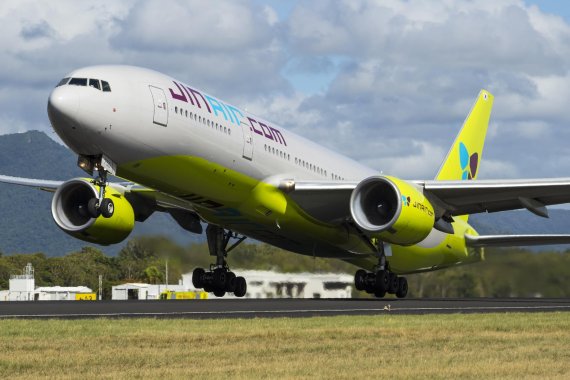
[Financial News] The Ministry of Land, Infrastructure and Transport (MOLIT) and the Korea Fair Trade Commission (KFTC) approved the merger of Jin Air, Air Seoul and Air Busan on the 12th. This confirmed that integrated Jin Air will launch on March 17 next year.
MOLIT and the KFTC decided that day to grant merger approval and approve the business combination filing, respectively, for the integration of three low-cost carriers (LCCs), including Jin Air.
MOLIT said the merger met review requirements, including capital adequacy, financial capacity, the soundness of the business plan, corporate governance and whether registered executives were foreign nationals. Its decision also took into account the licensing standards under the Aviation Business Act, expert reviews by the Korea Transport Institute (KOTI) and accounting firms, and the opinions of a merger advisory panel made up of industry and consumer representatives, as well as employment, legal and accounting experts. The merger received final approval after passing even the license advisory meeting.
The KFTC also approved the business combination filing for integrated Jin Air. It determined that the merger would not restrict competition, since Jin Air, Air Seoul and Air Busan are all Hanjin Group affiliates.
MOLIT did, however, impose certain conditions. Jin Air must complete, before integration, an inspection of changes to its safe-operation system in accordance with the plan it submitted, as well as obtain approvals from foreign aviation authorities. It must also report monthly on whether it is implementing its consumer protection plan.
MOLIT plans to ensure that Jin Air carries out its “Busan Second Hub Development Plan” without disruption. The aim is to strengthen Busan’s aviation conditions rather than weaken them, dispelling concerns that Air Busan, a carrier based in Busan, will disappear when integrated Jin Air launches.
Key measures include increasing international routes at Gimhae International Airport from 28 to 33 and raising weekly flight frequencies from 281 to 339. The plan also calls for adding more aircraft based in Busan, introducing routes departing from Busan and developing Gimhae International Airport into an independent maintenance hub. It will also retain existing employees and expand the professional workforce, including cabin crew and aircraft mechanics.
Pressure to develop Busan as a second hub is expected to continue even after integrated Jin Air takes off. The government faces the task of revitalizing regional airports, while political circles in Busan and South Gyeongsang need a carrier based there.
MOLIT is also preparing follow-up measures in response to the growing scale of Hanjin-affiliated airlines. Park Jun-sang, head of MOLIT’s Aviation Industry Division, said of the planned integration of Korean Air and Asiana Airlines as full-service carriers (FSCs) on December 17, and the merger of the three LCCs, “We will strictly manage and supervise the process of integrating and operating each airline to ensure that no safety issues arise and consumer convenience is not diminished.”
One of MOLIT’s management and oversight measures is to foster competing LCCs. The launch of integrated Korean Air and integrated Jin Air will increase the scale of Hanjin-affiliated airlines. Integrated Korean Air will become, in effect, the only FSC among Korean carriers, while integrated Jin Air will rise to become the largest LCC.
[email protected] Kim Yun-ho Reporter