South Korea and Vietnam Hold Seminar in Ho Chi Minh City on Cooperation in Energy and Offshore Plant Services
- Input
- 2026-11-12 14:41:57
- Updated
- 2026-11-12 14:41:57
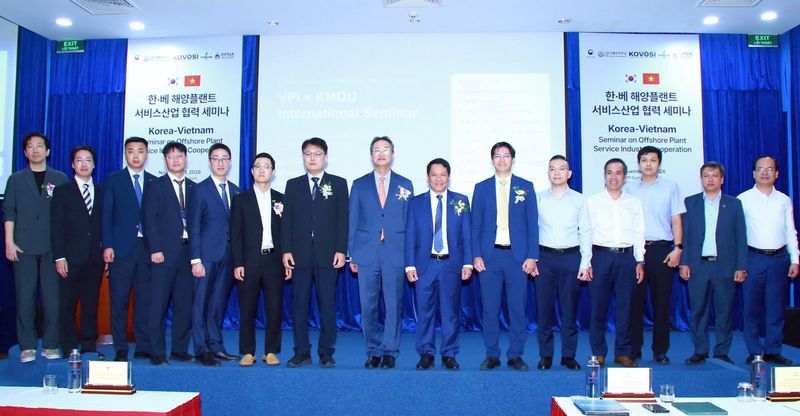
【Hanoi, Vietnam—Correspondent Kim Jun-seok】Korea Maritime and Ocean University (KMOU) is joining forces with the Vietnam Petroleum Institute (VPI) to strengthen practical cooperation between South Korea and Vietnam in energy transition and offshore plant services.
According to local media reports and other sources on the 12th, Korea Maritime and Ocean University held the Korea-Vietnam Offshore Plant Services Industry Cooperation Seminar jointly with the Vietnam Petroleum Institute (VPI) in Ho Chi Minh City on the 11th. The seminar was organized to share medium- and long-term forecasts for Vietnam’s energy market and South Korea’s experience in infrastructure and technology development, and to identify potential opportunities for cooperation around three key agenda items: liquefied natural gas (LNG) and gas; offshore technology and new energy; and ways for institutions and companies in the two countries to jointly pursue projects.
Consul General Jeong Jeong-tae said at the event, “Vietnam is pursuing two goals at the same time: securing a stable energy supply to support economic growth and transitioning its energy system toward carbon neutrality.” He added that “the offshore plant services market is expanding as demand continues for the maintenance and repair of existing offshore facilities, alongside major energy projects such as the Block B–O Mon gas field development project and the development of new oil fields.”
Consul General Jeong continued, “South Korea has global competitiveness in the design, fabrication, transportation, offshore installation and project management of ships and offshore plants.” He stressed that “if South Korea’s technological capabilities and project management expertise are combined with Vietnam’s understanding of local conditions and industrial base, new business opportunities will be created not only in the maintenance, repair, modification and decommissioning of offshore structures, but also in offshore wind power.”
Pham Quy Ngoc, head of the Gas, Power and New Energy Division at VPI’s Petroleum and Gas Processing Research and Development Center, presented an outlook for Vietnam’s energy market and forecast, “Vietnam’s total installed power generation capacity is expected to reach 183–236 GW by 2030, while electricity demand is projected to double by 2030 and surge to four to five times its current level by 2050.” He also explained, “LNG, offshore wind power and nuclear energy will play central roles in the future energy mix, while the introduction of a competitive electricity retail market in 2027, the direct power purchase agreement (DPPA) system and the growth of the carbon credit market will provide broad opportunities for domestic and international investors.”
Major South Korean shipbuilding and energy companies took part in the event and presented advanced technology solutions. Ko Jin-gyu, a representative of Hanwha Ocean, presented modular LNG liquefaction technology designed to maximize fabrication and installation efficiency, as well as solutions for the design and construction of offshore wind turbine installation vessels and offshore substations.
Park Young-seok, president of Korea Gas Technology Corporation (KOGAS-Tech), drew on South Korea’s experience in building an LNG ecosystem to outline the potential for expanding cooperation into LNG bunkering services for ships, the use of LNG cold energy and hydrogen production. He emphasized the importance of closely linking supply chains, port infrastructure and ship demand. Yoo Mu-seong, a director at SB Seonbo, introduced technology for converting aging LNG carriers into floating storage and regasification units (FSRUs), underscoring the resulting reductions in investment costs and construction time compared with building new vessels.
Specific strategies for cooperation between the two countries were also presented. Cho Il-hyung, head of the ETRS Center at Korea Maritime and Ocean University, proposed four priority cooperation programs: LNG and FSRUs; offshore wind installation and supply chain development; decommissioning and recycling aging offshore structures; and training skilled personnel. The plan is to expand cooperation in stages under a 2026–2029 roadmap, beginning with the establishment of a cooperation framework and joint research, followed by the selection of pilot projects, supply chain development and the launch of full-scale projects.
VPI Deputy Director Phan Minh Quoc Binh said, “Cooperation with international partners, including South Korea, will generate enormous synergies in LNG, hydrogen, offshore wind power and offshore plant decommissioning.” He added, “The Korea-Vietnam Offshore Service Industry Cooperation Center (KOVOSI), established under a memorandum of understanding (MOU) between VPI and the ETRS Center at Korea Maritime and Ocean University, will serve as a key bridge linking research, technology and business in the two countries.”
[email protected] Kim Jun-seok Reporter