“Once you're chairman, we have to look after you even after you retire”... Financial holding companies pay billions of won in adviser and consultancy fees [Governance Reform]
- Input
- 2026-11-12 10:59:55
- Updated
- 2026-11-12 10:59:55
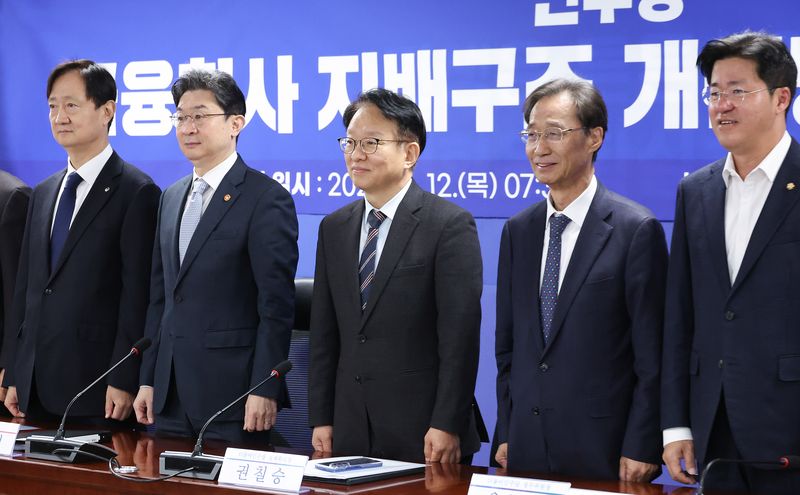
[Financial News] A special review of the corporate governance of eight major financial holding companies by the Financial Supervisory Service found that many had paid large advisory or consulting fees to retired chairmen over extended periods. The review once again confirmed that some financial holding companies continued providing financial support to former chief executives (CEOs) after they left office.
According to the results of a special review of the corporate governance of eight financial holding companies (KB, Shinhan, Hana, Woori, NongHyup, BNK, iM and JB), released by the Financial Supervisory Service on the 12th, one company paid a former chairman a total of 2.8 billion won in advisory fees over four years after the chairman left office. It also provided a separate special contribution payment upon retirement. The company appointed the former chairman to its advisory committee and paid an average of 700 million won a year. The review found that objective verification of the advisory work performed was insufficient. Another financial holding company appointed a former chairman as an adviser and paid an average of 400 million won a year for two years. When the contract was extended, there was no sufficient review of whether the additional appointment was appropriate. Some financial holding companies appointed retired outside directors as advisers or advisory committee members, paying up to 80 million won a year, or continued providing indirect support in the form of donations to academic societies, research institutes or universities with which they were affiliated.
An official at a financial holding company said, “Some overseas financial firms also keep former executives on after retirement in roles such as advisers,” adding, “Given the nature of the financial industry, where human talent is everything, this can also keep them from going to competitors.” The official added pointedly, “But it is different from Korea in that they keep records of the actual work and advisory services provided.”
Financial authorities plan to establish reasonable compensation standards when appointing former chairmen and others as advisers or advisory committee members, and to require disclosure of the amounts paid and the work performed. They are also pursuing a recommendation that compensation committees review whether compensation is appropriate. An official at a financial authority said, “The industry needs to overhaul on its own the unreasonable practices that have repeatedly occurred in CEO reappointment and retirement processes.” The official also outlined plans to improve the system to create a fair competitive environment, including systematically managing a standing pool of CEO candidates and giving external candidates time to prepare. This special review follows President Lee Jae Myung’s criticism last year of financial holding companies’ governance structures and the practice of chairman reappointments as a “corrupt inner circle.”
Meanwhile, the Financial Supervisory Service’s review found that outside directors’ role in checking management was also not functioning properly. Of the 6,100 votes cast on 993 agenda items handled last year by the boards and subcommittees of eight financial holding companies, only one was a dissenting vote by an outside director. There were also no cases of outside directors being replaced based on the results of 2024–2025 evaluations.
The review also uncovered cases in which people close to an incumbent chairman, such as the chairman’s doctoral adviser or former colleagues, were involved in the appointment and reappointment process, as well as cases in which negative questions were directed only at competing candidates or meeting minutes were amended after the fact to favor the incumbent chairman.
[email protected] Park Mun-su Reporter