Next-generation destroyer KDDX: South Korea’s homegrown integrated combat system, the “brain of the ship,” begins defect-free fielding
- Input
- 2026-11-12 11:07:30
- Updated
- 2026-11-12 11:37:38

The Defense Acquisition Program Administration (DAPA) said on the 12th that it had held an opening ceremony for the KDDX combat system’s Land-Based Test System (LBTS) at the Agency for Defense Development (ADD) Samcheok Maritime Research Center. About 100 key figures from the military, research institutions and local government attended, including Lee Nam-gyu, commander of the ROK Navy’s First Fleet; Lee Yong-tae, director of the Information Planning Staff at Navy Headquarters; Seo Hui-seon, head of ADD’s 5th Technical Research Institute; and Park Sang-su, mayor of Samcheok. They came together to mark the beginning of the “Korean Aegis” era.■ A “destroyer on land” spanning 6,700 square meters: zero trial and error, a hub for evolutionary developmentCalled the “brain” and central nervous system of a ship, a combat system integrates sensors such as multifunction radars and sonars, ship-to-air and ship-to-ship weapons, and communications and navigation equipment. It is a core weapon system that detects and tracks complex enemy threats in real time and engages them immediately. To respond without gaps to the growing threats posed by North Korean ballistic missiles and hypersonic anti-ship missiles, it is essential to ensure overwhelming processing power and flawless system reliability.
Built on an area of approximately 6,700 square meters (about 2,026 pyeong), the Samcheok LBTS is South Korea’s largest land-based verification facility, replicating on land the operational and electromagnetic environment of a destroyer at sea. Until now, if software conflicts or defects were found during sea trials after expensive, advanced equipment had already been installed aboard a ship, the hull might have had to be dismantled and modified, entailing enormous rework costs and the critical risk of delays in bringing the ship into service.
Before equipment is installed aboard a ship, the Samcheok LBTS will run numerous simulated engagement scenarios and extreme-load tests on land to identify and address 100% of defects in advance, eliminating such trial and error at its source. After equipment setup and stabilization, the facility will begin full-scale operations in 2027.
This facility is not merely a one-off test site for developing a single KDDX. DAPA plans to use it even after development of the KDDX combat system is complete as a permanent R&D platform for “evolutionary development”—identifying advanced technologies for future use aboard domestic ships and continuously upgrading their performance.■ Among the world’s few independent “Aegis-class” developers: building a flagship-class combat-system brain beyond the Daegu classMilitary and defense-industry experts view the opening of the test facility as a decisive turning point that places South Korea among the countries with independent technology for what is, in effect, a “K-Aegis” ship weapons system. Only a handful of countries worldwide have developed and deployed operationally, using their own software (source code), the highly complex combat systems that combine multifunction phased-array radars (MFRs) with large destroyer-class platforms to detect and track air, surface and underwater targets simultaneously and centrally control air-defense, anti-ship and ballistic-missile-interception weapons.
In fact, apart from the U.S. Navy’s Aegis system, only a handful of countries—including the United Kingdom, France and Italy, which jointly developed the air-defense system PAAMS, as well as China (the Chinese Aegis) and Russia—have independent destroyer combat systems. International military experts say that Europe’s PAAMS system has earned considerable confidence in the West for its precision interception technology and the maturity of its system integration. China and Russia, by contrast, are still said to face validation challenges compared with Western systems in the reliability of multisensor fusion under combat conditions and software stability, despite rapidly fielding systems and expanding their inventories in quantitative terms. If South Korea successfully completes the KDDX combat system, it is expected to mark a turning point in the country’s rise as a maritime defense power, achieving both world-leading software reliability and technological independence.
Our military’s efforts to develop domestic combat-system technology have already made considerable progress. Since the 2000s, combat systems successfully developed independently under the leadership of ADD and the domestic defense industry have been installed and are in operational service aboard the Navy’s mainstay Incheon-, Daegu- and Chungnam-class frigates, as well as Dosan Ahn Changho-class submarines.
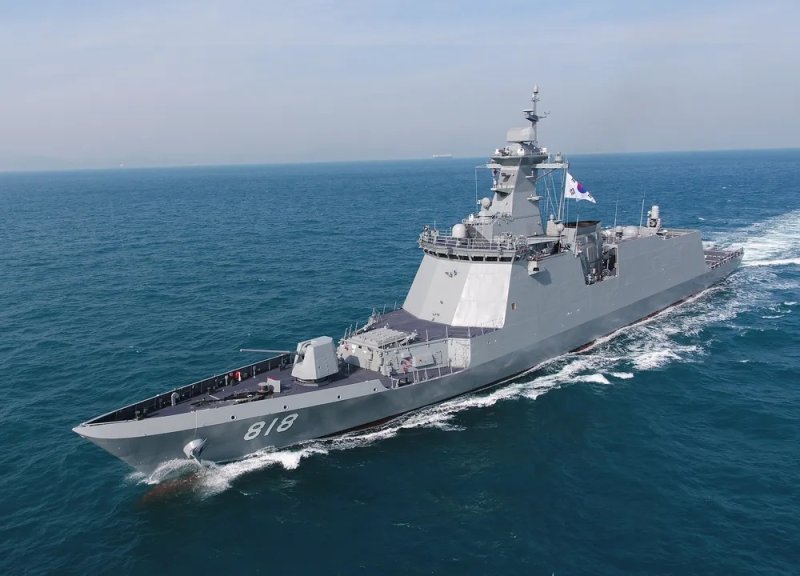
Whereas the systems used on existing Daegu-class frigates and other ships focused on the survival of individual vessels and on anti-submarine and anti-ship warfare—providing “individual-ship air defense” (protecting only the ship itself, with limited ability to provide an air-defense umbrella for all friendly ships and the fleet)—the KDDX combat system is a “flagship-class area air-defense brain” that directs the air-defense network for an entire fleet and intercepts multiple ballistic and hypersonic missiles simultaneously. Its data-processing speed, sensor fusion and level of automated engagement are on an entirely different scale. By eliminating reliance on foreign technology and securing the authority to upgrade performance independently, it is also expected to dramatically strengthen South Korea’s competitiveness in winning contracts in the global ship-export market.■ Key challenges include “ROK-U.S. Aegis joint interoperability”; Samcheok test facility to serve as strategic hubDefense-industry experts identify “interoperability in ROK-U.S. combined operations” as a key challenge that must be addressed for the successful development of an independent “Korean Aegis.” In the event of a contingency on the Korean Peninsula, there can be no gaps in real-time data sharing or tactical coordination if the ROK Navy’s KDDX and U.S. Navy Aegis destroyers are to operate as an integrated air-defense network.
The KDDX combat system is currently designed to fully support U.S. military and NATO-standard tactical data links (Link 16 and Link 22), enabling ROK and U.S. ships to exchange target locations and identification information in real time for combined operations. It is understood that LBTS infrastructure capable of replicating the same operational environment on land is essential to continuously upgrade interoperability software with the U.S. Navy’s Aegis system and regularly conduct simulated engagement tests in line with increasingly sophisticated combined tactical doctrines.
Ultimately, the Samcheok Land-Based Test System is expected to serve not merely as a domestic development testbed, but as a key outpost for verifying the reliability of future combined air-defense operations between the ROK and U.S. navies and leading the global standardization of Korean combat systems.
Jeong Jae-jun, head of the Force Buildup Program Bureau at the Defense Acquisition Program Administration, stressed, “The opening of this Land-Based Test System is highly significant because it supports the successful development of the KDDX combat system and establishes an independent foundation for us to verify the performance of ship combat systems ourselves.” He added, “We will actively support evolutionary development incorporating advanced technologies and performance upgrades, contributing to improved combat capabilities for our Navy and stronger export competitiveness for the K-Defense Industry.”
[email protected] Lee Jong-yoon Reporter