'Reduced to Rubber Stamps': Outside Directors at 8 Bank Holding Companies Cast Just One Dissenting Vote... A Mere 0.0164% [Governance Reform]
- Input
- 2026-11-12 11:15:05
- Updated
- 2026-11-12 13:15:23
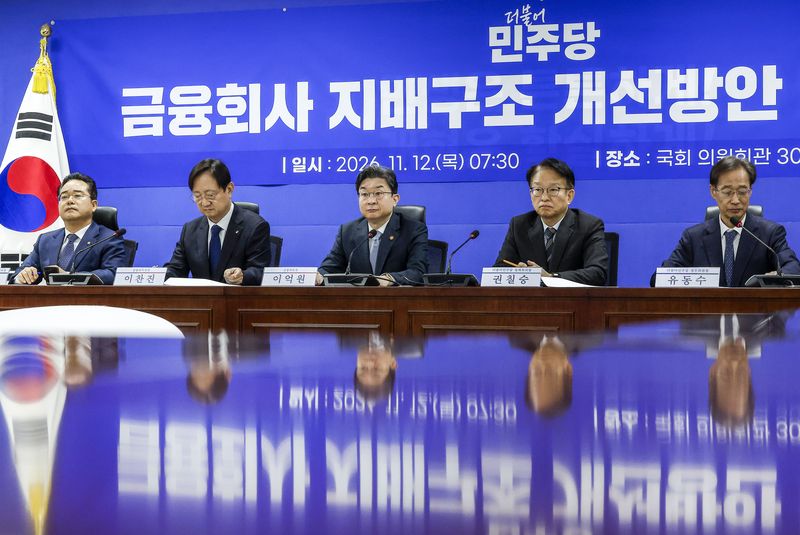
[Financial News] Outside directors on the boards of bank holding companies—often called “ownerless companies”—are supposed to keep management in check. But they cast a dissenting vote on an actual board agenda item just once out of 6,100 votes in total, according to figures compiled. Financial authorities have announced various measures to address the failure of outside directors to perform a meaningful oversight role. Financial firms maintain, “This is because when objections arise during prior consultations and discussions, the agenda item is not put forward in the first place; the checks-and-balances function is still being performed.”
According to findings on eight bank holding companies (KB, Shinhan Financial Group, Hana, Woori, NH NongHyup, BNK Financial Group Inc., iM and JB Financial Group) released by the Financial Supervisory Service on the 12th, the boards’ function of keeping management in check was found to be virtually nonoperational.
Financial authorities said that outside directors cast just one dissenting vote among the 6,100 votes recorded by boards and subcommittees last year. They also found that, because meetings were not recorded, board secretariats sometimes arbitrarily left outside directors’ remarks out of the minutes or added them after meetings at the request of individual directors. The management of board minutes was criticized as inadequate. The governance reform plan announced by financial authorities that day included a measure to keep verbatim transcripts documenting how discussions were conducted.
Outside directors received compensation close to 100 million won, along with benefits such as cars, drivers and health checkups, and some were found to have received financial support even after leaving office. In addition to base salaries of 48 million to 55 million won, they received position and meeting allowances. For each meeting they attended, they also received cars and drivers in addition to allowances intended to cover expenses. Some holding companies appointed former outside directors as advisers or to similar positions and paid them up to 80 million won a year, or indirectly supported them through donations to their affiliated academic societies, research institutes or universities.
The process for appointing outside directors also lacked transparency. Although the incumbent chair is not allowed to take part in their appointment, numerous cases were found in which people close to the chair were appointed without their independence being vetted, then took part in succession procedures and supported the chair’s reappointment. Most holding companies had no deliberation principles or criteria for appointing outside directors, or applied them only as a formality. Only a small number explicitly set and used targets for diversity in board composition.
Management of the standing candidate pool for outside directors was also inadequate. Although a large share of candidates were recommended externally, those ultimately appointed were mostly people recommended internally. Two of the eight holding companies had no cases of appointments based on recommendations from outside organizations. There were also cases in which a candidate recommended by an outside director was added to the final candidate pool that same day without a detailed assessment or eligibility review, then recommended as a final candidate 10 days later.
The CEO succession process also lacked objectivity and transparency. One bank holding company amended its internal corporate governance rules on the day before selecting its first-round candidate pool, after the succession process had begun, changing the age criterion for eligibility to remain in office and extending the incumbent chair’s reappointment term. It also required external candidates to submit succession-process applications within five business days. Most external candidates gave up applying because they did not have enough time.
At every stage of the succession process for the incumbent chair’s reappointment, all committee members voted for the chair’s reappointment as their first choice, and the grounds for their evaluations were not properly documented. Management of the Nomination Committee’s minutes was also inadequate.
Management of the standing candidate pool for potential contenders for the next CEO was also poor. The internal pool was managed with a focus on subsidiary CEOs, whose selection left considerable room for the incumbent chair’s views to be reflected. The external pool included people such as retired executives from other companies and former government officials, who were difficult to regard as genuine contenders; many declined to take part in the succession process.
Cases of financial support for former CEOs after they left office also came to light. Many holding companies appointed former chairs as advisers and paid them large sums over long periods without verifying their performance. For example, Holding Company A paid its former chair a large special service award upon retirement, then appointed the person as an adviser and paid an average of 700 million won a year for four years. Holding Company B appointed its former chair as an adviser and paid an average of 400 million won a year for two years, without discussing or reviewing whether the additional appointment was appropriate when extending the contract.
[email protected] Park Mun-su Reporter