Gangnam’s downturn pulls down Seongdong and Gangdong, while southern Gyeonggi rides semiconductor boom
- Input
- 2026-11-12 14:00:00
- Updated
- 2026-11-12 14:00:06
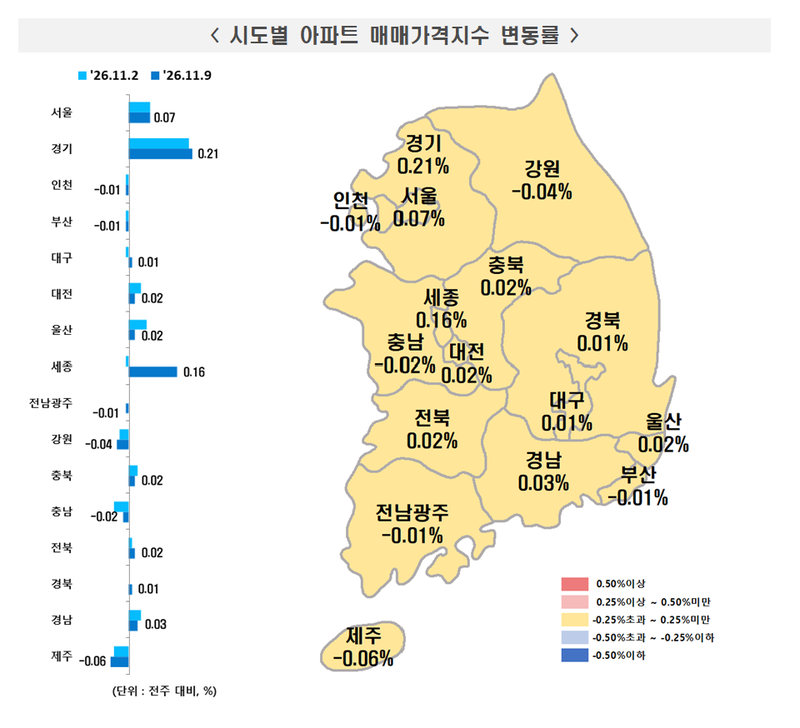
According to the Korea Real Estate Board on the 12th, Seoul apartment sale prices rose 0.07% in the second week of November (as of the 9th) from the previous week. They continued their upward trend for 92 consecutive weeks, though the rate of increase was unchanged from the previous week.
The shift to declines in Seongdong and Gangdong stands out in particular. Seongdong turned lower for the first time in 32 weeks, since the fifth week of March (-0.02%); Gangdong did so for the first time in 33 weeks, since the fourth week of March (-0.06%).
The downturn in Seoul’s three Gangnam districts also continued. Songpa fell 0.35%, substantially widening its decline, followed by Seocho (-0.26%) and Gangnam (-0.25%). Gangnam and Seocho’s cumulative declines this year stand at 0.49% and 2.27%, respectively. This contrasts with gains of 11.90% and 12.20%, respectively, over the same period last year.
The Gangbuk area led Seoul’s gains. Seongbuk District rose 0.39%, widening its increase from the previous week. It was followed by Gangbuk District at 0.32%, Dongdaemun District at 0.28% and Jungnang District at 0.27%.
Nationwide apartment sale prices rose 0.07%. The Seoul metropolitan area gained 0.14% and Gyeonggi Province rose 0.21%, while Incheon fell 0.01%.
The area with the highest increase nationwide was Giheung District in Yongin. Its gain widened from 0.60% the previous week to 0.63% this week. Yeongtong District in Suwon rose 0.60%, Dongtan in Hwaseong 0.56%, and Byeongjeom 0.47%. These areas are considered to be benefiting from the semiconductor boom.
Other areas also posted strong gains, including Gunpo (0.56%), Dongan District in Anyang (0.50%) and Wonmi District in Bucheon (0.40%).
Nam Hyuk-woo, a researcher at Woori Bank’s Real Estate Research Institute, said, "As people who have sold homes in southern Gyeonggi move up to higher-tier areas one after another, prices in the region’s higher-tier areas remain strong. However, high-priced areas in southern Gyeonggi that have overheated after sharp price increases over a short period are seeing relatively lower rates of increase."
Nationwide apartment jeonse prices rose 0.10%. They increased 0.16% in the Seoul metropolitan area, while Seoul and Gyeonggi each rose 0.17% and Incheon rose 0.11%.
[email protected] Choi Ga-young Reporter