[Exclusive] Real estate trust company wins another damages suit over missed construction-completion deadline ... ruling turns the tide
- Input
- 2026-11-12 15:27:17
- Updated
- 2026-11-12 15:45:19
According to industry sources on the 12th, the Seoul Central District Court recently dismissed the claim brought by Korea Investment & Securities Co., Ltd. (the plaintiff) in a lawsuit over damages for failure to meet a construction-completion obligation against KB Real Estate Trust (the defendant). Korea Investment & Securities had earlier sued the trust company, seeking payment of 15.6 billion won in loan principal and overdue interest over a failure to meet the completion deadline for a project in Pyeongtaek, Gyeonggi Province. The claim was based on the construction-completion agreement.
The agreement between the lender group and the trust company states that “if the trust company fails to fulfill its construction-completion obligation, it must compensate the lenders for the losses they incur (loan principal and interest, as well as overdue interest).” Construction completion means completing a building within a specified period. The completion deadline for the Pyeongtaek project was exceeded by 88 days.
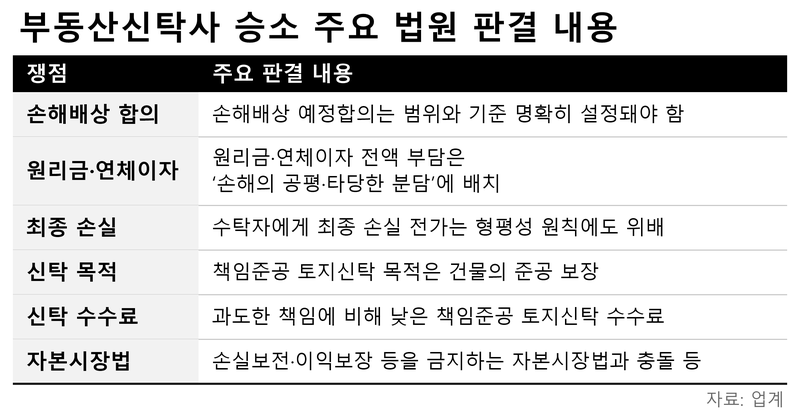
The court ruled in favor of the trust company. The key point was that it was insufficient to conclude that a provision requiring payment of the full loan principal and interest, as well as overdue interest, constituted an agreement on liquidated damages. The ruling states that such an agreement is possible only if a specific amount is fixed.
The court stated that “no specific provision was made regarding the reference date for determining the exact amount of the loan principal and interest and overdue interest,” adding that “if the parties had intended to enter into an agreement on liquidated damages, they would likely have included wording that specifically and clearly defined the scope and basis for calculating the amount.”
The court also stated that “the purpose of a responsible-completion land trust is to increase the likelihood that lenders will recover their loans through completion of the building. It is difficult to view it as directly guaranteeing repayment of principal and interest, as well as overdue interest, to the lenders, regardless of whether the building is completed or of the results of its disposal or operation.”
The court also cited the low trust fees earned by responsible-completion land trusts. It added that “if the agreement were interpreted to require payment of all loan principal and interest, as well as overdue interest, that would mean the trust company was taking on risk while receiving low compensation, which is difficult to accept.”
The court ruled that “for these reasons, it is difficult to regard full compensation for the loan principal and interest, as well as overdue interest, as an agreement on liquidated damages. Since the plaintiff has made no specific claims or submitted proof regarding the amount of actual losses incurred, we dismiss the plaintiff’s claim.”
In September, the court issued its first ruling that it was not reasonable to require a real estate trust company to unconditionally compensate a lender group for all loan principal and overdue interest, even if it had exceeded the completion deadline stipulated in its construction-completion agreement. With this ruling, the number of cases in which trust companies have prevailed has risen to two.
One industry source said, “When the first ruling in favor of a trust company came out, quite a few people viewed it as a ‘minority ruling.’ But with trust companies winning successive rulings, we believe there is a significant shift underway from decisions that had been uniformly in favor of lender groups.”
[email protected] Lee Jong-bae Reporter