LG CNS explores solutions for the future of physical AI with leading global robotics scholars
- Input
- 2026-11-12 10:00:00
- Updated
- 2026-11-12 10:00:00
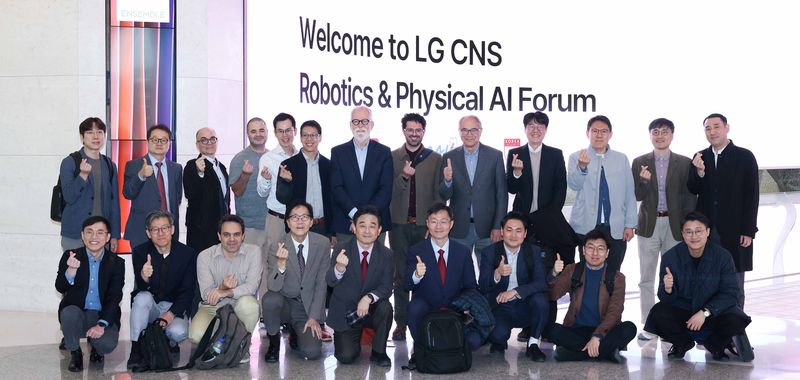
[Financial News] LG CNS held the 2026 Robotics & Physical AI Forum at its Future Robotics Lab at its Magok headquarters, where it discussed the industrial applications of physical AI and directions for its future development with leading robotics scholars from Korea and abroad.
According to LG CNS on the 12th, the forum shared the latest research and demonstration efforts in core physical AI technologies, including robot foundation models (RFMs), data, intelligent robotic hardware and simulation, and discussed technical challenges and development directions for applying them in real-world industrial settings.
Drawing on at least 20 years of experience carrying out at least 1,000 robotics-based smart factory and smart logistics projects, LG CNS presented directions for applying physical AI in industry. It also introduced PhysicalWorks Forge, a robot-learning platform launched this year, and PhysicalWorks Baton, an agentic AI-based platform for robot operations and control.
Researchers from around the world shared the latest research findings, focusing on robot intelligence and control technologies. Professor Lee Chi-geun of the University of Toronto presented the development of robot foundation models and key technologies for applying them to real-world robots. He explained methods for combining data from different robots, as well as technologies such as Flow Matching and Action Chunking that enable robots to move smoothly and continuously. He also identified differences in robots’ movements, latency and the challenge of obtaining data as issues to be addressed going forward.
About 100 people attended the event, including faculty and graduate students from the University of Toronto, Sogang University, Chung-Ang University and Korea University, as well as LG CNS employees. Professors researching fields spanning robotics and artificial intelligence (AI)—including reinforcement learning, robot locomotion and intelligent mechanisms, dynamic and stochastic optimization, machine learning, and deep-learning model optimization—exchanged views with LG CNS robotics experts on physical AI trends and ways to apply the technology in industrial settings, continuing collaboration between academia and industry.
Attendees exchanged views on recent developments in physical AI and examples of its application in industries such as logistics and manufacturing, as well as the technical and operational challenges involved in introducing robots reliably, the capabilities companies and universities need to develop, and the role of people in the age of robots.
LG CNS Executive Vice President Lee Jun-ho, head of the Smart Logistics & City Business Division, said, “We will continue to strengthen our technological competitiveness through ongoing exchanges with academia and build our business capabilities so that research findings can lead to innovation in real-world industrial settings.”
[email protected] Yeon Ji-an Reporter