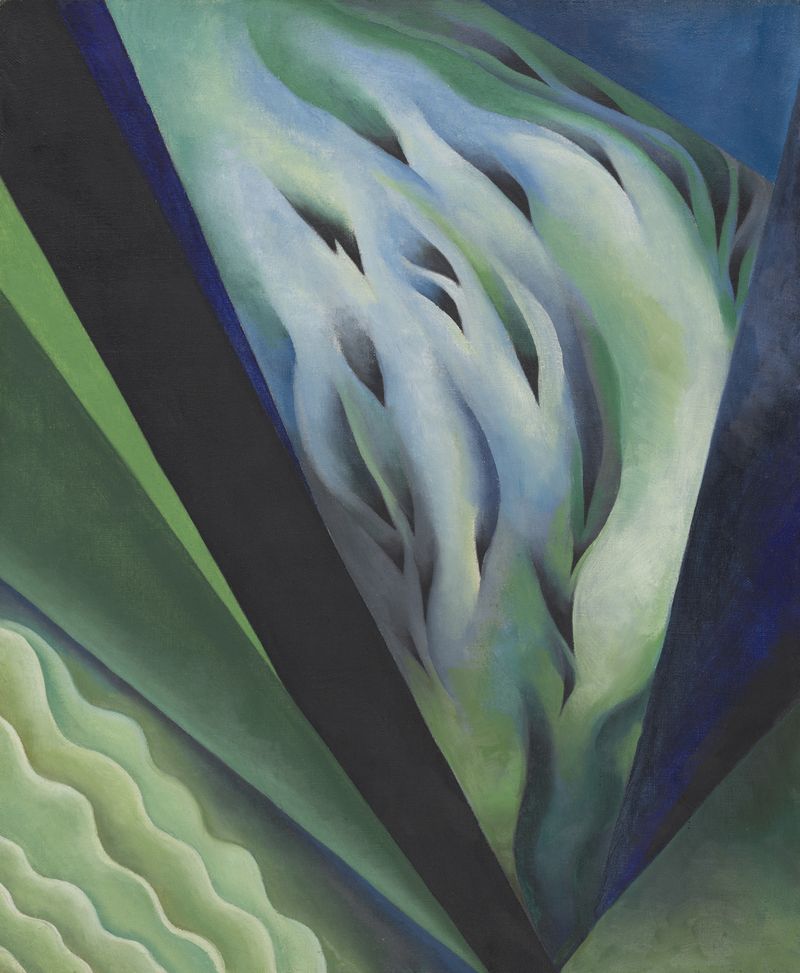
Georgia O’Keeffe’s Blue and Green Music (1919–1921). Oil on canvas, 58.4 × 48.3 cm. Alfred Stieglitz Collection, Art Institute of Chicago, gift of Georgia O’Keeffe. Courtesy of the National Museum of Modern and Contemporary Art, Korea Pale blue and green sweep beside a black diagonal. At lower left, light-green curves overlap. This is Georgia O’Keeffe’s Blue and Green Music (1919–1921). Farther inside the gallery, a cow’s skull and white flowers fill the canvas.“Georgia O’Keeffe and American Modernism” opens on the 12th in Exhibition Room 2 at the National Museum of Modern and Contemporary Art, Gwacheon. Running through March 21 next year, the exhibition features 117 items, including works by 13 artists as well as photographs, videos and furniture. It includes 16 of O’Keeffe’s paintings—the largest number ever shown in Korea—and spans her early work through her late work.
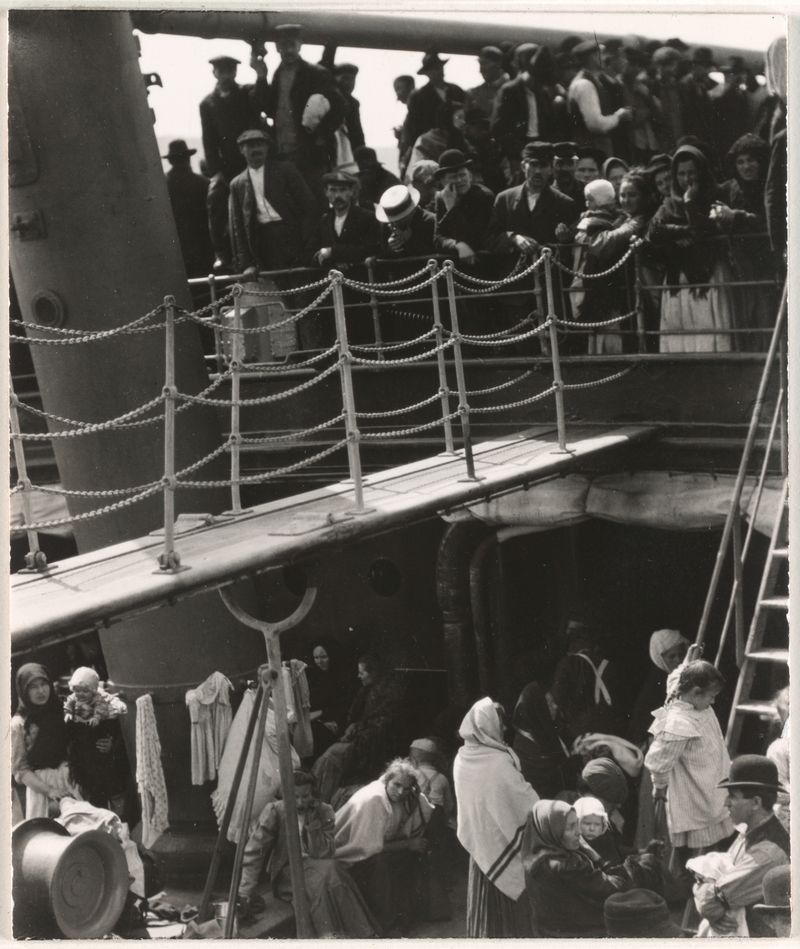
■ Stieglitz’s Camera and Experiments in AbstractionAlfred Stieglitz’s The Steerage (1907) hangs in the middle of a blue wall. In the photograph, passengers holding children can be seen below the steamship’s passageway. Stieglitz published the photography magazine Camera Work and ran a gallery in New York, helping fellow artists stage exhibitions and sell their work. For about 20 years, he photographed O’Keeffe’s face, hands and other features, leaving around 300 photographs.
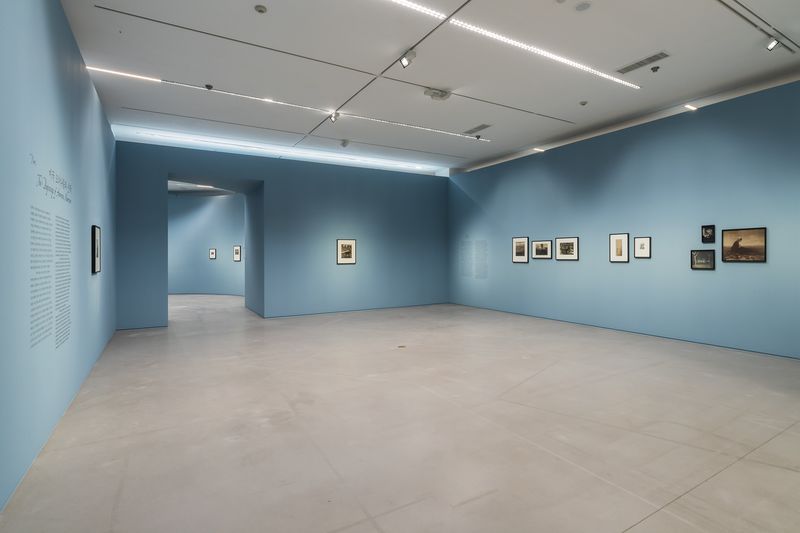
Installation view of Part 1 of “Georgia O’Keeffe and American Modernism” at the National Museum of Modern and Contemporary Art, Gwacheon. Photographs by Alfred Stieglitz and others hang on the blue wall. Courtesy of the National Museum of Modern and Contemporary Art, Korea After Stieglitz died in 1946, O’Keeffe spent three years organizing his works and collection. At a press conference on the 11th, Lee Su-jeong, a curator at the National Museum of Modern and Contemporary Art who organized the exhibition, explained that O’Keeffe had considered “where these materials would be put to best use” and donated them to several museums across the United States.
The Stieglitz Collection, which O’Keeffe began donating to the Art Institute of Chicago in 1949, is at the heart of the exhibition. Lee added that showing the Lee Kun-hee Collection at the Art Institute of Chicago provided the occasion for discussions about this exhibition.
The exhibition’s second section explores cities transformed by industrialization, the American landscape and experiments in abstraction. John Marin captured in prints the energy of New York as skyscrapers rose. Arthur Dove placed a blue moon beside storage tanks painted with metallic paint. Influenced by Wassily Kandinsky, O’Keeffe used straight diagonals and repeating curves in Blue and Green Music to express the rhythm of music.
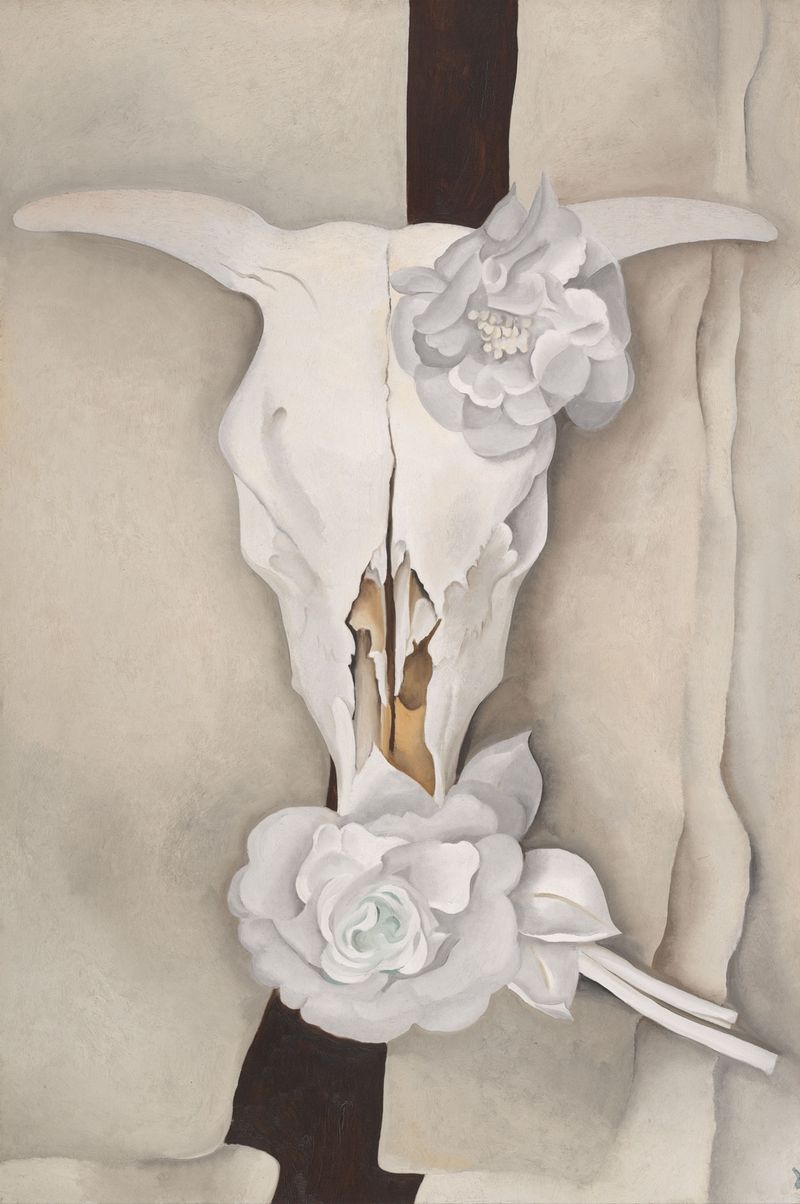
Alfred Stieglitz’s The Steerage (photographed in 1907, printed in 1913 or earlier). Photogravure, image 32 × 25.8 cm. Collection of the Art Institute of Chicago, gift of Robert A. Taub. Courtesy of the National Museum of Modern and Contemporary Art, Korea ■ The New Mexico Desert and a Late-Career PerspectiveO’Keeffe often visited New Mexico even before settling there in 1949. She took animal bones she found in the desert by train to her home in New York and used them as decorations. In Cow’s Skull with Calico Roses (1931), flowers are placed beneath the right horn and at the tip of the muzzle. They are artificial flowers that decorated cemeteries in northern New Mexico. This work can be seen only at the Gwacheon exhibition.
O’Keeffe drove a modified car around in search of red hills and barren landscapes. The curator said that because she used the back seat as a workspace, her canvases of desert landscapes were relatively small.
Georgia O’Keeffe’s Cow’s Skull with Calico Roses (1931). Oil on canvas, 91.4 × 61 cm. Alfred Stieglitz Collection, Art Institute of Chicago, gift of Georgia O’Keeffe. Courtesy of the National Museum of Modern and Contemporary Art, Korea The subject of the late work From a Day with Juan IV (1977) is the Washington Monument. O’Keeffe painted a section midway up the monument, where the color of the stone changes, after looking up at it with her assistant, Juan Hamilton.
The exhibition also includes nine portraits of O’Keeffe taken by Stieglitz, Yousuf Karsh and others. In the immersive video World of O’Keeffe, visitors can view New Mexico landscapes while listening to the artist’s own voice.
At 3 p.m. on opening day, Sarah Kelly Oehler, a curator at the Art Institute of Chicago, will give a lecture on the Stieglitz Collection. Admission is 3,000 won with the combined ticket for the Gwacheon museum. The exhibition is scheduled to travel to the Museum of Contemporary Art Busan next April.
[email protected] Jang In-seo Reporter