[Field Report] AI technology leaves the lab and sets sail for the market with Kakao
- Input
- 2026-11-12 09:00:00
- Updated
- 2026-11-12 09:00:00
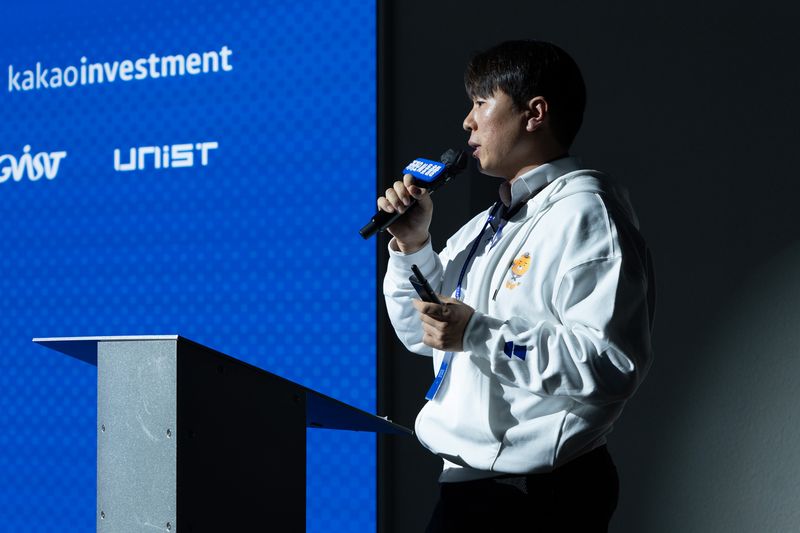
[Financial News] On the morning of the 10th, at Kakao AI Campus in Yongin, Gyeonggi Province, AI startup teams from four science and technology institutes—the Korea Advanced Institute of Science and Technology (KAIST), Gwangju Institute of Science and Technology (GIST), Daegu Gyeongbuk Institute of Science and Technology (DGIST), and Ulsan National Institute of Science and Technology (UNIST)—stood before investors. It was an opportunity to test whether AI technologies developed in research labs could lead to real businesses.
Held that day, Kakao AI Sail: Set Sail, Season 2 is an AI startup competition run by Kakao Investment Co., Ltd. and kakao AI sail. The program identifies promising AI technologies and connects them with investment and proof-of-concept (PoC) projects at Kakao affiliates.
12 of 122 teams reach the finals; Rokon takes the top prize
A total of 122 teams applied for the second edition this year, an increase of about 85% from the 66 teams in the first edition. The program is open not only to students enrolled at the four institutes, but also to graduate students, researchers, faculty members, and alumni entrepreneurs. It also welcomes prospective startup teams that have yet to establish a corporation. Kakao, KakaoBank Corp, Kakao Mobility Corp., Kakao Entertainment Corp., Kakao Pay, and other affiliates set 18 challenges related to business needs, and the startup teams presented technologies and business models to address them.
Twelve teams that passed joint screening by Kakao affiliates and an investment review by Kakao Investment Co., Ltd. advanced to the finals that day and competed in investor presentations (IR). Rokon, which took the top prize, presented technology that enables AI to learn work-related knowledge dispersed throughout a company and the know-how of its employees. Its key innovation is using AI to automate the construction of ontologies (knowledge structures), a task previously carried out by specialist engineers stationed at companies. According to Rokon, the technology can cut a process that typically took three to six months to an average of two to three hours, while achieving performance at about 90% of that of the existing method.
The work agent Puzzle, developed using this technology, learns employees’ work patterns and question-and-answer exchanges to help with tasks such as preparing quotes and looking up prices from past transactions. Rokon proposed connecting Puzzle with Kakao’s AI service Kanana to provide 10.2 million employees at small and medium-sized businesses with a personalized AI assistant that can help them search for work-related information and respond to work messages after hours, among other tasks.
The excellence awards went to Millitrack and Space AI. Millitrack presented technology that enables autonomous robots to determine their location even in harsh conditions involving dust and water vapor. The approach adds a location-tracking device and markers to existing robots, and has also been applied at industrial sites such as POSCO Pohang Steelworks and Samsung shipyards. For Kakao Mobility Corp., Millitrack proposed Bring Plus, an industrial autonomous transport service that adds the company’s location-tracking device to existing autonomous robots.
Space AI presented technology that incorporates the force exerted on an object and the degree of its deformation into virtual simulations, raising robots’ success rate at grasping objects from 61.5% to 84.2%. It proposed a free, 12-week PoC to apply the technology to Kakao Mobility’s robot service Bring and test the safe loading and unloading of goods.
Five teams received honorable mentions: F22, GeoRobot, Rocket Tools, Tripbuilder, and Quester.
Investment and technology validation links support commercialization

Unlike ordinary startup competitions, Kakao AI Sail can lead to investment and PoCs even after the awards are presented. This competition offers a total of 75 million won in prize money, as well as investment consideration by Kakao Investment Co., Ltd. and opportunities for PoCs with Kakao affiliates.
The first edition produced cases that went on to secure investment and business partnerships. AniBridge AI, with roots at KAIST, secured follow-on investment after receiving an investment from Kakao Investment Co., Ltd., and achieved a company valuation of 20 billion won. Blackbox, a startup team from UNIST, conducted a paid PoC with Kakao Entertainment Corp., while Broz, with roots at DGIST, successfully raised investment and is discussing technical integration with Kakao Map.
Kim Do-young, CEO of Kakao Investment Co., Ltd., emphasized the need to invest in research achievements at regional science and technology institutes, saying, “About 73% of venture investment funds last year were concentrated in companies in the Seoul metropolitan area.” Kim said, “A ship is safest when it is in port, but a ship’s purpose is not to stay in port,” and added, “I hope you, too, will move toward bigger dreams, inspired by the meaning of this launch.”
[email protected] Choi Hye-rim Reporter